Section
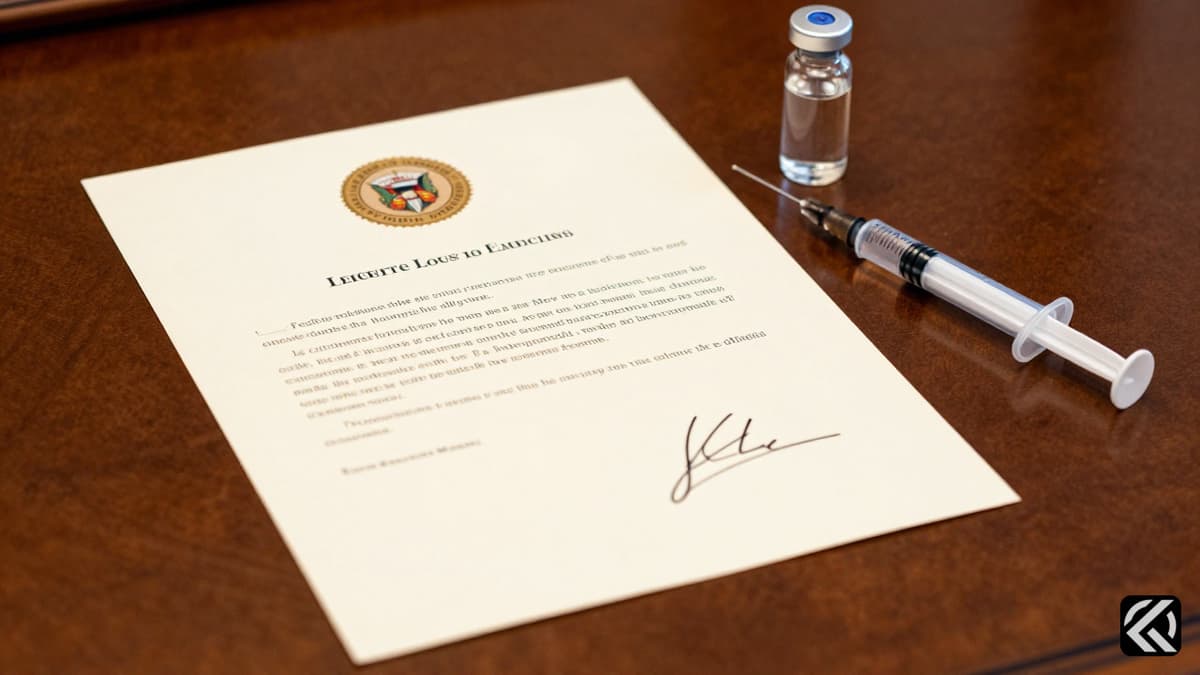
President Trump signed an executive order reducing recommended childhood vaccines from 18 to 11 diseases. We fact-checked his claims regarding dosage sizes and safety concerns.
On Monday, US President Donald Trump signed an executive order in the Oval Office that significantly alters the landscape of pediatric preventive care by limiting the number of vaccines recommended for children. During the ceremony, the President made several assertions regarding vaccination protocols that subsequent fact-checking revealed to be misleading or false. The Centers for Disease Control and Prevention (CDC) previously recommended childhood vaccinations against 18 different diseases; the new order reduces this recommendation to 11 diseases. Additionally, the directive advises splitting the mumps, measles, and rubella shots, known as MMR, into separate administrations rather than a combined shot.
Following the signing, White House press secretary Karoline Leavitt distributed a graphic labeled "72 injections," depicting a baby surrounded by needles. Trump also stated that the government was requiring "72 jabs" for children. These statements have been identified as inaccurate. While federal guidance influences school-entry requirements, the specific rules are determined at the individual state level, meaning the exact number of scheduled vaccinations varies across the United States. Furthermore, the figure of 72 cited by the White House represents the cumulative doses a person might receive by age 18, not the amount given to infants or "little children." This total also encompasses annual flu and Covid-19 doses, which are not part of the core childhood immunization schedule.
A significant portion of the controversy surrounding the new order stems from the President's characterization of vaccine dosages and safety profiles. Trump claimed during the event that a vaccination looks like "the size of the bottle of soda poured into a little child's body," a comparison that medical data strongly refutes. According to the Food and Drug Administration (FDA), a single dose of the MMR MMR vaccine is 0.5ml, which amounts to roughly a fraction of a teaspoon. Josh Michaud, associate director with Kaiser Family Foundation's Global and Public Health Policy Program, clarified that even all recommended vaccinations combined "don't add up to anything close to the size of a bottle of soda." He noted that the total volume is "a very, very much smaller amount" than what Trump suggested, highlighting a substantial disconnect between the President's rhetoric and medical reality.
The President also raised concerns about the safety of administering the vaccines together, stating, "Together, there could be a possibility they're quite lethal." This claim contradicts established public health data. The CDC states that most people who receive the MMR vaccine do not experience serious adverse reactions. The agency emphasizes that receiving the vaccine is significantly safer than contracting the measles, mumps, or rubella illnesses it is designed to prevent. While the CDC acknowledges that the most severe risks include febrile seizures or serious allergic reactions, these outcomes are described as "extremely rare." Studies indicate that only one out of every 3,000 to 4,000 children vaccinated with MMR runs the risk of febrile seizures, underscoring the high safety profile of the immunization.
A critical component of Trump's justification for the new order involved claims regarding autism rates. The President argued, "It's many, many times what it used to be years ago, and it gets progressively worse. And we had progressively more and more vaccines." He asserted that the rate of autism was "one in 10,000 20 years ago." While autism rates have indeed increased over the last two decades, the growth has not reached the magnitude cited by Trump. In 2006, the CDC estimated the rate of autism in the US population to be one in 110. By 2008, this estimate had risen to one in 88.
Experts attribute these rising rates primarily to changes in diagnostic criteria, greater recognition of the condition, and increased testing. Crucially, multiple studies have found no autism link to vaccines. A comprehensive December 2025 study by the World Health Organization, which analyzed data involving dozens of studies and millions of children across multiple countries, found "no causal link between vaccination and [autism]." Experts explain that the tendency to wrongly associate vaccines with autism arises because the period of childhood vaccinations, between birth and five years old, overlaps with the more common period for autism diagnoses. They stress that this overlap represents correlation, not causation.
The reduction of recommended vaccines and the push to split the MMR shot have ignited immediate debate regarding the standard of care. The executive order effectively overrides previous CDC recommendations, creating a divergence between federal advice and historical standards. State-level vaccine mandates will likely face new interpretations or legal challenges as officials determine how to align school-entry requirements with the new federal guidance. The White House's graphic and the President's comments have amplified public confusion, potentially impacting vaccination uptake rates. Health officials are now tasked with communicating the scientific consensus on dosage and safety to a public that has been exposed to exaggerated claims about injection volumes and lethal risks.
The long-term implications of this executive action extend beyond the immediate reduction in recommended diseases. By recommending fewer vaccines and splitting the MMR shots, the administration is fundamentally altering the immunization timeline for a generation of children. This shift may lead to varied compliance rates depending on state-level enforcement and parental perception. The spread of misinformation regarding dosage sizes and safety profiles poses a challenge for public health communicators aiming to restore trust in established medical protocols. As the new order takes effect, the medical community must continue to provide clear, evidence-based information to counteract the narrative that vaccines are overly burdensome or dangerous. The divergence between political rhetoric and medical statistics highlights the ongoing tension between policy decisions and scientific guidance in public health matters. Future monitoring will be essential to assess whether the split administration of vaccines affects herd immunity levels or increases the incidence of preventable diseases. The medical community remains steadfast in its reliance on data-driven assessments rather than anecdotal or exaggerated claims when guiding public health policy.
The executive order reduces recommended diseases from 18 to 11 and suggests splitting the MMR shot. Experts confirm no link to autism. Future impacts may include varied state compliance and challenges in public communication regarding safety.
Oct 3, 2026 04:08 UTC
FlyDubai Co-Pilot Banned in Oman Over Extremism Concerns
Oct 3, 2026 00:50 UTC
Israel-Mumbai Campaign Honors Captain Smit After Flydubai Incident
Oct 2, 2026 18:13 UTC
Captain Smit Machchhar’s Courage Saves Flydubai Flight FZ1073 From Disaster
Oct 2, 2026 16:45 UTC
Captain Smit Machchhar Saves Plane Mid-Fall
Oct 1, 2026 16:22 UTC
32 Children Dead in Balaghat: A Health and Poverty Crisis