Section
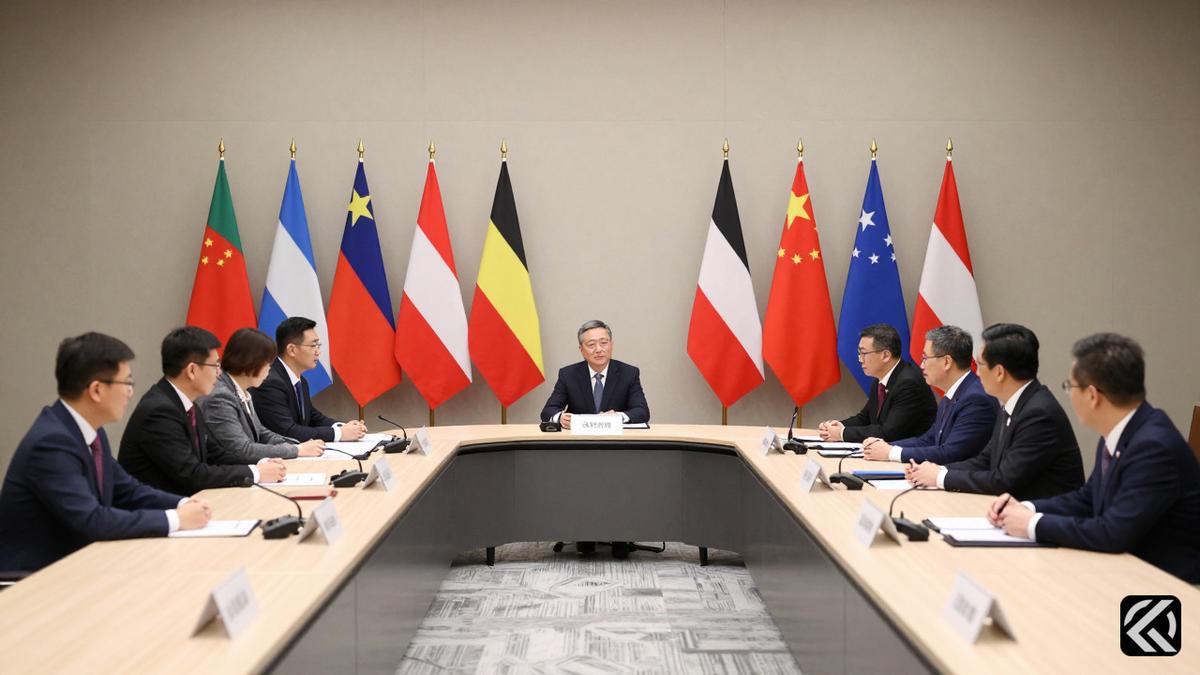
Beijing describes the upcoming meeting between Trump, Xi, and Putin in Shenzhen as a landmark event for global stability, despite skepticism about tangible results.
On Monday, Beijing described the upcoming China-Russia-U.S. summit as being of "groundbreaking significance," emphasizing the historic nature of a face-to-face meeting between the leaders of the three nations. China’s Foreign Ministry confirmed that President Xi Jinping will host U.S. President Donald Trump and Russian President Vladimir Putin in Shenzhen on November 19, 2026, during the sidelines of the APEC summit. This event marks the first-ever direct encounter among the heads of state of these three global powers.
The gathering is framed by Beijing as a critical opportunity to safeguard world peace and promote strategic stability in major-country relations. Foreign Ministry spokesperson Mao Ning stated that the leaders will engage in deep exchanges regarding their differences and the stabilization of relations, noting that such communication serves the mutual interests of China, Russia, and the United States. While the official rhetoric from Beijing underscores the irreplaceable role of head-of-state diplomacy in providing strategic guidance, the atmosphere surrounding the event is one of cautious expectation rather than guaranteed diplomatic breakthroughs.
Despite the enthusiastic coverage from Chinese state media, which has hailed the event as a testament to Beijing’s global standing, many observers and experts anticipate that the summit will remain more symbolic than substantial. U.S. officials have indicated that the agenda will likely focus on the ongoing war in Ukraine, the situation in West Asia, including efforts to stabilize global energy supplies, and matters of nuclear arms control. However, whether these discussions will yield concrete, actionable outcomes remains highly uncertain given the entrenched positions of the involved parties.
The enthusiasm in China stands in stark contrast to the geopolitical realities on the ground. Beijing officially maintains its support for a multipolar world order and eschews references to a "G2" with the United States or a "G3" involving China, Russia, and the U.S. Nevertheless, the symbolism of hosting the meeting in Shenzhen is being utilized to highlight Beijing’s image as a stable and responsible major country. An editorial in the Global Times argued that the trilateral dialogue demonstrates the international community’s high recognition of China’s diplomatic image. The editorial dismissed critics who view the meeting as an attempt to carve out spheres of influence or establish a "new Yalta system," labeling such views as one-sided and historically ignorant.
Experts within China, however, acknowledge the growing strategic rivalry between China and the U.S., as well as the enduring rift between Russia and the West, particularly concerning the continued war in Ukraine. Su Liuqiang, a scholar at the Centre for American Studies at the Shanghai Institutes for International Studies, noted that Russia was the most enthusiastic participant among the three nations. He described the likely format as an informal exchange rather than a structured, formal trilateral summit.
"The fact that China, Russia and the U.S. will sit down for face-to-face talks once again demonstrates that the head-of-state diplomacy plays an irreplaceable role in providing strategic guidance," the Global Times editorial stated, framing the effort as a new phase in China’s major-country diplomacy. This narrative is designed to counteract naysayers who focus on power politics over responsibility. Yet, practical limitations loom large. Su Liuqiang pointed out substantial political resistance within the U.S., where anti-Russia sentiment remains strong among both the American public and European allies. There is significant opposition to negotiating with Moscow while bypassing Ukraine and Europe.
Furthermore, the three countries have markedly different priorities. Russia’s core concern is securing negotiations for a ceasefire in Ukraine. The United States is primarily interested in the implications of the Russia-Ukraine conflict and non-proliferation issues. China supports peace talks but must carefully balance its relations with the U.S., Russia, Europe, and Ukraine. In this complex context, a low-profile meeting is considered the more realistic option, with any practical outcomes likely limited to stabilizing global energy supplies.
While China prefers multilateralism over exclusive triumvirates, Mr. Su suggested that the meeting nonetheless signals a growing interest in managing competition between major powers. The goal appears to be preventing this competition from escalating or spinning out of control, even if structural competition continues to define global geopolitics. The Shenzhen meeting thus serves as a pressure valve, allowing leaders to communicate directly without the immediate expectation of resolving deeply rooted conflicts.
The Shenzhen meeting, held during APEC events, underscores a pragmatic approach to managing the inherent tensions between the world's largest economies. While the China-Russia-U.S. summit may not produce immediate treaties or ceasefire agreements, it establishes a crucial channel for direct communication. As strategic rivalry persists, such high-level dialogues will likely become essential mechanisms for crisis prevention. The long-term impact suggests a future where major powers continue to compete structurally but rely on these symbolic, low-profile interactions to maintain a fragile stability and prevent unintended escalation in regions like Ukraine and West Asia.
Nov 17, 2026 16:45 UTC
US Intel Warns of Iran Dirty Bomb Plot in DC
Nov 17, 2026 12:48 UTC
Quad Summit Manila: Modi, Trump Focus on Indo-Pacific Security
Nov 17, 2026 10:43 UTC
Ukraine Strike Collapses Crimean Bridge Ahead of Diplomatic Talks
Nov 16, 2026 16:25 UTC
Beijing Claims Historic Significance for Trilateral Talks in Shenzhen
Nov 17, 2026 16:58 UTC
PM Modi Urges Global Stability at Asean-India Summit