Section
Beijing celebrates the landmark Shenzhen summit as a historic moment for major-power diplomacy, though experts doubt substantive outcomes amidst deep geopolitical divides.
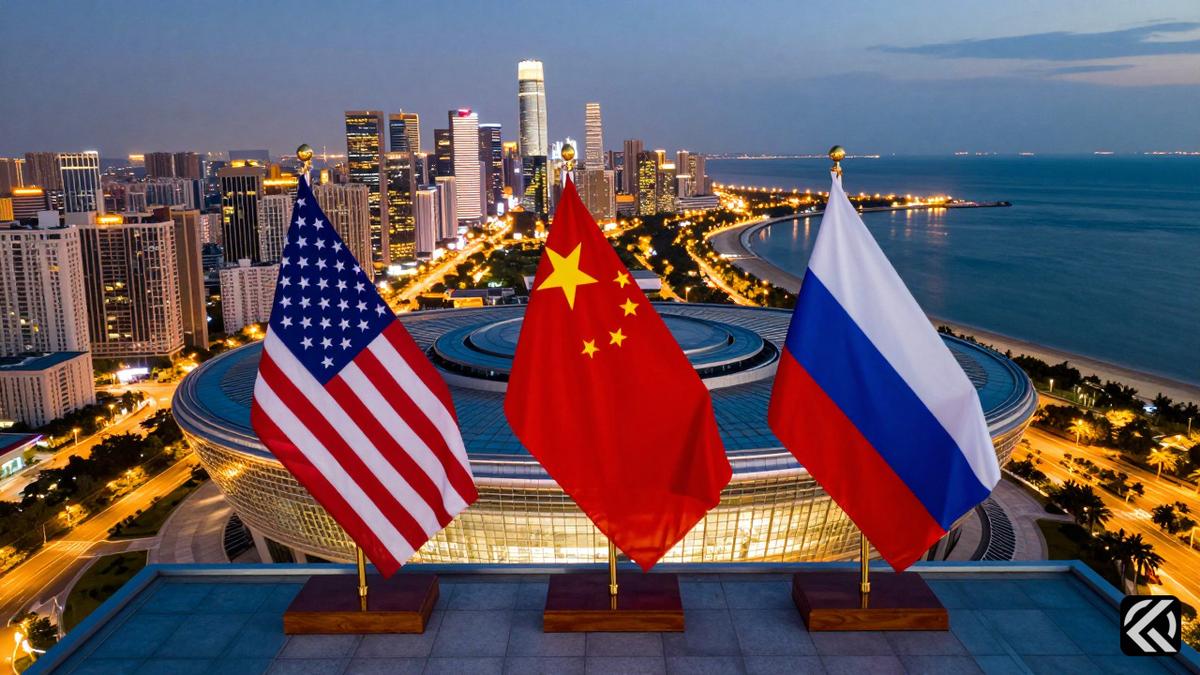
In a major diplomatic move, Beijing has celebrated the upcoming meeting of the United States, China, and Russia as possessing “groundbreaking significance.” The capital officially announced the details of the event on Monday, November 16, 2026, highlighting the symbolic weight of hosting the leaders of the world’s most powerful nations on Chinese soil. The meeting is scheduled for Thursday, November 19, 2026, taking place in Shenzhen on the sidelines of the APEC summit.
China’s Foreign Ministry confirmed that President Xi Jinping will host President Donald Trump and President Vladimir Putin for this historic gathering. This event marks the first-ever face-to-face meeting among the heads of state of these three countries. The diplomatic focus will center on safeguarding world peace and promoting strategic stability in major-country relations. Foreign Ministry spokesperson Mao Ning stated that strengthening communication, managing differences, and stabilizing relations serve the interests of all three nations, framing the China-Russia-U.S. summit as a critical step toward global equilibrium.
The enthusiasm in Beijing contrasts sharply with the skepticism prevalent among international observers and experts. U.S. officials have indicated that the agenda is heavily focused on the war in Ukraine, the situation in West Asia, including the goal of stabilizing global energy supplies, and nuclear arms control. However, whether there will be any concrete outcomes on any of those highly contentious issues remains to be seen. The meeting is widely expected to be more symbolic than substantive, serving as a platform for dialogue rather than immediate policy shifts.
Despite the lack of anticipated tangible results, state media in China has vigorously haled the significance of the meeting. Beijing officially eschews references to a “G2” with the U.S. or a “G3” with the two countries and Russia, maintaining that it supports a multipolar world order. At the same time, the symbolism of China hosting the meeting has been seized upon to highlight Beijing’s rising global standing. The editorial board of the Global Times published an article emphasizing the irreplaceable role of head-of-state diplomacy in providing strategic guidance. They argued that fostering a new type of major-country relationship marks a new phase in China’s diplomacy, featuring proactive leadership and systematic construction.
The Shenzhen summit is portrayed by Beijing as a manifestation of the international community’s high recognition of China’s image as a stable and responsible major country. The state-run publication took aim at critics, arguing that those who view the trilateral meeting as major powers “carving out new spheres of influence” or establishing a “new Yalta system” hold a one-sided view of history. These critics, the editorial claimed, ignore historical patterns and focus solely on the needs of individual parties while disregarding overall interests. They are accused of emphasizing power over responsibility and losing sight of the ideal of democratising international relations.
Symbolism aside, few experts in China expect substantial outcomes amid what they acknowledge is growing strategic rivalry between China and the U.S. on the one hand, and an enduring rift between Russia and the West on the other, especially with the continuing war in Ukraine. Russia was “most enthusiastic” among the three for the summit, according to Su Liuqiang, a scholar at the Centre for American Studies at the Shanghai Institutes for International Studies. He noted that an informal exchange was likelier than a more structured, formal trilateral summit due to political constraints.
On the one hand, there is substantial political resistance in the U.S., Su explained. Anti-Russia sentiment remains strong in both the U.S. and among its European allies, with significant opposition to negotiating with Moscow while bypassing Ukraine and Europe. On the other hand, the three countries have differing priorities. Russia’s core concern is negotiations on a ceasefire in Ukraine, the U.S. is interested in the Russia-Ukraine conflict and non-proliferation, and China supports peace talks but must also balance its relations with the U.S., Russia, Europe, and Ukraine.
In this complex context, a low-profile trilateral meeting is the more realistic option. Practical outcomes could emphasize stabilizing global energy supplies, a topic of mutual interest. While China preferred “multilateralism” over ideas such as the G2 or a U.S.-China-Russia triumvirate, Mr. Su said a meeting would still be significant in suggesting that while structural competition between big powers would still continue to define global geopolitics, there was increasing interest in “managing that competition and preventing it from escalating or spinning out of control.”
The Shenzhen summit signals a shift toward managed competition rather than alliance formation among the world's top powers. While concrete agreements are unlikely, the mere act of dialogue suggests a collective desire to prevent geopolitical escalation. This symbolic engagement highlights the necessity of maintaining channels of communication to stabilize global energy and nuclear frameworks amidst deep-seated rivalries.
Nov 17, 2026 16:45 UTC
US Intel Warns of Iran Dirty Bomb Plot in DC
Nov 17, 2026 12:48 UTC
Quad Summit Manila: Modi, Trump Focus on Indo-Pacific Security
Nov 17, 2026 10:43 UTC
Ukraine Strike Collapses Crimean Bridge Ahead of Diplomatic Talks
Nov 16, 2026 16:25 UTC
Beijing Claims Historic Significance for Trilateral Talks in Shenzhen
Nov 17, 2026 16:58 UTC
PM Modi Urges Global Stability at Asean-India Summit