Section
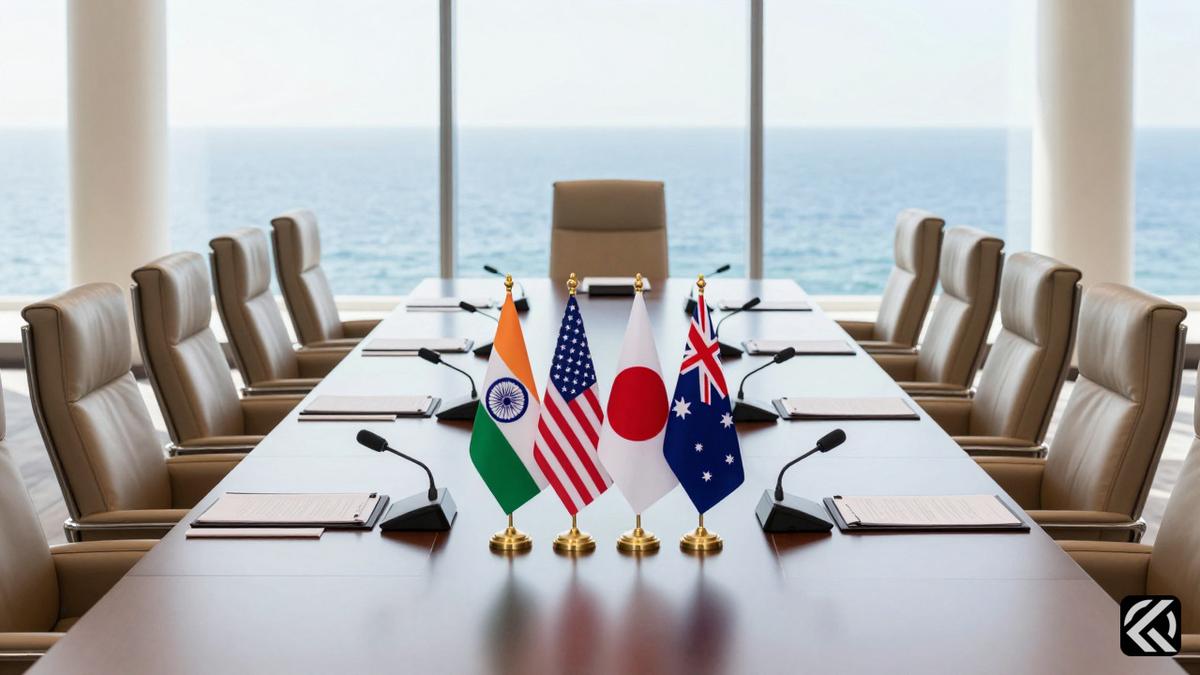
World leaders gather in Manila for high-stakes diplomatic talks, focusing on maritime security, artificial intelligence cooperation, and strengthening strategic ties in the Indo-Pacific.
At the Quad Summit in Manila, leaders from India, the United States, Japan, and Australia convened to address critical regional challenges. The high-level engagement focused on strengthening economic cooperation, advancing artificial intelligence technologies, and enhancing maritime and cybersecurity protocols.
U.S. President Donald Trump confirmed four key outcomes from the meeting, highlighting the growing importance of the four-nation grouping. He described the member nations as the "four corners of a free, open, stable, and prosperous Indo-Pacific," noting their close coordination on regional security, economic stability, and diplomacy. The confirmed initiatives include the Quad Business Leaders’ Forum, a Super Intelligence Accelerator, a Maritime Intelligence Sharing Corporation, and enhanced cybersecurity intelligence-sharing cooperation.
For India, the Quad represents a pivotal strategic alliance. Prime Minister Narendra Modi described the grouping as a "constructive and trusted partnership" dedicated to providing reliable solutions across the Indo-Pacific. He pointed to the political will demonstrated by five foreign minister meetings since January last year as evidence of their shared commitment.
Modi highlighted that the partnership spans diverse areas including maritime security, trusted supply chains, new technologies, and disaster response. He expressed confidence that the current meeting would help set concrete goals for the next phase of cooperation. "Together, we must chart a new direction for the future of our region," Modi stated, aiming to elevate the Comprehensive Strategic Partnership to new heights.
During the summit, the United States signaled significant geopolitical moves. President Donald Trump revealed plans to hold a separate bilateral meeting with Russian President Vladimir Putin at the upcoming APEC summit in Shenzhen, contingent on availability. Additionally, Trump announced that the U.S. is accelerating rare earth production, aiming to catch up to Chinese output within ten months.
Economic and energy strategies were also central to the discussions. Japanese Prime Minister Sanae Takaichi proposed the creation of an Asian energy agency to help the region cope with potential oil crises. She suggested establishing an oil security task force and utilizing Japan’s underused crude oil storage facilities for ASEAN members, with plans to assist them in building their own stockpiling facilities in the long term.
The diplomatic efforts in Manila extended beyond the Quad framework to include broader ASEAN interactions. India and ASEAN leaders agreed to deepen cooperation on disaster management, leveraging early warning systems, satellite data sharing, and rapid humanitarian assistance deployment. This agreement recognizes the region's exposure to hazards such as earthquakes, tsunamis, and cyclones, emphasizing the need for a disaster-resilient Southeast Asia.
The 23rd ASEAN-India Summit yielded a series of proposals aimed at technological and infrastructural connectivity. Key initiatives include a long-term Maritime Cooperation Plan, a joint cyber forensics training program, and an ASEAN-India Space Hackathon. Cooperation in nuclear energy and mining for critical minerals was also highlighted as a priority for future technical exchanges.
On the technology front, ASEAN leaders adopted a declaration promoting AI-powered growth among micro, small, and medium enterprises (MSMEs). Recognizing MSMEs as the backbone of ASEAN economies, the declaration encourages voluntary assessments of AI readiness and focuses on affordable technology solutions and digital infrastructure. AI literacy was identified as a key requirement for responsible adoption.
The visit also held cultural and symbolic significance. Prime Minister Modi participated in the foundation-stone laying ceremony for the redevelopment of Manila’s historic Gurudwara Khalsa Diwan. Baba Manmohan Singh, the Granthi of the Gurudwara, expressed gratitude, describing Modi as a religious man with deep affection for the Sikh community.
Modi noted the strengthening connectivity between India and ASEAN, citing direct flights to nine ASEAN countries and increasing tourism as indicators of a robust partnership. This marked his third visit to an ASEAN country in the year, underscoring the special importance of the region to India’s development and prosperity.
Amidst these diplomatic engagements, security considerations were present in Manila. Reports indicated potential protests against President Trump’s visit, with demonstrators calling for an end to conflicts in West Asia and criticizing U.S. policies. The U.S. Embassy in Manila had temporarily suspended consular services during the summit period in accordance with Philippine government proclamations for special non-working days.
The outcomes of the Quad and ASEAN-India summits in Manila signal a decisive shift toward institutionalized regional cooperation. By formalizing frameworks for AI acceleration, maritime intelligence sharing, and energy security, the participating nations are moving beyond ad-hoc diplomacy to structured strategic alliances. The proposed Asian energy agency and joint cyber forensics initiatives suggest a long-term trend of integrated defense and economic policies designed to counterbalance regional volatility.
Looking ahead, the commitment to rare earth production independence and critical mineral cooperation indicates a broader effort to decouple supply chains from potential geopolitical rivals. The emphasis on AI literacy and MSME support points to an economic strategy focused on digital sovereignty. As leaders prepare for subsequent talks in Shenzhen, the groundwork laid in Manila suggests that the Indo-Pacific will increasingly be defined by coordinated multilateral responses to security and economic challenges, reinforcing the centrality of these alliances in global stability.
Nov 17, 2026 16:45 UTC
US Intel Warns of Iran Dirty Bomb Plot in DC
Nov 17, 2026 12:48 UTC
Quad Summit Manila: Modi, Trump Focus on Indo-Pacific Security
Nov 17, 2026 10:43 UTC
Ukraine Strike Collapses Crimean Bridge Ahead of Diplomatic Talks
Nov 16, 2026 16:25 UTC
Beijing Claims Historic Significance for Trilateral Talks in Shenzhen
Nov 17, 2026 16:58 UTC
PM Modi Urges Global Stability at Asean-India Summit