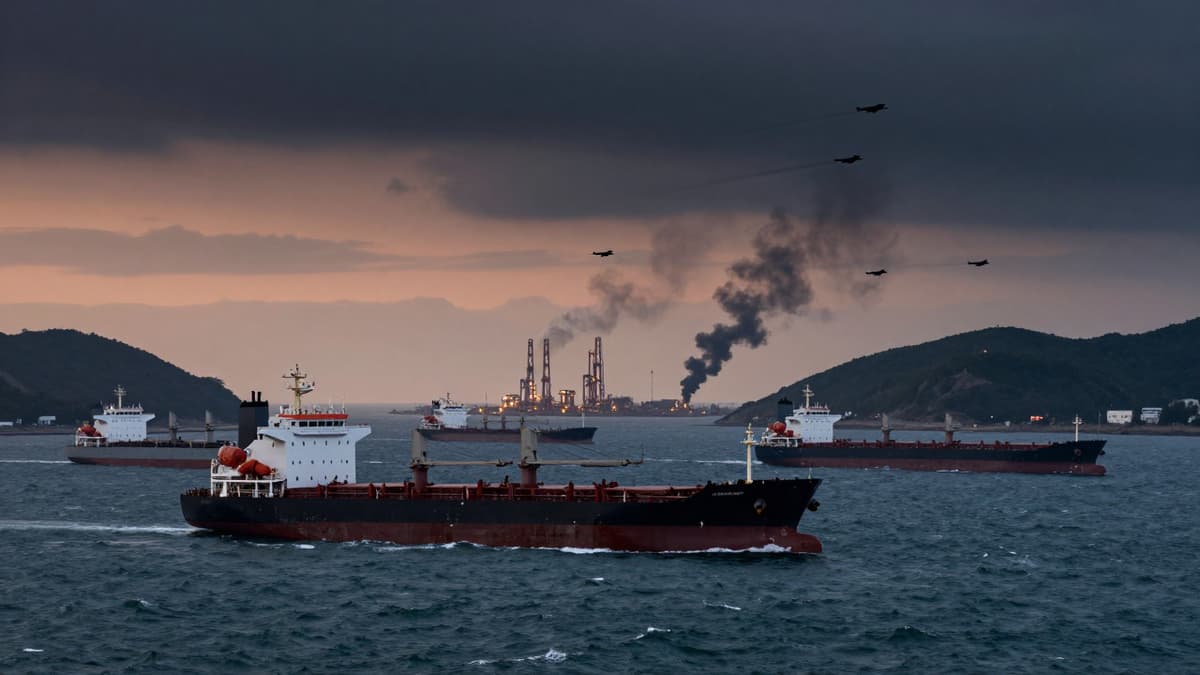
Day 26 of the US-Israel offensive against Iran sees intensified missile strikes and a diplomatic deadlock, stranding thousands of vessels in the volatile Strait of Hormuz.
The war launched by the United States and Israel against Iran has entered its twenty-sixth day, marked by intense military escalation and a stark rejection of diplomatic overtures. Despite the White House signaling an openness to a deal, Tehran has dismissed a 15-point US peace plan as "extremely maximalist and unreasonable," deepening the crisis. The conflict continues to roil global energy markets, particularly due to severe disruptions in the Strait of Hormuz, where approximately 2,000 vessels are currently stranded.
This day has seen a divergence between military actions and diplomatic rhetoric. While the US has deployed more than 50,000 troops, including two aircraft carriers and 200 combat aircraft, the US Central Command also released video footage of strikes targeting Iranian military infrastructure. Iranian officials view this massive military build-up alongside peace talks as a lack of genuine diplomatic intent, leading to domestic confusion where citizens face constant bombardment and missile launches. Meanwhile, the United States faces domestic political pressure regarding rising prices and interest rates, prompting President Donald Trump to defend the operation as a "great military achievement" against political opponents.
In the Gulf region, the violence has spread rapidly, affecting critical infrastructure and causing immediate casualties. Saudi Arabia reported multiple attacks against the Eastern Province, home to major oil facilities like Ras Tanura and Ghawar, forcing forces to intercept at least 32 drones and a ballistic missile in a single 11-hour window. Kuwait International Airport also faced a drone attack that sparked a fire at a fuel tank, though officials confirmed no casualties occurred. The situation has become even more volatile with reports of casualties in Bahrain, where a Moroccan civilian working with UAE forces was killed in an Iranian attack.
The humanitarian and logistical crisis is accelerating, with the Gulf Cooperation Council (GCC) demanding representation in any peace talks to secure the free flow of energy. The crisis in the Strait of Hormuz has created severe challenges for 20,000 seafarers, prompting France's military chief to plan talks aimed at restoring maritime navigation. Analysts suggest that the current volatility could lead to enforced rationing and reduced reliance on complex global fossil fuel supply chains, a trend already visible in Sri Lanka, which has ordered street lights and neon signs switched off to cut energy consumption by 25 percent.
While military operations intensify, diplomatic channels remain active but fragile. Pakistan's Prime Minister Shehbaz Sharif has offered to host negotiations to stop the US-Israeli war, while Chinese diplomat Wang Yi emphasized that "talking is always better than fighting." French President Emmanuel Macron has also urged Tehran to engage in good-faith negotiations. However, these efforts face significant hurdles as Israel asserts its own strategic goals. Israel's UN Ambassador Danny Danon stated clearly that Israel is not part of US-Iran talks and that military operations will continue until Iran's nuclear and missile capabilities are eliminated.
The conflict has also expanded into southern Lebanon, where a cluster missile struck a neighborhood in Kiryat Shmona. Israel has declared its intent to seize control of a 30km "security zone" into Lebanon, intensifying strikes on Hezbollah targets. The Lebanese Ministry of Public Health reports that at least 1, 072 people have been killed since the offensive escalated on March 2. UN Secretary-General Antonio Guterres warned that fighting between Israel and Hezbollah must not condemn Lebanon to the same fate as Gaza, a sentiment echoed by Canada, which condemned Israel's plans to occupy territory while calling on Hezbollah to disarm.
Simultaneously, Iraq struggles to balance its reliance on both Washington and Tehran. Following a suspected US attack on a paramilitary base in Anbar that killed 15 people, the Iraqi government granted Iran-backed groups the right to respond. The Islamic Resistance in Iraq claims to have launched 23 operations against enemy bases in the last 24 hours, complicating the regional security landscape. As oil prices tumble on reports of a potential US deal that Iran immediately rejects, the uncertainty suggests that current energy policies, including work-from-home mandates and rationing, may become mandatory as governments seek to reduce dependency on volatile supply chains.
The convergence of military escalation and diplomatic failure points toward a prolonged period of instability. With Iran rejecting peace terms and the US maintaining a massive troop presence, the likelihood of a swift resolution remains low. The continued disruption in the Strait of Hormuz threatens to force long-term structural changes in global energy consumption, likely accelerating the shift toward domestic supply security. As Israel pushes for a larger security zone in Lebanon and Iraq remains a contested ground between US and Iranian interests, the potential for a broader regional conflagration grows. Unless a diplomatic breakthrough occurs that satisfies all parties, the current trajectory suggests sustained economic pressure on global markets and an increasingly volatile security environment for the Middle East.
May 9, 2026 21:40 UTC
Russia Cuts Heavy Armor From Victory Day Parade Amid War
Join 50,000+ readers getting the global briefing every morning.
No spam. Unsubscribe anytime.
May 10, 2026 05:02 UTC
MV Hondius Arrives in Tenerife Amid Hantavirus Outbreak
May 10, 2026 03:02 UTC
Vijay Takes Oath, Ending Dravidian Party Era in Tamil Nadu
May 10, 2026 01:28 UTC
Nine TVK Leaders Join C. Joseph Vijay as Tamil Nadu Ministers
May 9, 2026 23:27 UTC
India’s Strategic Leap: Agni-5 with MIRV Trial Success


