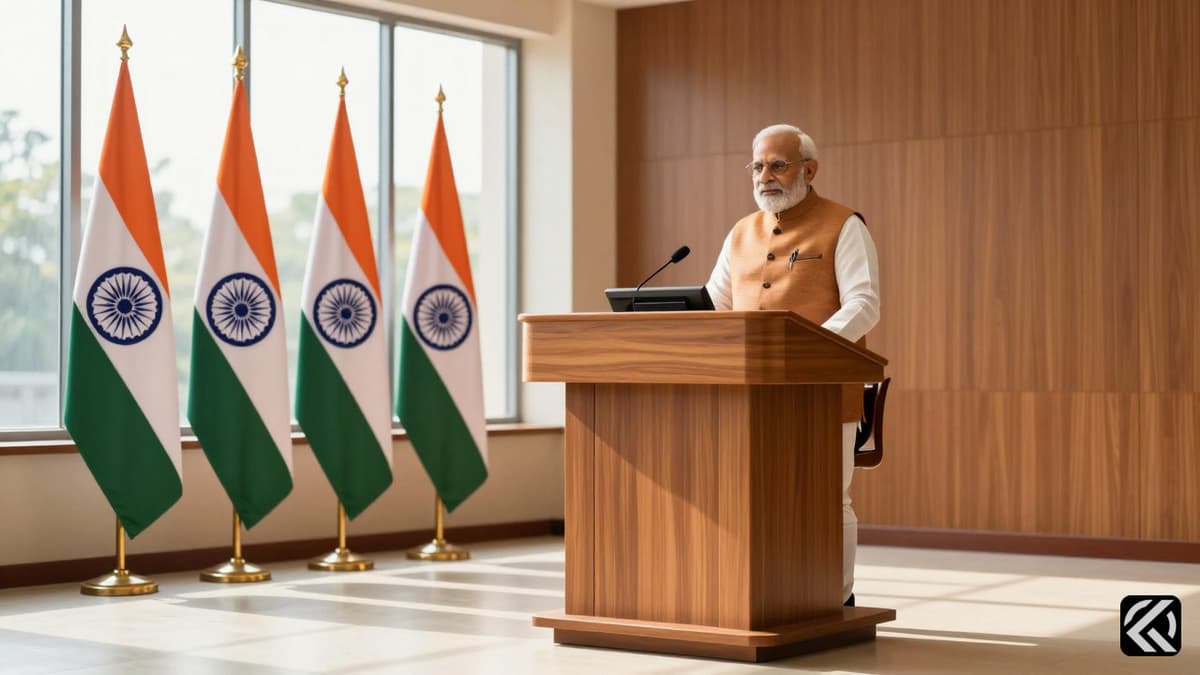
A historic shift in Tamil Nadu politics unfolds as C. Joseph Vijay assumes office, marking the end of alternating dominance by traditional parties.
The political landscape of Tamil Nadu has undergone a seismic shift as Tamilaga Vettri Kazhagam (TVK) president C. Joseph Vijay prepares to be sworn in as the state’s Chief Minister. This pivotal moment is scheduled for Sunday, May 10, 2026, effectively concluding nearly sixty years of political dominance characterized by the alternating rule of the state’s two major Dravidian parties, the DMK and the AIADMK. The transition marks a definitive new chapter in the region's governance, moving away from established political patterns toward a fresh coalition model.
The path to the Chief Minister’s office was secured on Saturday, May 9, 2026, when Tamil Nadu Governor Rajendra Vishwanath Arlekar appointed Mr. Vijay as the Chief Minister-designate. This appointment followed the confirmation that Mr. Vijay had garnered the support of 120 MLAs-elect within the 234-member Legislative House. The consolidation of this majority was achieved through strategic alliances, culminating in the evening of Saturday when both the VCK and the IUML announced their support. This critical backing pushed the TVK’s total tally to 120, ensuring a stable numerical advantage in the Assembly.
Following the confirmation of support, Mr. Vijay visited the Governor at Lok Bhavan in Chennai. During this meeting, he formally handed over letters of support from the Congress, CPI, CPI (M), VCK, and IUML. These documents validated his position as the leader capable of forming a government. The Governor’s directive was clear: the new administration must prove its strength in the Assembly within a specific timeframe.
The swearing-in ceremony will take place at the Nehru Stadium in Chennai at 10 a.m. on Sunday. The event will not only see Mr. Vijay take the oath but also nine other Ministers, including several senior leaders from the TVK. This expanding cabinet signals the coalition's intent to distribute power among its partners. Mr. Vijay will lead this coalition government with the Congress as a key partner, reflecting a broader political alignment that extends beyond the TVK’s own ranks.
The formation of this government represents a significant departure from the historical norms of Tamil Nadu politics. For almost six decades, the state’s political narrative was defined by the tug-of-war between the DMK and the AIADMK. The rise of the TVK, led by C. Joseph Vijay, disrupts this long-standing duopoly. The inclusion of parties like the CPI, CPI (M), VCK, and IUML in the supporting coalition indicates a multi-polar political strategy that relies on extensive networking rather than a single-party majority.
Governor Arlekar has mandated that Mr. Vijay seek a vote of confidence in the Assembly on or before May 13. This deadline adds a layer of immediate urgency to the new government’s agenda. The period leading up to this vote will be critical in testing the cohesion of the coalition. The support letters submitted to the Governor serve as the initial proof of strength, but the confidence vote will be the true test of their parliamentary presence.
The political uncertainty that had characterized the days following the elections has now dissipated. The specific timing of the VCK and IUML’s support on Saturday evening resolved the immediate questions regarding the majority count. This resolution allowed the Governor to formally invite Mr. Vijay to form the government, bringing an end to the speculation that had prevailed over the last few days.
The new administration inherits a state with complex social and economic challenges. The shift in power is expected to influence policy directions significantly. With the Congress as a partner, the government may see a realignment of national-state political dynamics in the region. The presence of communist parties in the support base suggests a focus on labor and welfare issues, while the VCK’s involvement highlights commitments to social justice and Dalit rights.
The swearing-in of C. Joseph Vijay as Chief Minister sets the stage for a new political era in Tamil Nadu. The ending of the alternating Dravidian rule creates a vacuum that the TVK and its allies must fill. The coalition’s ability to maintain unity will determine its longevity. The vote of confidence by May 13 will serve as the first major hurdle for the new government. Success in this vote would legitimize their claim to power and allow them to focus on legislative agendas.
The inclusion of nine other ministers suggests a distributed leadership model. This structure may facilitate quicker decision-making but could also lead to internal negotiations regarding portfolio allocations. The support from regional and ideological allies like the VCK and CPI indicates that the government will likely prioritize inclusive policies. The historical context of six decades of bi-polar rule means that opposition strategies will need to adapt to this new multi-party reality.
The role of the Governor in facilitating this transition highlights the constitutional processes underpinning state politics. The clear timeline provided by the Governor ensures a swift establishment of the new administration. The public’s reaction to this change will be indicative of the electorate's appetite for new leadership. The transition from election to governance will be closely watched by political analysts nationwide.
The long-term impact of this shift could redefine Tamil Nadu’s political identity. If the TVK-led government proves effective, it may encourage the rise of regional parties across India. The coalition’s policy outcomes will be scrutinized against the backdrop of previous administrations. The next few months will be crucial in defining the nature of this new political order.
The appointment of C. Joseph Vijay marks a definitive break from the past, ending the cycle of DMK and AIADMK dominance. The coalition’s strength, verified by 120 MLAs, provides a stable foundation for governance. The upcoming confidence vote will test the durability of the alliances formed by the TVK, Congress, and other partners. If the coalition holds, it could lead to a new model of governance in the state, characterized by multi-party cooperation rather than single-party hegemony. The next phase will focus on policy implementation and maintaining internal unity, with the potential to reshape political strategies across the country.
May 9, 2026 21:40 UTC
Russia Cuts Heavy Armor From Victory Day Parade Amid War
Join 50,000+ readers getting the global briefing every morning.
No spam. Unsubscribe anytime.
May 10, 2026 05:52 UTC
Celebrate Mother's Day 2026 With These Essential Wishes
May 10, 2026 05:02 UTC
MV Hondius Arrives in Tenerife Amid Hantavirus Outbreak
May 10, 2026 01:28 UTC
Nine TVK Leaders Join C. Joseph Vijay as Tamil Nadu Ministers
May 9, 2026 23:27 UTC
India’s Strategic Leap: Agni-5 with MIRV Trial Success