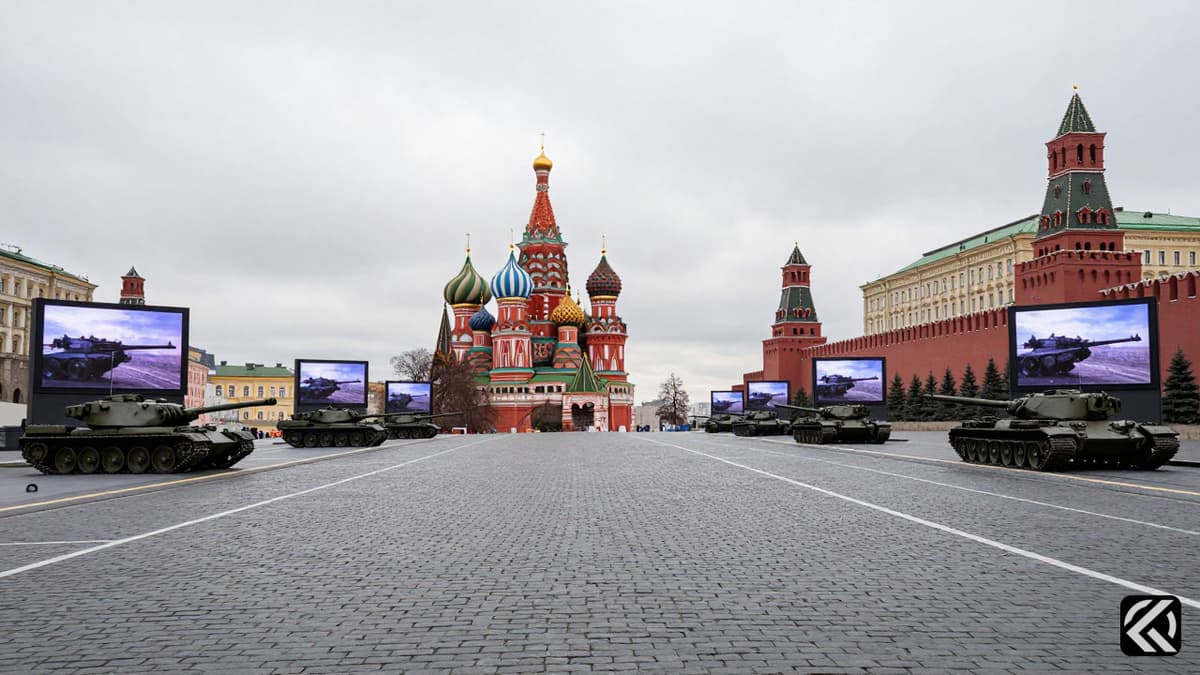
Amid escalating tensions and an elusive war outcome, Russia hosts one of its most stripped-down Victory Day parades in years, prioritizing display over presence.
Russia has hosted one of its most significantly scaled-back Victory Day parades in recent history, marking a stark departure from the military pageantry that has historically defined this national celebration. Held on May 9 on Moscow’s Red Square, the event was conducted under the shadow of a deadly conflict in Europe that has raged for more than four years without a decisive victory for Moscow’s forces. The Kremlin cited the ongoing threat of attack from Ukraine as the primary justification for the reduced physical footprint of the parade. This decision underscores the evolving nature of Russia’s military posture and the intense security concerns surrounding the capital during this anniversary.
The traditional display of military might, which once featured rows of heavy armor and nuclear-capable systems rolling across the cobblestones, was entirely absent this year. In place of the tangible hardware, the square was dominated by giant screens broadcasting footage of Russia’s advanced weaponry to the public and to viewers watching via state television. This technological substitution served as a visual stand-in for the physical absence of tanks and other heavy military equipment, reflecting both logistical constraints and strategic security calculations. The visual narrative shifted from a ground-level assertion of power to a broadcast-heavy presentation of capability.
Instead of a physical procession, the parade featured a curated digital exhibition of Russia’s most formidable assets. Viewers were treated to imagery of the Yars intercontinental ballistic missile, a new Arkhangelsk nuclear submarine, the Peresvet laser weapon, the Sukhoi Su-57 fighter jet, and the S-500 surface-to-air missile system. Drones and artillery were also displayed on these massive screens, creating a virtual armory that replaced the traditional physical display. This approach allowed the state to project strength and technological advancement without exposing valuable hardware to potential threats or logistical risks during the ongoing conflict.
Soldiers and sailors, some of whom had directly served in Ukraine, marched across the square, chanting in unison as they passed the reviewing stand. President Vladimir Putin watched from his seat alongside Russian veterans, positioned in the shadow of Vladimir Lenin’s Mausoleum. The presence of North Korean troops, who have reportedly fought against Ukrainian forces in Russia’s Kursk region, added a geopolitical dimension to the proceedings, signaling deepening international alliances amid isolation from Western nations. Fighter jets flew overhead, their sonic booms echoing against the Kremlin’s towers, providing an auditory component to the otherwise screen-centric visual experience.
During the ceremony, Putin delivered an eight-minute address, framing the current conflict as a continuation of the heroic legacy celebrated on this holiday. He referenced the Soviet Union’s defeat of Nazi Germany and the 27 million Soviet citizens, including many from what is now Ukraine, who perished during that war. Putin’s speech drew a direct line between the past and present, suggesting that the current soldiers are the spiritual successors of the victorious generation. He characterized the current conflict as a struggle against an aggressive force armed and supported by the entire NATO bloc.
“The great feat of the victorious generation inspires the soldiers carrying out the tasks of the special military operation today,” Putin said during his address. He emphasized the resilience of his forces, stating, “They are confronting an aggressive force armed and supported by the entire NATO bloc. And in spite of that, our heroes march forward.” This rhetoric served to bolster domestic morale and justify the sacrifices made over the past four years, despite the elusive nature of a decisive military outcome.
The decision to limit the physical parade reflects the broader strategic reality facing Moscow. With a decisive victory remaining out of reach after years of intensive fighting, the Russian leadership appears focused on managing resource allocation and security risks. The shift from physical tanks to digital displays of nuclear and advanced conventional weaponry suggests a prioritization of deterrence messaging over traditional intimidation tactics. This method allows for the display of strategic assets without the vulnerability associated with moving heavy equipment through the capital during a time of heightened threat levels.
The inclusion of North Korean troops in the march signals a significant expansion of Russia’s military partnerships. Their participation, particularly noting their engagement in the Kursk region, highlights the internationalization of the conflict and the efforts to bolster Russian manpower and military cooperation with other nations opposed to Western influence. This global dimension adds complexity to the narrative of the parade, transforming it from a purely nationalistic celebration into a statement of geopolitical alignment.
The reduction in physical hardware and the reliance on digital displays during the Victory Day parade indicate a long-term shift in Russia’s military communication strategy. As the conflict with Ukraine persists without a clear conclusion, Moscow may continue to prioritize secure, virtual presentations of power over vulnerable public displays of heavy armor. This approach suggests an enduring state of heightened security in the capital and a potential normalization of digital warfare propaganda. The reliance on such tactics over the coming years could reshape how future military milestones are commemorated, moving away from traditional parades toward more controlled, screen-mediated narratives that minimize physical risk while maintaining the projection of strength.
May 9, 2026 21:40 UTC
Russia Cuts Heavy Armor From Victory Day Parade Amid War
Join 50,000+ readers getting the global briefing every morning.
No spam. Unsubscribe anytime.
May 9, 2026 21:40 UTC
Russia Cuts Heavy Armor From Victory Day Parade Amid War
May 9, 2026 21:28 UTC
Delhi Terror Threat: Security Intensified at BJP HQ on Deen Dayal Upadhyaya Marg
May 9, 2026 19:32 UTC
Hardliners Sabotage Iran-US Negotiations Amidst Fractured Regime
May 9, 2026 19:30 UTC
India Successfully Deploys MIRV Agni-5 Missile System


