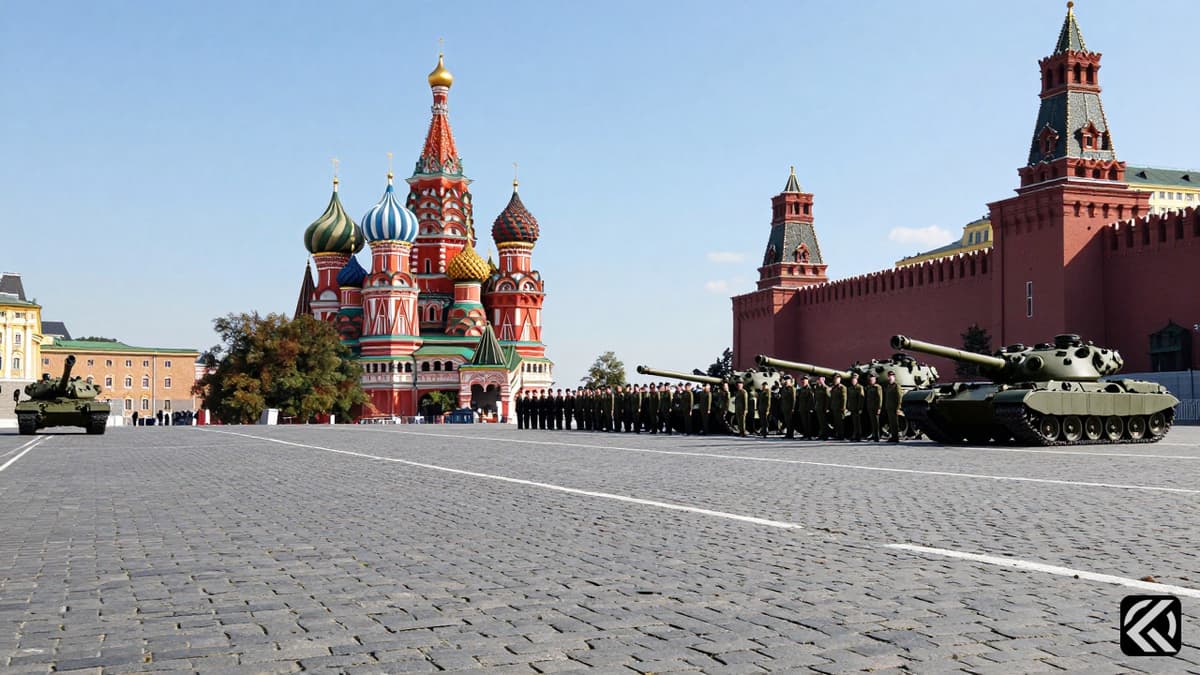
Moscow hosts a historic Victory Day parade stripped of heavy armor, signaling shifting security dynamics amidst ongoing conflict with Ukraine.
Russia has held its annual Victory Day military parade in Moscow to mark the defeat of Nazi Germany during the second world war, though the event has undergone a significant transformation this year. The parade, scaled back due to security concerns, began around 10 am (07:00 GMT) in Red Square, commencing with a military formation bearing the Russian flag. This modification marks a stark departure from previous years, reflecting the complex operational realities currently facing the Kremlin.
The absence of heavy machinery was a notable feature of this year's ceremony. For the first time in nearly two decades, the event took place without tanks, missiles, or other heavy weapons, aside from a traditional flyover of combat jets. Instead, the 45-minute parade featured a video presentation of Russian military equipment currently deployed to Ukraine. Al Jazeera’s Yulia Shapovalova, reporting from Moscow, noted that assets were physically excluded based on an understanding that "tanks are needed at the [military] front, not at the parade."
Security protocols were heavily intensified as President Vladimir Putin addressed the crowd. Putin, who has utilized Victory Day for over 25 years to showcase military power and rally domestic support, emphasized national resilience. “Victory has always been and will be ours,” Putin declared, adding that the key to success lies in moral strength, courage, and the ability to endure. He invoked the legacy of the Soviet generation’s victory to inspire current soldiers, stating, “The great feat of the generation of victors inspires the soldiers carrying out the goals of the special military operation today.”
The Kremlin cited the “current operational situation” and the threat of Ukrainian attacks as primary drivers for the format change. Kremlin spokesperson Dmitry Peskov confirmed that authorities had implemented “additional security measures.” This caution comes amidst heightened tensions, with Ukraine’s President Volodymyr Zelenskyy suggesting earlier in the week that Russian authorities feared drones might disrupt the festivities. Zelenskyy later issued a decree mockingly permitting Russia to celebrate on Saturday, declaring Red Square temporarily off-limits to Ukrainian strikes. Peskov dismissed this as a “silly joke,” while Russian authorities warned of a “massive missile strike on the center of Kyiv” if the celebrations were disrupted.
Amidst the military display, significant diplomatic movements occurred. United States President Donald Trump announced that Russia and Ukraine had agreed to his request for a ceasefire running from Saturday through Monday, along with an exchange of prisoners. Trump declared the break in fighting could be the “beginning of the end” of the conflict. However, these hopes were quickly dampened as both sides traded accusations of ceasefire violations mere hours after the announcement.
The Ukrainian General Staff reported that the number of attacks by Russia reached 51 since the beginning of the day. Simultaneously, Russia’s defence ministry accused Ukrainian armed groups of launching drone and artillery attacks despite the ceasefire declaration. Despite these immediate disputes, Putin stated after the parade that he believes Russia’s war on Ukraine is “coming to an end.” He also expressed hope to meet his Ukrainian counterpart in person once a lasting peace deal is agreed to.
The parade included military units from North Korea, highlighting broader international alignments. Putin framed the current conflict as a struggle against an “aggressive force armed and supported by the entire NATO bloc,” asserting, “I firmly believe that our cause is just.” Victory Day remains a pivotal moment in the national psyche for Russia and former Soviet states, commemorating the 27 million Soviet lives lost between 1941 and 1945. Putin described the holiday as a celebration of pride and love for the country, underscoring a shared duty to defend the Motherland’s interests.
The significant scaling down of the Victory Day parade serves as a potent symbolic indicator of the material and logistical constraints currently impacting Russian military operations. By removing heavy armor from the capital’s center, the Kremlin acknowledges the demand for such assets at the front lines, a decision driven by the immediate threat of Ukrainian counter-offensives. This shift suggests that the regime is prioritizing operational necessity over traditional displays of overwhelming force, potentially signaling a more defensive posture in the near term.
Looking ahead, the failure of the Victory Day ceasefire to hold despite high-level diplomatic interventions indicates deep skepticism regarding near-term diplomatic breakthroughs. The rapid escalation of mutual accusations suggests that any future agreements will face intense verification challenges. Furthermore, Putin’s claim that the war is “coming to an end” contrasts sharply with the active combat conditions reported on the ground. As the conflict enters its fifth year, the divergence between political rhetoric and military reality may widen, forcing Russia to rely increasingly on historical narratives to maintain domestic cohesion while navigating a protracted and resource-intensive Russia-Ukraine war.
May 9, 2026 19:32 UTC
Hardliners Sabotage Iran-US Negotiations Amidst Fractured Regime
May 9, 2026 17:43 UTC
Moscow's Stripped-Down Victory Day: A Shift in Military Display
May 8, 2026 19:28 UTC
Iran Transforms Destroyed B1 Bridge Into Symbol of Resistance
May 8, 2026 15:53 UTC
China Confirms Technical Aid for J-10CE Fighter Jets in Regional Conflict
May 9, 2026 23:27 UTC
India’s Strategic Leap: Agni-5 with MIRV Trial Success


