Tamil Nadu witnesses a historic political shift as C. Joseph Vijay prepares to assume the Chief Minister’s office, ending the era of alternating Dravidian dominance.
Tamil Nadu is poised for a monumental political transformation as C. Joseph Vijay, president of the Tamilaga Vettri Kazhagam (TVK), is scheduled to be sworn in as the Chief Minister on Sunday, May 10, 2026. This event marks the conclusion of nearly six decades of political history dominated by the alternating rule of the state’s two major Dravidian parties, the DMK and the AIADMK. The transition follows a period of intense political uncertainty that was resolved on Saturday, May 9, when the Governor officially appointed Mr. Vijay as the Chief Minister-designate. This appointment came after he successfully demonstrated the support of 120 MLAs-elect within the 234-member state assembly, securing the necessary majority to form a stable government.
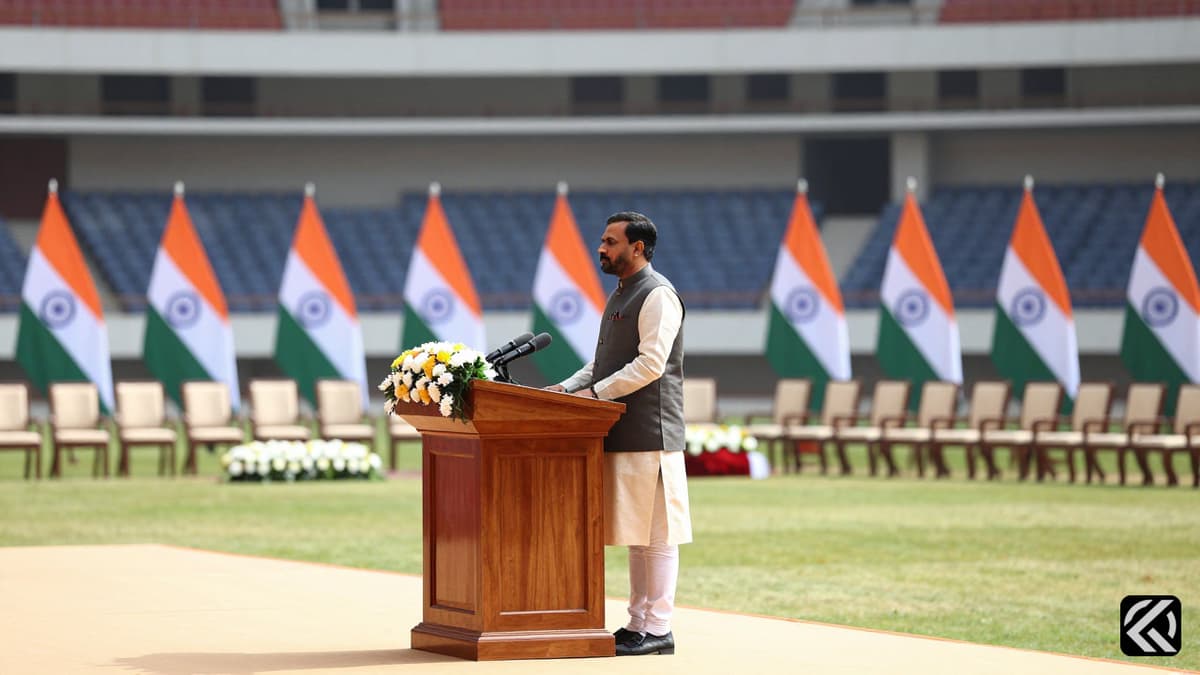
The swearing-in ceremony is set to take place at the Nehru Stadium in Chennai at 10 a.m. on May 10. During this historic event, Mr. Vijay will be joined by nine other ministers, including several senior leaders from the TVK, who will also take their oaths. The new administration will be a coalition government, with the Indian National Congress serving as a key partner. Governor Rajendra Vishwanath Arlekar has directed Mr. Vijay to seek a vote of confidence in the Legislative Assembly on or before May 13, a critical step to validate the government's majority. The political landscape in the state shifted dramatically in the hours leading up to the appointment. After securing support from the CPI and CPI (M), the TVK awaited the decision of the VCK. The uncertainty was lifted in the evening when the VCK and the Indian Union Muslim League (IUML) formally extended their support. This brought the total tally of supporting MLAs to 120. Following this development, Mr. Vijay visited the Governor at Lok Bhavan in Chennai to submit letters of support from the Congress, CPI, CPI (M), VCK, and IUML.
The TVK, which emerged as the single largest party in the recent Assembly elections by winning 108 seats, will lead the new government. Mr. Vijay holds an effective strength of 107 seats within his party as he was elected from two constituencies and must vacate one. The coalition’s foundation is built on a diverse array of political alliances. The TVK secured the support of five Congress MLAs-elect and two MLAs each from the CPI, CPI (M), VCK, and IUML. Notably, these supporting parties had contested the recent elections as part of the DMK-led Secular Progressive Alliance (SPA). However, in a significant strategic shift, the Congress broke ties with the DMK to forge a post-poll alliance with the TVK. The other supporting parties have clarified their position, stating that while they are aiding TVK in government formation, they intend to remain part of the DMK-led alliance as a political coalition. This dual alignment highlights the complex nature of post-election politics in the state.
The reaction to the Governor’s decision was immediate and celebratory among the ruling party’s base. TVK cadres across the state, including at the party headquarters in Panaiyur and various other locations, celebrated Mr. Vijay’s appointment by distributing sweets and bursting crackers. The mood reflected a sense of historic achievement, marking the entry of a new political force into the leadership of the state. The formation of this government was driven partly by the desire to avoid a period of President’s rule. With the CPI and CPI (M) already having expressed support, the TVK had been anxiously awaiting the VCK’s final decision. Although the VCK was expected to announce support around noon, the formal letter was delivered to TVK general secretary (election campaign management) Aadhav Arjuna only in the evening.
The rationale behind the VCK’s decision was articulated by its founder-president, Thol. Thirumavalavan. Speaking to reporters at the VCK headquarters, Mr. Thirumavalavan explained that the Left parties and the VCK have historically functioned together based on shared ideology since the time of the People’s Welfare Front. He stated that in the context of the current political crisis, both groups consulted and decided together, keeping a long-term vision in mind. The decision to support the TVK was made after consultation with the party’s high-level committee. Mr. Thirumavalavan emphasized that the primary basis for this decision was to prevent the imposition of President’s rule in Tamil Nadu through the exploitation of this political crisis. He expressed that the VCK did not want to act as an obstacle to the TVK forming a new government.
Furthermore, Mr. Thirumavalavan made it clear that the VCK would extend unconditional support to the government from outside. When questioned about the implications of this move on the relationship with the DMK, he asserted that the VCK remains part of the DMK-led alliance but has utilized its political independence to take this stand. He expressed confidence that this decision would not negatively affect their relationship with the DMK. This nuanced political maneuvering underscores the strategic flexibility of smaller parties in shaping the executive landscape. The appointment of Tamil Nadu’s new Chief Minister signals a break from traditional power dynamics, introducing a coalition model that blends the strength of a single large party with the ideological breadth of multiple allies.
The swearing in of C. Joseph Vijay represents a definitive end to the sixty-year duopoly of the DMK and AIADMK in Tamil Nadu. The state is now navigating a new era of coalition governance, where power is distributed among parties with varying ideological backgrounds but shared governance goals. The involvement of parties like the VCK and IUML, who maintain ties to the opposition-led SPA, suggests a fluid political environment where alliances are pragmatic rather than rigid. This structure may lead to a more collaborative legislative process, as the government must balance the demands of its coalition partners. The coming weeks, particularly the vote of confidence by May 13, will test the stability of this new arrangement. If successful, this could set a precedent for multi-party coalitions in the state, reducing the dominance of traditional dynastic politics and empowering regional and ideological parties. The long-term impact may be a more diverse political landscape where policy formulation requires broader consensus among varied political entities.
May 9, 2026 19:32 UTC
Hardliners Sabotage Iran-US Negotiations Amidst Fractured Regime
May 9, 2026 17:43 UTC
Moscow's Stripped-Down Victory Day: A Shift in Military Display
May 8, 2026 19:28 UTC
Iran Transforms Destroyed B1 Bridge Into Symbol of Resistance
May 8, 2026 15:53 UTC
China Confirms Technical Aid for J-10CE Fighter Jets in Regional Conflict
May 9, 2026 23:27 UTC
India’s Strategic Leap: Agni-5 with MIRV Trial Success