Section
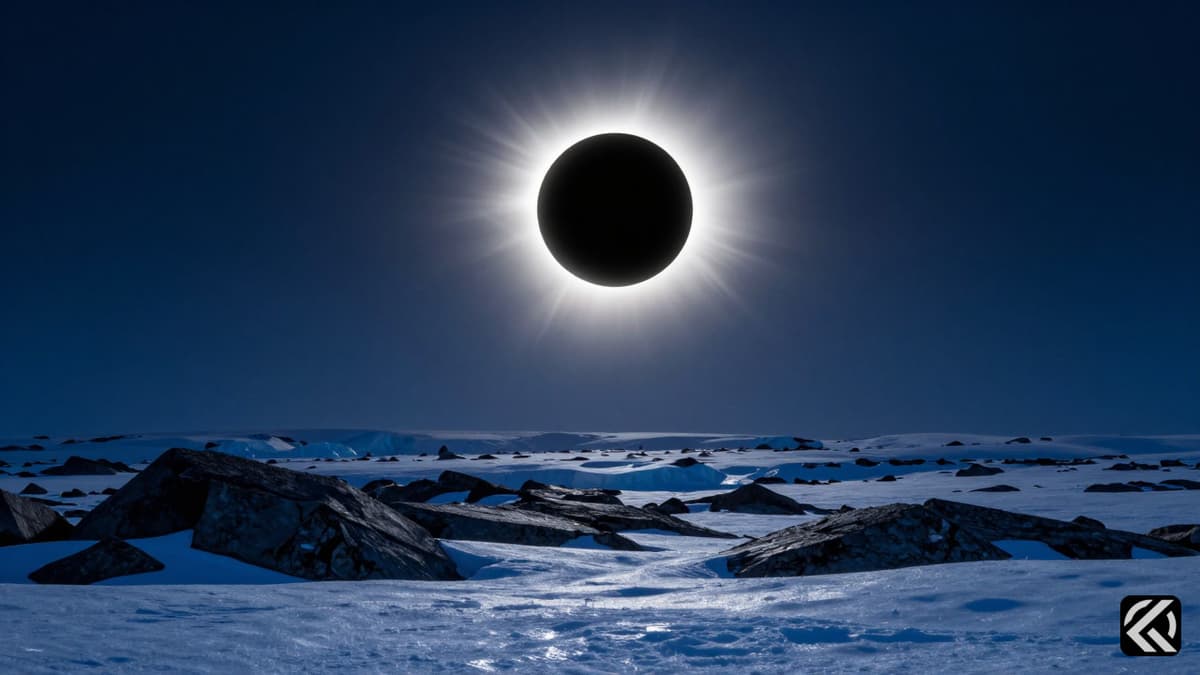
The world paused to witness a profound astronomical event on Wednesday as a total solar eclipse created a stellar spectacle for millions of people. This rare celestial phenomenon occurred when the moon moved directly between the sun and Earth, casting a distinct shadow on our planet. The alignment was significant enough to completely block the sun’s light from specific areas of the world, offering a brief but intense period of darkness for those in the path of totality.
People in Greenland and Iceland were among the primary witnesses to this dramatic display. For approximately two minutes, the skies in these northern regions went completely dark, transforming the daytime environment into a twilight state. The precision of this celestial event allowed observers in these specific locations to experience the total phase of the eclipse, where the moon's disk entirely covers the sun. This period of totality is one of the most sought-after astronomical events for enthusiasts and casual observers alike, providing a unique opportunity to view the sun's corona, which is usually obscured by the sun's bright surface.
Meanwhile, a vast array of locations outside the path of totality experienced a different variation of the event. In Spain, and a small portion of Portugal, the eclipse presented a rare opportunity to witness a sunset eclipse. As the celestial bodies aligned during the late hours of the day, viewers in these Iberian locations enjoyed a sunset eclipse, watching a crescent sunset afterward. This specific timing added a layer of dramatic beauty to the experience, blending the astronomical event with the natural daily cycle of the sun setting.
Watch the moon eclipse the sun in a rare celestial event that darkened skies over Greenland and Iceland, offering a unique astronomical spectacle for observers worldwide.
Elsewhere, the experience was less absolute but no less fascinating. A partial eclipse, in which the moon appears to take a “bite” out of the sun, occurred over a broad swath of geography. This partial phase was visible across the northern United States, Canada, much of Europe, and northwestern Africa. In these regions, observers did not experience full darkness but could see the moon covering a significant portion of the sun's disk. This widespread visibility underscores the global scale of astronomical events and how a single celestial alignment can impact millions of lives across different continents simultaneously.
The mechanics of the total solar eclipse rely on the precise orbital dynamics of the moon and the Earth. When the moon moves between the sun and Earth, it casts a shadow that has two distinct parts: the umbra, where the sun is completely blocked, and the penumbra, where the sun is only partially blocked. Those in the path of the umbra, such as in Greenland and Iceland, experience totality. Those in the penumbra, covering the northern United States, Canada, and parts of Europe and Africa, experience a partial eclipse. The duration of totality, roughly two minutes in this instance, depends on the relative distances of the moon and the sun from Earth and the speed at which the moon's shadow sweeps across the planet.
The cultural and scientific impact of such events is profound. For centuries, total solar eclipses have inspired awe, scientific inquiry, and cultural storytelling. Today, they serve as important opportunities for public engagement with astronomy. Millions of people who might not otherwise consider themselves astronomy enthusiasts find themselves drawn to the sky to witness this rare alignment. The visibility across multiple continents, including the specific mention of Greenland, Iceland, Spain, Portugal, the northern US, Canada, Europe, and northwestern Africa, highlights the interconnected nature of modern observation. Social media and digital platforms allow these moments to be shared instantly, creating a global community of witnesses.
The specific locations highlighted in this event offer diverse geographical contexts for the eclipse. Greenland and Iceland, with their Arctic and sub-Arctic landscapes, provided stark, cold backdrops for the darkening sky. Spain and Portugal, with their warmer climates and historic architecture, offered urban and rural settings for the sunset eclipse. The northern United States and Canada provided expansive continental views, while northwestern Africa offered a perspective from the southern edge of the eclipse's reach. This geographical diversity adds to the richness of the event, allowing for varied photographic and observational opportunities.
The occurrence of the total solar eclipse on Wednesday serves as a reminder of the dynamic nature of our solar system. These events are not merely optical illusions but the result of complex gravitational interactions and orbital mechanics. The moon's orbit is tilted relative to Earth's orbit around the sun, which means eclipses do not happen every month. They occur only when the moon is near one of its orbital nodes, the points where its path crosses the ecliptic plane. This rarity is what makes each eclipse a special event, eagerly anticipated by astronomers and the public alike.
The widespread visibility of this event suggests a growing global interest in astronomical phenomena. As travel becomes more accessible, more people will seek out future eclipses, boosting tourism in path-of-totality regions like Greenland and Iceland. The partial eclipse's reach across the northern US, Canada, Europe, and Africa indicates that educational outreach in these areas can leverage such events to promote STEM engagement. The combination of totality and partial phases offers a comprehensive view of celestial mechanics, likely leading to increased public demand for astronomical knowledge and observation tools in the coming years.
Oct 3, 2026 04:08 UTC
FlyDubai Co-Pilot Banned in Oman Over Extremism Concerns
Oct 3, 2026 00:50 UTC
Israel-Mumbai Campaign Honors Captain Smit After Flydubai Incident
Oct 2, 2026 18:13 UTC
Captain Smit Machchhar’s Courage Saves Flydubai Flight FZ1073 From Disaster
Oct 2, 2026 16:45 UTC
Captain Smit Machchhar Saves Plane Mid-Fall
Sep 18, 2026 12:35 UTC
Bolivia's Newly Discovered Feline Species Named Leopardus tilcayo