Section
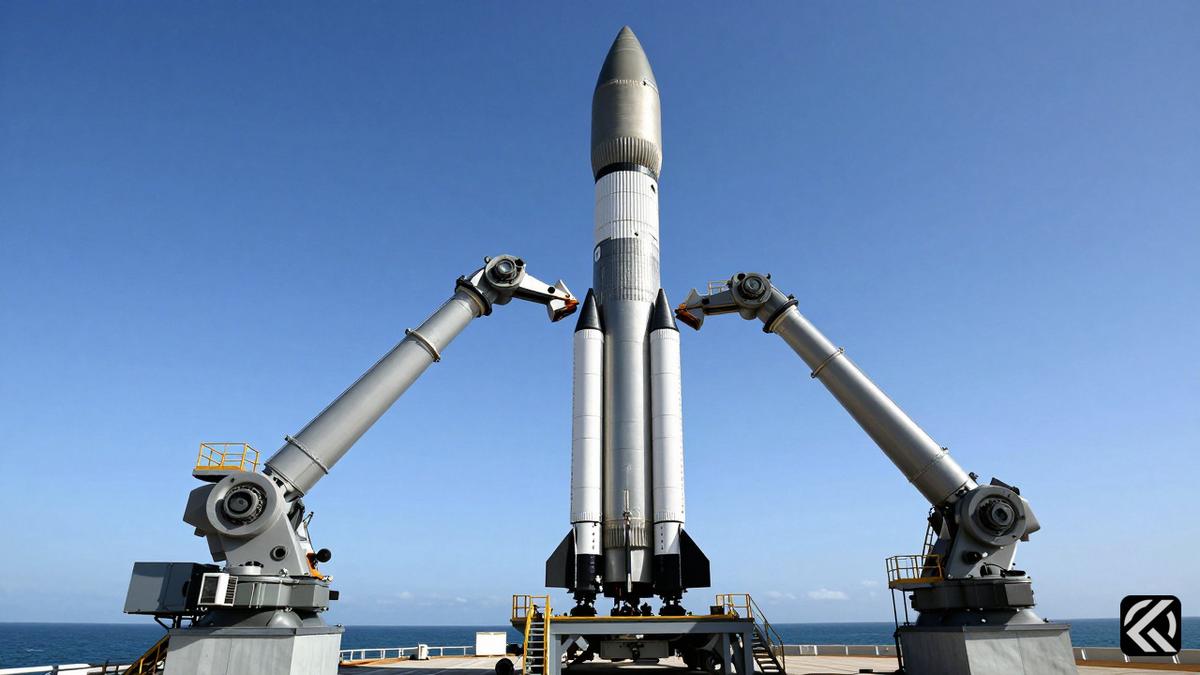
SpaceX achieves a historic first by catching Starship midair with giant mechanical arms, advancing its goal of fully reusable rockets and lunar exploration.
SpaceX’s Starship spacecraft returned from a 22-hour journey in orbit on Saturday, marking a pivotal moment in aerospace history. The stainless steel vehicle was successfully caught by giant mechanical arms at the Texas launch tower from which it had departed a day earlier. This event represents the first successful recovery of the spacecraft in midair, a critical step toward Elon Musk’s vision of a fully reusable rocket system. While the catch was a success, SpaceX fell short of its immediate goal of recovering both rocket stages, as the Super Heavy booster exploded shortly after Friday’s launch.
The dramatic landing sequence began with Starship firing an engine to initiate its descent through clouds over the Starbase facility. Upon reaching the launch site, the spacecraft reignited its engines to turn upright and slowly lowered itself into the mechanical arms, known as Mechazilla. After being securely grasped, the engines shut down, leaving the charred spacecraft suspended above the ground. SpaceX shared video footage of this historic moment, capturing the spacecraft descending and settling into the arms. Commentator Dan Huot expressed excitement during the broadcast, exclaiming, "Look at her! Baby, she's back!" Elon Musk congratulated his team, while NASA Administrator Jared Isaacman praised the achievement as "almost magic," noting it is making "more believers by the day."
The 407-foot rocket lifted off late Friday from SpaceX’s Starbase facility in Texas. Its two stages separated successfully, allowing the upper-stage Starship to continue toward orbit. During the mission, Starship deployed 26 advanced Starlink satellites and circled Earth 14 times at an altitude of 161-165 miles. This was SpaceX’s 15th full-scale Starship mission since 2023 and its second trip to orbit. The spacecraft’s systems, including its heat shield, appeared to function well during re-entry, where it traveled at around 17,000 miles per hour.
However, the Super Heavy booster, which carried the spacecraft into space, failed in its own recovery attempt. Approximately 10 minutes after liftoff, the booster’s engines stopped firing too early. Its guidance system detected an incorrect position and automatically initiated a diversion toward the water, followed by the booster's destruction. Wreckage remains in the Gulf of Mexico, cordoned off by buoys, while engineers investigate the cause of the failure. This highlights that while the upper stage recovery was successful, full two-stage recovery remains a challenge.
While the successful catch marks a key step, SpaceX has yet to retrieve both stages in a single mission. The spacecraft’s heat shield, composed of black hexagonal tiles, is not yet fully reusable. Reuters reported that the company is developing new tile designs requiring little or no refurbishment between flights. This effort is central to Musk’s goal of operating Starship like a commercial aircraft, enabling rapid, repeated flights with minimal downtime. Currently, SpaceX’s Falcon 9 rocket has a reusable first stage but discards its second stage after each of its more than 700 launches since 2010.
The SpaceX Starship program is critical to broader space exploration goals, particularly NASA’s Artemis moon programme. NASA is paying billions for Starship to serve as a lunar lander for Artemis astronauts later this decade. The facility in Texas is expected to be the starting point for NASA’s next Artemis mission, which will remain in orbit to allow astronauts to practice lunar lander operations. This will pave the way for Artemis IV in 2028, aiming for humanity’s first Moon landing since the Apollo era.
The success of this mission underscores the viability of large-scale reusable launch systems. By demonstrating the ability to catch the spacecraft midair, SpaceX has validated a method that drastically reduces turnaround time compared to traditional landings. This capability is essential for the economic model of frequent space travel and satellite deployment. The integration of Starlink satellite deployment within the same mission further demonstrates the dual-use potential of the vehicle for both communication infrastructure and deep-space missions.
The upcoming transition of Starship launches from Texas to Florida’s Kennedy Space Center is a significant logistical shift. This facility is expected to serve as the starting point for future Artemis missions. The success of the midair catch reduces the risk associated with using Starship as a crewed lunar lander. It also supports the long-term ambition of sending a fleet of spacecraft to Mars and building a city there. As engineers investigate the booster failure, the focus remains on achieving full reusability for both stages. The successful recovery of Starship reinforces its role as the cornerstone of SpaceX’s and NASA’s future in space exploration.
The successful midair catch of Starship represents a definitive leap forward in reusable rocket technology. This achievement not only validates SpaceX’s engineering approach but also strengthens the timeline for NASA’s lunar return. By enabling faster refurbishment and lower costs, this technology will likely accelerate the development of orbital data centers and interplanetary travel. The continued integration of Starship into the Artemis moon programme suggests that lunar exploration will become more frequent and sustainable in the coming years, bringing humanity closer to permanent bases on the Moon and eventual settlements on Mars.
Nov 17, 2026 16:45 UTC
US Intel Warns of Iran Dirty Bomb Plot in DC
Nov 17, 2026 12:48 UTC
Quad Summit Manila: Modi, Trump Focus on Indo-Pacific Security
Nov 17, 2026 10:43 UTC
Ukraine Strike Collapses Crimean Bridge Ahead of Diplomatic Talks
Nov 16, 2026 16:25 UTC
Beijing Claims Historic Significance for Trilateral Talks in Shenzhen
Nov 17, 2026 14:43 UTC
Howard Lutnick’s Tenure Tested by Internal Discord and Scandals