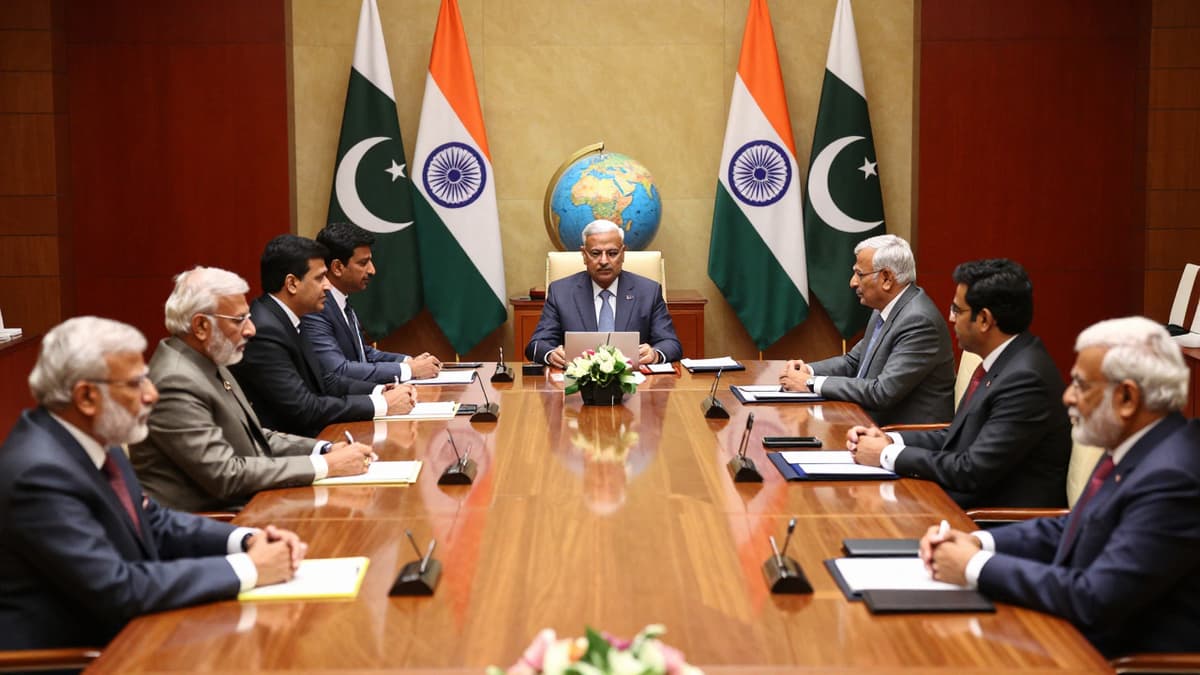
At a crucial all-party meeting, Foreign Minister S Jaishankar firmly stated that India cannot be a broker nation, dismissing claims that Pakistan has scored diplomatically through recent mediation efforts.
The Indian government firmly rejected suggestions that Pakistan has successfully scored diplomatically by offering mediation between Iran and the United States. During a significant all-party meeting convened on Wednesday, Foreign Minister S Jaishankar clarified New Delhi's stance, emphasizing that India not a broker nation in the manner of its neighbor. This clarification came amidst widespread speculation regarding the potential for third-party intervention in the escalating West Asian conflict.
The discussion was triggered by the recent buzz surrounding Pakistan's offer to mediate, a move that the Indian leadership viewed with skepticism. Sources quoting S Jaishankar noted that the neighbor has historically been a "past master at inserting itself into conflicts." The minister recounted Pakistan's previous roles as an intermediary between China and the US in 1971 and between the US and Iran in 1981. He clarified that he was not mocking or criticizing current Pakistani actions but rather placing them in historical perspective. The Indian strategy, he emphasized, follows a path of multi-alignment designed specifically to serve national interests, a strategy that has allowed the country to maintain robust equations with Iran.
At the meeting, which was presided over by Defence Minister Rajnath Singh, the government was represented by a high-powered delegation including Home Minister Amit Shah, Finance Minister Nirmala Sitharaman, Petroleum Minister Hardeep Puri, and Parliamentary Affairs Minister Kiren Rijiju. Opposition MPs also attended, including Mukul Wasnik of the Congress, John Brittas of the CPM, Asaduddin Owaisi of the AIMIM, Supriya Sule of the NCP, and Sanjay Singh of the AAP. The opposition flagged a host of critical issues, ranging from Prime Minister Narendra Modi's visit to Israel just before the war broke out to India's perceived silence over the assassination of Iran's Supreme Leader Ayatollah Ali Khamenei. Concerns were also raised regarding the availability of oil and gas supplies.
S Jaishankar addressed the geopolitical complexity directly, noting the lack of clarity regarding the format and ultimate fate of US-Iran talks. He pointed out the uncertainty surrounding who would be negotiating on behalf of Iran, specifically highlighting the sudden emergence of Parliamentary Speaker Mohammad Bagher Ghalibaf as Tehran's chief negotiator. The minister reiterated that while India enjoys good relations with Iran, the country's primary objective remains safeguarding its own strategic interests through multi-alignment rather than acting as a global broker.
Petroleum Minister Hardeep Puri took the floor to address the immediate economic concerns raised by the opposition. He assured the gathered parliamentarians that India currently holds sufficient stockpiles of petrol and diesel to manage domestic needs. Furthermore, the minister confirmed that the government has already initiated steps to tie up new sources of supply to ensure energy security amidst the volatile regional situation. This was a direct response to the anxieties expressed by opposition leaders regarding potential fuel shortages.
Kiren Rijiju, the Parliamentary Affairs Minister, summarized the government's stance, stating that its position had been clearly explained to address the concerns of the opposition parties. He noted that during such challenging times, unity is essential. "They also asserted that in such a challenging situation, we all have to stand together," Rijiju said, highlighting the Prime Minister's appeal for Parliament to rise together in the face of adversity. Rijiju added that he believed the opposition parties had displayed a significant level of maturity during the proceedings, despite the intensity of the issues discussed.
The lone major opposition party that chose not to attend the meeting was the TMC, which called for the issue to be discussed specifically within the Parliament rather than a closed-door briefing. The absence highlighted the political divide, yet the government managed to present a unified front through the comprehensive participation of its top ministers. S Jaishankar's remarks regarding the "broker" status were particularly sharp, drawing a clear line between India's strategic autonomy and Pakistan's diplomatic approach. He insisted that India's foreign policy is driven by a need to serve its national interests through multi-alignment, rather than seeking to resolve conflicts as a neutral third party.
The meeting concluded with a clear reaffirmation of India's foreign policy doctrine, distinguishing its approach from regional rivals. By explicitly rejecting the role of a broker, the government signals that it will continue to prioritize its multi-alignment strategy over diplomatic mediation efforts that do not directly serve its national interests. Looking ahead, the lack of clarity in US-Iran negotiations suggests that the conflict may continue with unpredictable outcomes. However, with the government's assurance of sufficient fuel stocks and new supply lines, the immediate economic impact on India appears mitigated. The political landscape remains tense, but the consensus among attending parties points toward a unified national stance on the conflict, with opposition leaders displaying a readiness to support the government's energy security measures while maintaining their critiques on diplomatic silence and regional geopolitics.
May 9, 2026 21:40 UTC
Russia Cuts Heavy Armor From Victory Day Parade Amid War
Join 50,000+ readers getting the global briefing every morning.
No spam. Unsubscribe anytime.
May 10, 2026 05:02 UTC
MV Hondius Arrives in Tenerife Amid Hantavirus Outbreak
May 10, 2026 03:02 UTC
Vijay Takes Oath, Ending Dravidian Party Era in Tamil Nadu
May 10, 2026 01:28 UTC
Nine TVK Leaders Join C. Joseph Vijay as Tamil Nadu Ministers
May 9, 2026 23:27 UTC
India’s Strategic Leap: Agni-5 with MIRV Trial Success


