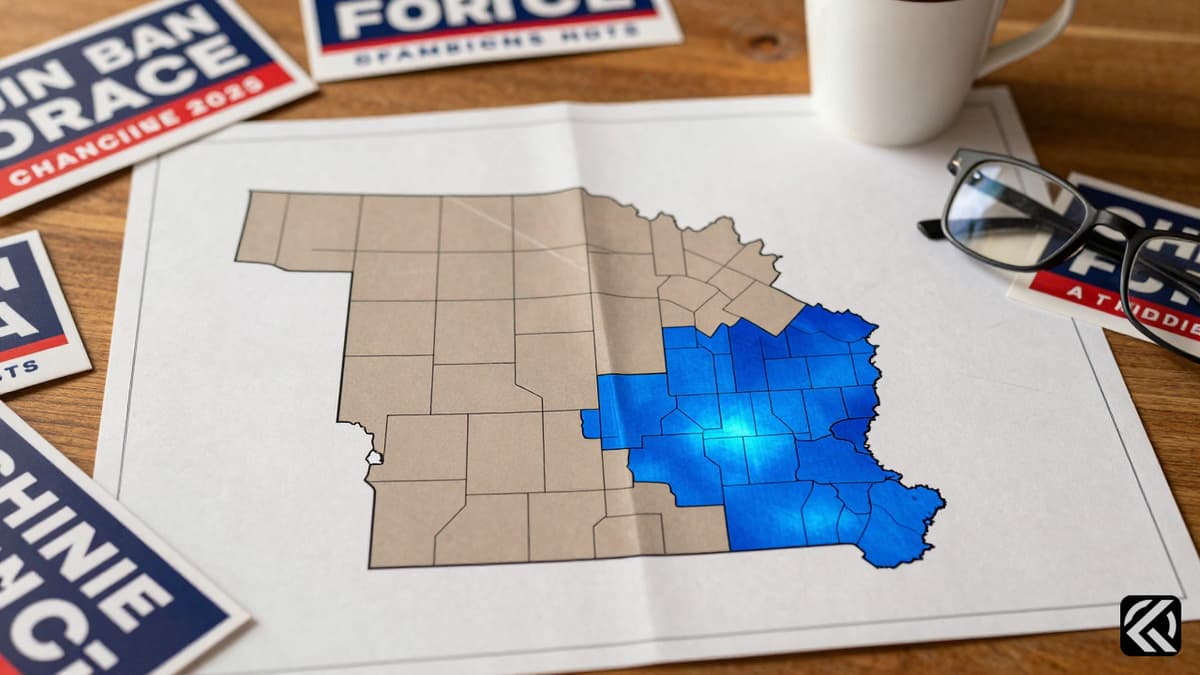
A fierce Democratic primary battle in Nebraska has erupted, centering on whether electing a specific candidate could jeopardize the state's lone remaining electoral vote, known as the Blue Dot.
Omaha may sit as a solitary point of political pride in a predominantly Republican state, but this geographic reality has ignited a bitter and complex divide within the local Democratic Party. The current congressional race, which serves as a proxy war over the state’s unique method of awarding electoral votes, has become one of the nation’s most closely watched primary contests.
The retirement of Republican Representative Don Bacon, one of only three House Republicans who won in districts that Kamala Harris also carried in 2024, has created an attractive open seat. This vacancy has drawn significant attention from Democrats aiming to win control of Congress in November. Two leading hopefuls, state senator John Cavanaugh and political newcomer Denise Powell, have engaged in a weeks-long conflict characterized by dueling advertisements, yard signs, and contentious neighborhood disputes.
The core of the disagreement revolves around the protection of what is colloquially known as the Blue Dot. Powell argues that electing Cavanaugh to Congress would allow him to relinquish his position in the state legislature. According to her campaign, this vacancy would be filled by Republican Governor Jim Pillen with an individual who would vote to eliminate the district-based system, effectively making Nebraska a winner-take-all state like 48 other states.
“We have fought so hard for fair representation, our Blue Dot, and to retain that electoral power,” Powell stated in a recent press release. “We cannot afford a candidate whose campaign hands Republicans the votes to gerrymander us into oblivion.”
The intensity of this specific dispute distinguishes the Nebraska race from other competitive elections across the country. Despite the local nature of the policy argument, the primary has attracted a deluge of outside spending. According to AdImpact, more than $6 million in advertising has flowed into the race. Two progressive super PACs have invested over $1 million on Omaha airwaves alone to amplify Powell’s warning that Cavanaugh’s election could cost Democrats the presidency.

In response, Cavanaugh has countered with ads labeling his opponent “Dark Money Denise.” His campaign and allies have planted signs vowing to stand up to former President Donald Trump. Additionally, six fellow state senators signed an open letter defending Cavanaugh, arguing that attacking him is misguided and that Democrats are likely to win other legislative races.
Nebraska and Maine remain the only two states in the country that divide Electoral College votes by congressional district rather than using a statewide winner-take-all formula. Under this unique system, the statewide winner receives two electoral votes, while the remaining votes are split one apiece among the leading vote-getters in each district.
This system has historically benefited candidates from both parties. President Donald Trump won a single electoral vote in Maine in 2016 and 2020 despite losing the state overall. In Nebraska, the opposite effect occurred, where Trump won only four of five electoral votes in 2020. The vulnerability of this system became apparent in the final weeks of the 2024 campaign, when Trump and his allies made a last-ditch effort to change Nebraska law, fearing a potential 269-269 Electoral College tie.
Trump personally spoke by phone to Nebraska Republican lawmakers to encourage them to change the rules for the upcoming election. However, opposition from lawmakers including Cavanaugh prevented Pillen from rallying sufficient support to alter the 30-year-old law. Pillen has since pledged to try again, hoping to muster support within the nation’s only unicameral legislature, which has a Republican supermajority.
For Democrats, the Omaha Democratic primary is now viewed as a critical juncture. When Bacon announced his retirement, Democrats seized the opportunity to target this eastern Nebraska district. For the last decade, Bacon successfully defeated all Democratic challengers. The initial campaign themes focused on rising costs and immigration, but the race has been completely consumed by the debate over preserving the state’s lone Democratic electoral vote.
The suggestion that the Nebraska Electoral College system was at risk originated with Crystal Rhoades, a Douglas County District Court clerk and one of six Democratic candidates. However, the narrative was rapidly amplified by Powell and out-of-state allies, including Emily’s List, through a multimillion-dollar spending campaign. A super PAC supporting Powell ran ads asking, “It’s how a House win in Nebraska could cost Democrats the presidency. Don’t let John Cavanaugh give away our blue dot.”
Powell, who previously operated a political action committee, describes herself as “one pissed-off Mom” in her advertisements. In contrast, Cavanaugh hails from a prominent Democratic family; his father represented the 2nd District in Congress from 1977 to 1981, and his sister serves in the state legislature.
Cavanaugh has addressed the controversy by explaining his timeline for leaving office if elected. He stated on his campaign website that he would not resign his legislative seat until January, after new senators are elected. He argues that elected Democrats in Nebraska are confident they will pick up enough seats in November to offset his vote. “Nebraska Democrats do not have to choose between standing up to Trump and protecting our blue dot,” Cavanaugh’s site asserts, dismissing the attacks as disingenuous.
The conflict in Nebraska highlights the delicate balance local parties must maintain within national frameworks. With outside groups spending millions to define the candidate who best protects the district-based vote, the race is no longer just about local representation but national electoral strategy. The outcome will determine not only who represents eastern Nebraska in Congress but also whether the state retains its unique method of casting votes in presidential elections. As the primary concludes, the focus remains on which candidate can effectively shield the Blue Dot from Republican efforts to consolidate voting power, a battle that could have ripple effects across the broader political map.
May 8, 2026 19:28 UTC
Iran Transforms Destroyed B1 Bridge Into Symbol of Resistance
Join 50,000+ readers getting the global briefing every morning.
No spam. Unsubscribe anytime.
May 9, 2026 13:53 UTC
Suvendu Adhikari Becomes West Bengal's New Leader
May 9, 2026 11:57 UTC
IUML Rejects TVK Support Rumors During Tamil Nadu Government Formation
May 9, 2026 11:57 UTC
Pentagon Unveils Declassified UFO Files Amidst Political Debate
May 9, 2026 09:41 UTC
Modi Touches Feet of Veteran Sarkar Amid West Bengal Victory