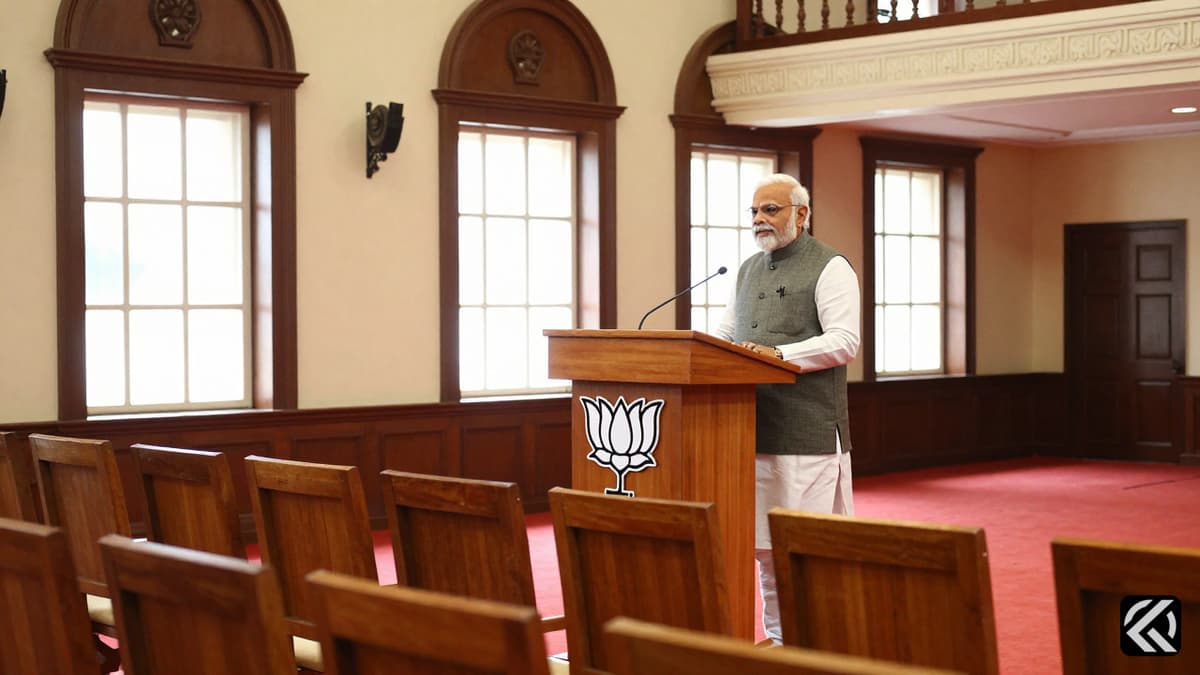
Suvendu Adhikari has been sworn in as West Bengal's chief minister, marking a dramatic political reversal as the BJP ends the Trinamool Congress's decade-long hold on the state.
Suvendu Adhikari, a prominent figure in Indian politics, was sworn in as the new chief minister of West Bengal on Saturday. His inauguration, attended by Prime Minister Narendra Modi, marks the end of a 15-year political era defined by the All India Trinamool Congress (TMC) and its leader, Mamata Banerjee. The Bharatiya Janata Party (BJP) secured 207 of the state’s 294 assembly seats in the recent election, a decisive victory that has reshaped the political landscape of the region. This transition represents one of the most significant shifts in Bengal’s recent history, moving power from a regional party to the national Hindu nationalist organization for the first time.
The path to this political dominance was not linear for Adhikari, whose career is rooted in the complex dynamics of local Bengal politics. Born in 1970 in Purba Medinipur district, he emerged from one of the state’s most influential political families. His father, Sisir Adhikari, was a veteran MP, and the family maintained a strong network across coastal West Bengal. Adhikari initially rose through the ranks of the Congress party before joining the TMC during its emergence as a potent anti-Left force. However, his political trajectory changed dramatically during the violent protests in Nandigram town in 2007. These protests, triggered by a proposed land acquisition project, weakened the then-ruling Left Front government and paved the way for Banerjee’s rise to power in 2011. Adhikari, who organized much of the ground movement, gained a reputation as an effective political organizer during this period.
For years, Adhikari was considered one of Mamata Banerjee’s closest lieutenants. He cultivated an image as a combative organizer with a sharp instinct for power, capable of navigating Bengal’s shifting political currents. Supporters viewed him as the ’s most recognizable face in the state, deeply rooted in local networks and street-level politics rather than the Delhi establishment. To critics, however, he embodied the increasingly polarized rhetoric defining the state. Their relationship eventually deteriorated, leading to his dramatic defection to the BJP in 2020, just months before the 2021 state elections. Contesting from Nandigram, Adhikari defeated Banerjee in a closely watched race, elevating his status within the BJP and cementing his role as her principal challenger.
Five years later, Adhikari has orchestrated an even more significant political upset. In the 2026 election, the BJP swept to power, defeating Banerjee in her long-time stronghold of Bhabanipur while Adhikari retained his Nandigram seat. This victory marks a striking reversal for the BJP, which was once a marginal force in Bengal. However, Adhikari’s ascent has been accompanied by controversy. In 2021, the Election Commission issued a notice regarding a speech where he allegedly referred to an opponent as "Begum" and suggested voting for her meant voting for a "mini-Pakistan." Last year, he triggered outrage by declaring the BJP would "physically throw Muslim MLAs out of the assembly" if elected, leading to accusations of hate speech, a privilege motion, and his suspension from the assembly. Additionally, he faced criticism for comments alleging that medicines distributed at a TMC-run medical camp could lead to birth control and reduce the Hindu population, remarks widely condemned as inflammatory.
The transfer of power has unfolded against a backdrop of renewed tension. On Wednesday, a close aide and personal assistant to Adhikari was shot dead in what BJP leaders described as a targeted attack. Police reported that unidentified assailants opened fire near the aide’s home, intensifying concerns about post-election violence in the state. This incident underscores the volatile nature of the political transition. Throughout his career, Adhikari has been admired by supporters for his aggressive campaigning style but criticized by opponents as a political rabble-rouser who has helped deepen divisions. As he assumes the role of Suvendu Adhikari leading the state administration, he faces the immediate pressure to shift from a firebrand politician to an effective administrator.
As the new West Bengal chief minister, Adhikari now confronts the critical task of stabilizing the state and addressing the expectations of his diverse coalition. The BJP’s sweeping victory has ended the Trinamool Congress’s long dominance, but the challenge lies in governing a state with deeply entrenched political loyalties. Adhikari must reassure investors and deliver tangible results in job creation to validate his party’s electoral success. The recent violence, including the killing of his aide, signals that the transition is not merely symbolic but involves real security risks that require immediate attention. Political analysts suggest that his ability to move beyond his controversial past and focus on administrative competence will determine the longevity of the BJP’s rule. The shift from opposition to governance demands a change in tone, as the state looks to the new leadership for economic progress and social harmony. Adhikari’s administration will be closely watched for its capacity to manage the expectations of both its nationalist base and the broader, diverse populace of West Bengal, setting the precedent for future political stability in the region.
May 8, 2026 19:28 UTC
Iran Transforms Destroyed B1 Bridge Into Symbol of Resistance
Join 50,000+ readers getting the global briefing every morning.
No spam. Unsubscribe anytime.
May 9, 2026 11:57 UTC
Pentagon Unveils Declassified UFO Files Amidst Political Debate
May 9, 2026 09:41 UTC
Modi Touches Feet of Veteran Sarkar Amid West Bengal Victory
May 9, 2026 07:15 UTC
Suvendu Adhikari Forms New BJP Cabinet in West Bengal
May 9, 2026 05:58 UTC
VCK Supports TVK as Tamil Nadu Faces Government Crisis