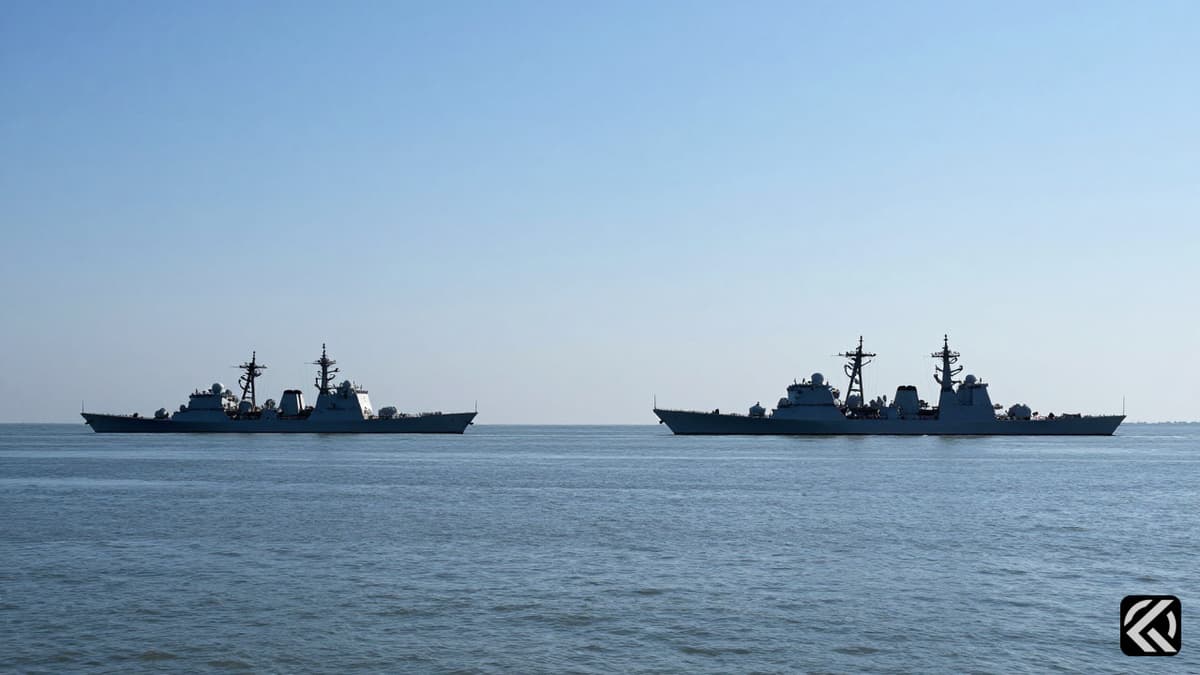
President Donald Trump issued a stark warning to Iran after US naval destroyers came under fire in the Strait of Hormuz, vowing escalated retaliation if no deal is signed.
US President Donald Trump announced on Thursday that three American naval destroyers were fired upon while navigating the Strait of Hormuz, yet emerged without any damage. In a stern post on Truth Social, the President described the incident as a successful transit despite the hostility, noting that the attackers suffered total destruction. He used the event to issue a direct ultimatum to Iran, declaring that the nation would face significantly harsher military retaliation if it fails to agree to a deal quickly. The incident underscores the escalating volatility in one of the world’s most critical energy shipping lanes, where tensions between the US and Tehran have recently surged.
The President detailed the specifics of the confrontation in his social media statement, describing the defense mechanisms employed by the US fleet. He wrote that missiles aimed at the destroyers were "easily knocked down" and drones were "incinerated while in the air." Trump characterized the falling debris as resembling "a butterfly dropping to its grave," emphasizing the effectiveness of the American defensive posture. He explicitly blamed Iran for the aggression, stating, "We’ll knock them out a lot harder, and a lot more violently, in the future, if they don’t get their Deal signed, FAST." This rhetoric aligns with his longstanding position that Iran is not a "normal Country" but is led by "LUNATICS," implying that normal diplomatic norms do not apply to Tehran's actions.
Following the incident, the three destroyers were reported to be returning to what Trump described as a US naval blockade in the region, which he termed a "Wall of Steel." The statement highlighted the resilience of the crews, praising their "wonderful" performance during the engagement. This naval maneuver occurs amidst a broader context of rising tensions in and around the Strait of Hormuz. Both the United States and Iran have recently reported a series of attacks and counter-attacks in the area, creating a fragile security environment. The US military confirmed that no American assets were hit during the exchange, while simultaneously targeting Iranian military facilities responsible for the "unprovoked" missile, drone, and small boat attacks against US warships transiting the strait.
According to US Central Command, the military strikes were a direct response to the aggression faced by the American forces. The command specified that the targeted facilities were responsible for the coordinated attacks that included missiles, drones, and small boats. This official account supports the President’s narrative of a successful defense against hostile actors. However, the situation remains highly contentious. Iranian state media has strongly condemned the US actions, accusing Washington of violating a ceasefire by targeting Iranian territory and civilian coastal areas. Specifically, Iran cited attacks near Qeshm Island, Bandar Khamir, and Sirik as violations that necessitate a "crushing response" to any further aggression.
The conflict highlights the strategic importance of the Strait of Hormuz, a chokepoint through which a significant portion of the world’s oil supply passes. Any disruption or escalation in this region has immediate global economic and security implications. The recent exchange of fire marks a significant escalation in the verbal and physical threats exchanged between Washington and Tehran. The US has moved beyond mere condemnation to active military engagement, while Iran has responded with threats of severe retaliation. The demand for a quick deal from the President suggests that diplomatic channels are still open but under extreme duress. The failure of Iran to agree to such a deal, as implied by the President's warning, could lead to further violent confrontations in the region.
The current standoff in the Strait of Hormuz presents a critical juncture for regional stability. With the US asserting its military superiority through the "Wall of Steel" blockade and Iran threatening a "crushing response," the likelihood of further direct conflict has increased. If diplomatic efforts to secure a deal fail, as warned by the President, the region may experience a prolonged period of heightened military activity. The ongoing reports of attacks from both sides suggest that the situation remains fluid and dangerous. Future developments will likely depend on whether Tehran heeds the call for a deal or if the cycle of retaliation continues to intensify, potentially drawing in other regional actors and disrupting global energy markets significantly.
May 8, 2026 19:28 UTC
Iran Transforms Destroyed B1 Bridge Into Symbol of Resistance
Join 50,000+ readers getting the global briefing every morning.
No spam. Unsubscribe anytime.
May 9, 2026 01:12 UTC
Suvendu Adhikari to Assume Office as Bengal's 9th Chief Minister
May 8, 2026 21:27 UTC
Trump Orders Pentagon to Release First UFO Files
May 8, 2026 21:20 UTC
Trump Issues Veiled Nuclear Threat Amid US-Iran Tensions
May 8, 2026 19:28 UTC
Iran Transforms Destroyed B1 Bridge Into Symbol of Resistance


