Amidst escalating tensions, Donald Trump asserts that a ceasefire with Iran persists after a violent exchange in the Strait of Hormuz, challenging conflicting claims from both military commands.
The geopolitical landscape involving Donald Trump and Iran has grown increasingly volatile following a late-night military exchange in the Strait of Hormuz. Despite the US president’s insistence that a ceasefire remains in place, both sides have exchanged fire, leading to mutually exclusive accusations of aggression.
The incident unfolded late on Thursday night, with no immediate clarity on which party initiated the hostilities. Iranian state media initially reported explosions in the region, describing them as an exchange of fire with an "enemy." Simultaneously, local reports from Tehran indicated that explosions were audible in the capital. Shortly thereafter, Iran’s top military command issued a statement alleging that the United States had targeted an Iranian oil tanker and another vessel approaching the Strait of Hormuz. The command also claimed that "aerial attacks" struck the coastal areas of Bandar Khamir, Sirik, and Qeshm Island.
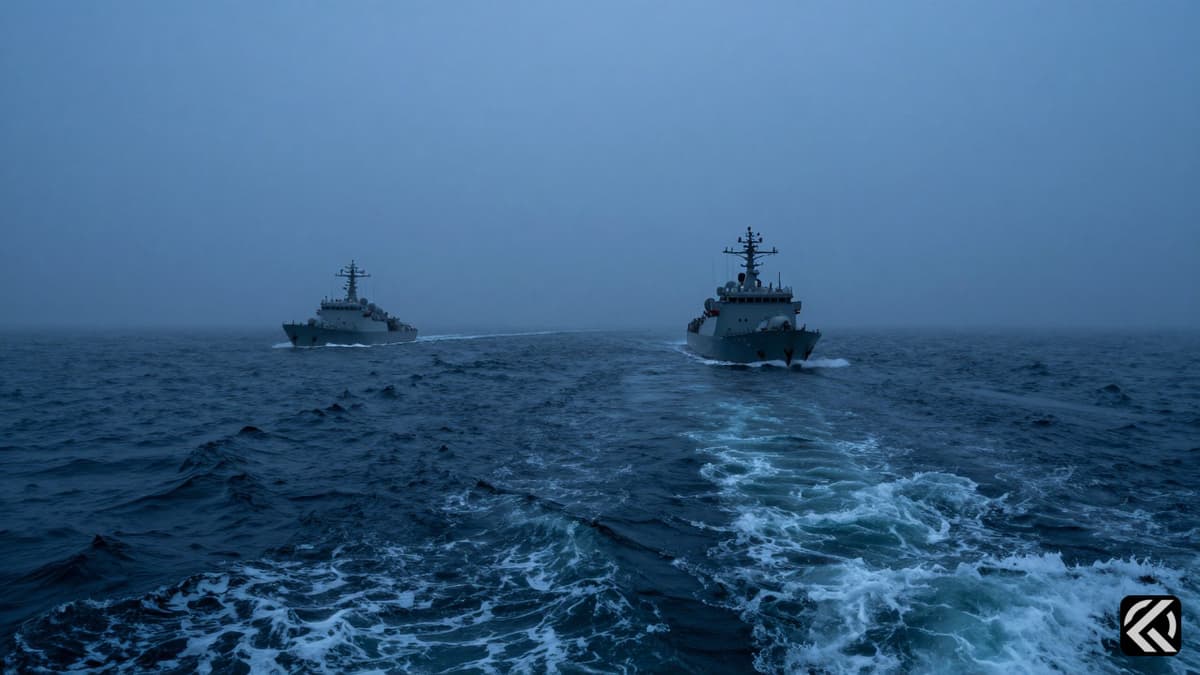
In response to these allegations, the US Central Command (Centcom) described the Iranian actions as "unprovoked." According to Centcom, Iranian forces launched multiple missiles, drones, and small boats as US Navy guided-missile destroyers were transiting through the strait. The US military stated that it responded with "self-defence strikes," eliminating inbound threats and targeting Iranian military facilities, including missile and drone launch sites, command and control locations, and intelligence nodes.
US President Donald Trump took to his social media platform, Truth Social, to address the developments. He described the destruction of multiple small boats with vivid imagery, noting they dropped "very much like a butterfly dropping to its grave." Trump asserted that "great damage" had been done to the Iranian attackers. However, his message carried a stern warning regarding the ongoing peace negotiations. He stated that if Iran does not sign a deal "FAST," the US will "knock them out a lot harder, and a lot more violently, in the future."
Iran’s top military command accused the US of a "violation of the ceasefire," stating that its forces responded immediately to the American aggression by attacking US military vessels and inflicting "significant damage." Despite the intensity of the skirmish, the US government maintains that it does not seek escalation but remains positioned to protect its forces. An Israeli source also clarified to the BBC that there was "no Israeli involvement" in the latest attacks, isolating the conflict between the two primary belligerents.
This flare-up occurs against a backdrop of fragile diplomatic efforts. The tensions arose just one day after Iran’s foreign ministry indicated it was considering a US proposal to end the war. US news outlet Axios reported that the White House believes it is closing in on a 14-point memorandum of understanding, which could establish a framework for more detailed nuclear negotiations. On Wednesday, an Iranian foreign ministry spokesman confirmed that the proposal was under consideration and that Tehran would share its views with Pakistani mediators.
Pakistan’s foreign minister expressed hope for a lasting resolution, stating that his country is "endeavouring to convert this ceasefire into a permanent end to this war." However, not all voices within Iran support the diplomatic track. A senior member of Iran's parliament dismissed the 14-point memorandum as a "wish list," undermining the credibility of the negotiations.
The diplomatic stalemate is further complicated by hardline rhetoric from both sides. On May 6, Trump wrote on Truth Social that if Iran did not agree to a deal, "the bombing starts, and it will be, sadly, at a much higher level and intensity than it was before." Responding to this threat, Ebrahim Rezaei, spokesperson for Iran's parliament's national security and foreign policy commission, posted on X that Iran "has its finger on the trigger." He warned that Iran would "deliver a harsh and regret-inducing response" if the US did not "surrender and grant necessary conditions."
Previous statements by Trump regarding the conflict, known as Operation Epic Fury, indicated that the initial US-Israeli offensive would end "assuming Iran agrees to give what has been agreed to." Prior to this, US Secretary of State Marco Rubio had declared the operation over and achieved its objectives. Trump also reiterated his claim that Iran had agreed to never possess a nuclear weapon, among other conditions. This claim remains unconfirmed by Tehran, with Iran’s nuclear program continuing to be a primary point of contention between the two nations.
The recent naval exchange in the Strait of Hormuz underscores the extreme fragility of the current ceasefire between the US and Iran. While both Donald Trump and Iranian officials publicly acknowledge the existence of a truce and ongoing negotiations, the immediate reality involves active military engagement and mutual accusations of violation. The dismissal of the 14-point memorandum by Iranian parliamentarians, combined with the threat of intensified bombing from the White House, suggests that the diplomatic framework is under severe stress. If the proposed deal is not secured rapidly, the region faces a high probability of escalation. The conflicting narratives regarding who fired first and the status of nuclear concessions indicate that the underlying trust required for a lasting peace is currently absent. The coming days will be critical, as the failure to sign a deal could trigger the violent escalation both sides have threatened, potentially drawing in regional actors and disrupting global energy supplies through this vital maritime chokepoint.
May 8, 2026 19:28 UTC
Iran Transforms Destroyed B1 Bridge Into Symbol of Resistance
Join 50,000+ readers getting the global briefing every morning.
No spam. Unsubscribe anytime.
May 9, 2026 01:12 UTC
Suvendu Adhikari to Assume Office as Bengal's 9th Chief Minister
May 8, 2026 21:27 UTC
Trump Orders Pentagon to Release First UFO Files
May 8, 2026 21:20 UTC
Trump Issues Veiled Nuclear Threat Amid US-Iran Tensions
May 8, 2026 19:28 UTC
Iran Transforms Destroyed B1 Bridge Into Symbol of Resistance


