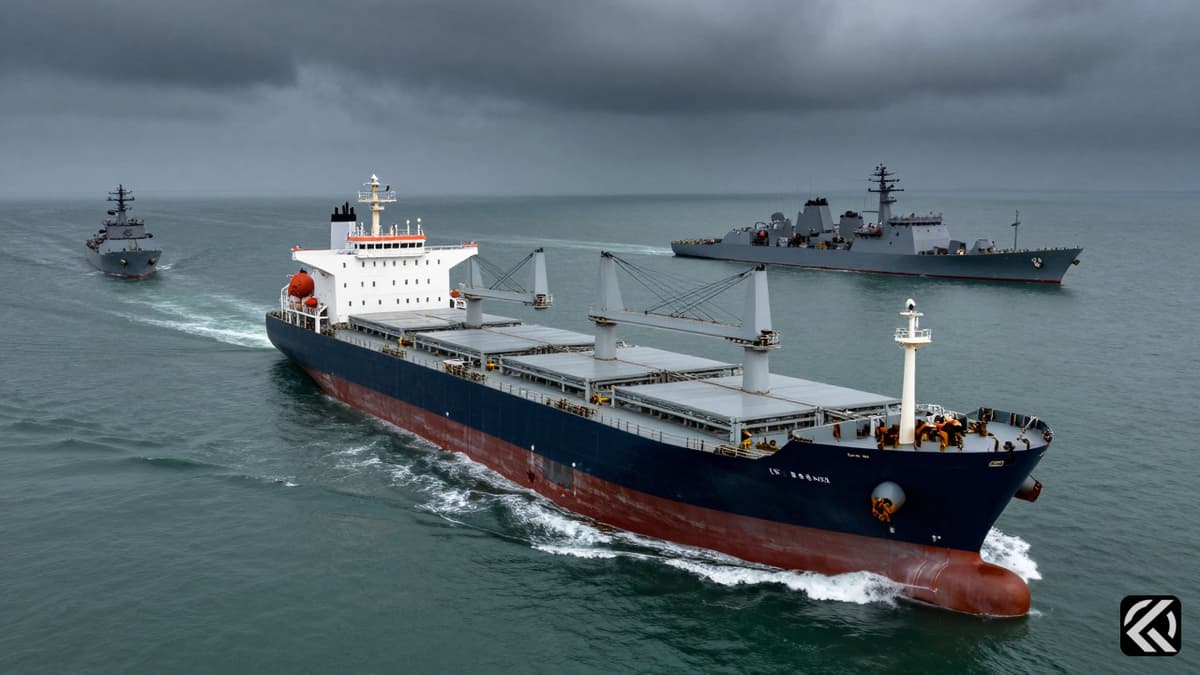
Tehran enforces strict new transit protocols, threatening naval action to cement dominance over the critical chokepoint, escalating global economic tensions.
Iran is forcing shippers to comply with a new protocol for transiting the Strait of Hormuz or risk attack. Tehran has laid out a set of new rules for vessels seeking to transit the strait, pressing ahead with efforts to formalize control in defiance of US warnings. Before the conflict began, the strait was free for any vessel to navigate. Since the US and Israeli campaign started, Iran has threatened to strike any ship passing without permission from the Islamic Revolutionary Guard Corps (IRGC) navy.
The move to set up an authority for the strait underscores Iran’s determination to cement control over what it sees as a spoil of war. Dominance of the waterway, through which one-fifth of the world’s oil and liquefied natural gas flows, would hand the Islamic Republic immense leverage over its neighbors and the global economy. The closure of the Strait of Hormuz unleashed the biggest oil supply shock in history, sending energy prices sharply higher. On Wednesday, US gas prices rose above $4.50 per gallon for the first time in four years.
On Wednesday, Supreme Leader Mojtaba Khamenei’s account on Telegram posted a message laying out his vision for the Persian Gulf. The leader called for a “new regional and global order under the strategy of a strong Iran” where there would be no place for foreigners “and their mischief.” He specifically pointed to “using the leverage of closing the strait” as one way to achieve that vision. At the end of April, a statement attributed to Khamenei indicated Iran would create the mechanism to supervise traffic at the waterway.
Iran would implement “new legal frameworks and management of the Strait of Hormuz,” the statement said, which would benefit its neighbors and prove economically fruitful. “Foreigners who come from thousands of kilometers away, acting maliciously out of greed, have no place there, except at the bottom of its waters,” it added.
The Strait of Hormuz Authority document now made available to shippers comprises more than 40 questions, requiring vessels to declare their name and identification number, any “previous name,” country of origin and destination. It also asks for the nationalities of the registered owners and operators and of the crew on board, plus details of the cargo. According to the PGSA, the information must be emailed to the authority before a vessel can transit the strait.
An email from PGSA shared with CNN includes a warning that “complete and accurate information is essential” to processing the vessel’s request to transit and that “further instructions will be communicated via email.” “Any incorrect or incomplete information provided will be the sole responsibility of the applicant, and any resulting consequences will be borne accordingly,” the email says. It’s unclear whether any shipping company has sought permission from the PGSA. Doing so could make them liable to US sanctions, according to analysts.
Iran has previously said it would deny passage through the waterway to vessels linked to the US or Israel, while other vessels may only transit with Iranian consent. India and Pakistan are among governments that have negotiated with Iran to secure passage of their flagged vessels. The Islamic Revolutionary Guard Corps (IRGC) uses an emergency radio communication frequency to warn shipping that it exercises control over the waterway.
The new requirements “look pretty similar to the questions we knew were already being asked of shipowners” by Iranian authorities, according to Richard Meade of maritime data analytics service Lloyd’s Intelligence. But this “formalizes the structure and appears to be a play by Iran to normalize its authority over transits.” It’s unclear from the document whether passage will incur a fee. Tehran has touted the strait as a potential revenue stream that could help rebuild the country after destruction caused by American and Israeli strikes. It is reportedly charging up to $2 million per vessel for passage.
Last week, the Treasury Department’s Office of Foreign Assets Control added guidance to its Frequently Asked Questions page clarifying that such payments would not be authorized for US persons or entities. “Payments to the government of Iran or the Islamic Revolutionary Guard Corps (IRGC), directly or indirectly, for safe passage through the Strait of Hormuz would not be authorized for US persons, including US financial institutions, or for US-owned or -controlled foreign entities,” it said.
The Iranians have made “demands for payments, payments for toll fees, as we say, for those vessels to be granted permission to sail,” said Dimitris Maniatis, CEO of maritime risk consultancy Marisks. Once they have permission, they sail with “a specific voyage plan … which always takes them through between the islands of Kashm and Larak,” close to the Iranian coast, Maniatis told CNN.
On Monday, the IRGC announced a new maritime control area that covered a large area to the west and east of the strait, stretching into the Gulf of Oman, according to a map issued with the announcement. Just as Iran seeks to exert control over the strait, the US naval blockade of shipping to and from Iranian ports continues. At the beginning of this week, US President Donald Trump announced the beginning of Project Freedom to assist vessels through the strait, only to pause it within 48 hours, at the request of Pakistani mediators.
The project did “add to the aggressive manner of the Iranians who want to control the strait,” according to Maniatis. Caught in the middle are as many as 20,000 seafarers on nearly 1,000 vessels trapped in the Persian Gulf, “with their crews in very difficult conditions, bearing all the consequences of a war that is expanding into something more regional,” says Maniatis. “Mariners are not soldiers. They are civilians who are piloting vessels, who are managing global trade. They should not be caught in a situation like this.”
Only 40 ships crossed the strait the entire week to May 3, according to Lloyd’s List. Pre-war traffic would see an average of 120 crossings a day. On Thursday, marine traffic data showed almost no tanker or freight traffic passing through the strait as Iran and the US contest the chokepoint. Analysts say any form of Iranian control would have long-term effects on oil flows through the strait.
“There is growing evidence that Iran may seek to retain strategic control of the strait for as long as possible. At the same time, the US may tolerate this outcome,” according to Matt Wright at Kpler, a marine intelligence firm. US officials have repeatedly said they wouldn’t accept Iranian control of the chokepoint. Wright estimates that should Tehran be able to control the waterway, transits would not exceed half of the pre-war average, with profound consequences for the global oil and gas markets.
Iran’s formalization of transit rules via the new authority signals a long-term effort to monetize and militarize the Strait of Hormuz. With transits dropping to negligible levels and payments demanded by the IRGC, the global supply chain faces sustained disruption. If Tehran retains this control, exports could remain at 40-50% of capacity, permanently altering geopolitical leverage and energy security dynamics for the foreseeable future.
May 7, 2026 17:24 UTC
Iran Enforces New Maritime Rules for Hormuz Transit
Join 50,000+ readers getting the global briefing every morning.
No spam. Unsubscribe anytime.
May 7, 2026 19:41 UTC
Court Rejects Hegseth’s Bid to Punish Kelly for Speech
May 7, 2026 17:29 UTC
Samrat Choudhary Becomes First BJP Chief Minister of Bihar
May 7, 2026 15:29 UTC
TVK Allies Urge Governor to Invite Vijay to Form Government
Rubio Meets Pope as Iran Weighs US War Proposal


