A major political shift in Bihar sees 32 new ministers take office, marking the end of Nitish Kumar’s long tenure and the start of a new alliance era.
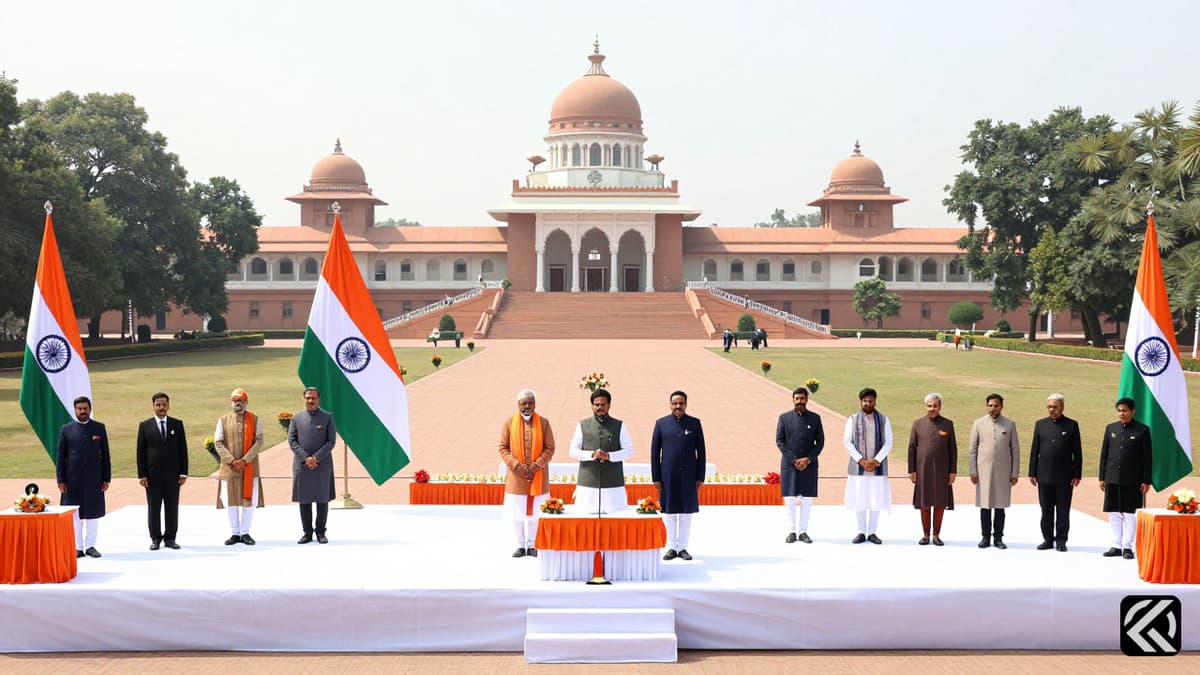
In a significant administrative transition for the state of Bihar, a total of 32 ministers were sworn in as part of the expanded government on Thursday, May 7, 2026. The swearing-in ceremony took place at the historic Gandhi Maidan, marking the formal establishment of the new council of ministers. These 32 officials, drawn from all constituents of the five-party National Democratic Alliance (NDA) operating within the state, took the oath of office under the administration of Governor Lt. Gen. (Retd.) Syed Ata Hasnain. This event signifies the consolidation of the current ruling coalition following recent political developments.
The formation of this new government follows a critical period of change initiated last month. The BJP-led government was established after Nitish Kumar, the supreme leader of the Janata Dal (United) or JD(U), resigned from his position as Chief Minister. Kumar’s resignation occurred immediately after he was elected to the Rajya Sabha, creating a vacancy that allowed for a shift in executive leadership. Following this resignation, Samrat Choudhary was appointed to lead the administration, becoming the first Bharatiya Janata Party (BJP) leader to head the government in Bihar’s history. This development effectively ends Nitish Kumar’s 21-year tenure at the helm of the State, a duration that has been characterized by Kumar’s significant influence over Bihar’s political narrative.
Samrat Choudhary was officially sworn in as the Chief Minister, presiding over a cabinet that includes both new inductees and experienced politicians from the existing coalition. Most of the newly sworn-in ministers had previously served in the Nitish Kumar Cabinet formed in November of the previous year, after the NDA returned to power in the Assembly elections. Among those who took the oath are prominent figures such as Nishant Kumar, who is the son of JD(U) supremo Nitish Kumar. Other notable inductees include Shrawon Kumar, Vijay Kumar Sinha, Dilip Kumar Jaiswal, Leshi Singh, Ram Kripal Yadav, Nitish Mishra, Damodar Rawat, Sanjay Singh (also known as Tiger), and Ashok Choudhary. Their inclusion reinforces the continuity of certain administrative strategies while introducing new faces to the executive branch.

The composition of the Bihar Cabinet reflects the diverse political partnerships that constitute the NDA alliance in the state. The JD(U) retains a substantial presence within the new government, holding a total of 15 ministerial positions. Within this party, Vijay Kumar Choudhary and Bijendra Prasad Yadav have been appointed as Deputy Chief Ministers, highlighting the party’s continued influence in the leadership structure despite Nitish Kumar’s transition to the Rajya Sabha. Additionally, Sanjay Kumar Singh and Sanjay Kumar Paswan, representing the Lok Janshakti Party (Ram Vilas), were inducted into the Cabinet. The Lok Janshakti Party is led by Union Minister Chirag Paswan, indicating the deep integration of Union-level leadership with state-level administration.
Further strengthening the coalition, sons of key Union Ministers were also inducted. Santosh Kumar Suman, the son of Jitan Ram Manjhi, who leads the Hindustani Awam Morcha (Secular), and Deepak Prakash, the son of Upendra Kushwaha of the Rashtriya Lok Morcha (RLM), returned to the government. This move underscores the dynastic and alliance-based nature of the current political configuration. The full roster of the newly inducted ministers illustrates the breadth of support for the Choudhary administration across multiple regional and national parties.
The detailed breakdown of the new council reveals the distribution of power among the allied parties. As Chief Minister, Samrat Choudhary (BJP) leads the government, supported by Deputy Chief Ministers Vijay Kumar Choudhary and Bijendra Prasad Yadav, both from the JD(U). The BJP section of the cabinet includes Ram Kripal Yadav, Kedar Gupta, Nitish Mishra, Mithlesh Tiwari, Rama Nishad, Vijay Kumar Sinha, Dilip Jaiswal, Pramod Chandravanshi, Lakhvinder Paswan, Sanjay Singh Tiger, Engineer Kumar Shailendra, Nand Kishore Ram, Ramchandra Prasad, Arun Shankar Prasad, and Shreyasi Singh. This significant number of BJP appointees marks a decisive turn in the state's administrative direction.
In the JD(U) segment, the inducted ministers include Nishant Kumar, Shravan Kumar, Madan Sahni, Lesi Singh, Shweta Gupta, Bhagwan Singh Kushwaha, Damodar Rawat, Bulo Mandal, Sunil Kumar, Sheila Mandal, Ratnesh Sada, Jama Khan, and Ashok Choudhary. The presence of Nishant Kumar among the ministerial inductees is particularly notable, as it represents a generational shift within the Kumar political family’s involvement in active governance, complementing his father’s role in the Rajya Sabha. The Lok Janshakti Party (Ram Vilas) is represented by Sanjay Kumar Paswan and Sanjay Kumar Singh. The Hindustani Awam Morcha (Secular) is represented by Santosh Kumar Suman, and the Rashtriya Lok Morcha (RLM) by Deepak Prakash.
The swearing-in of 32 ministers across five allied parties consolidates the political foundation of the new administration, ensuring stability following the leadership transition. With Samrat Choudhary firmly established as the first BJP Chief Minister and key allies like the JD(U) and Lok Janshakti Party securing Deputy Chief Minister roles and ministerial portfolios, the coalition appears unified. The inclusion of sons of prominent national leaders like Nishant Kumar, Santosh Kumar Suman, and Deepak Prakash suggests a strategy to integrate the next generation of political dynasties into the state machinery. This broad-based cabinet, drawing from the NDA’s full spectrum, aims to manage diverse regional interests while implementing the BJP’s agenda in Bihar. The long-term impact may involve a shift in policy priorities away from the previous 21-year era, potentially focusing on new infrastructure and governance models aligned with the central government’s influence, while maintaining coalition harmony among diverse partners.
May 7, 2026 17:24 UTC
Iran Enforces New Maritime Rules for Hormuz Transit
Join 50,000+ readers getting the global briefing every morning.
No spam. Unsubscribe anytime.
May 7, 2026 19:41 UTC
Court Rejects Hegseth’s Bid to Punish Kelly for Speech
May 7, 2026 17:24 UTC
Iran Enforces New Maritime Rules for Hormuz Transit
May 7, 2026 15:29 UTC
TVK Allies Urge Governor to Invite Vijay to Form Government
Rubio Meets Pope as Iran Weighs US War Proposal