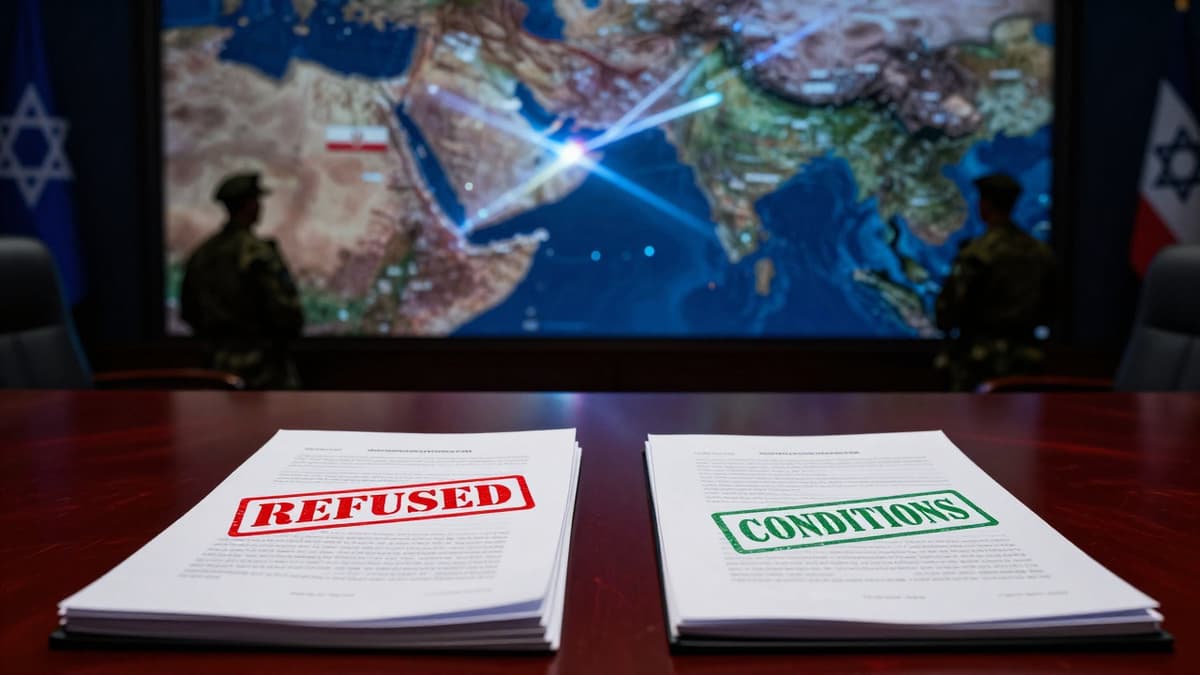
Iran has firmly dismissed a U.S. peace proposal on Wednesday, setting its own stringent conditions while missile exchanges with Israel continue to intensify across the region.
On Wednesday, March 25, 2026, Iran officially dismissed a United States proposal aimed at ending the ongoing Iran-Israel war, simultaneously establishing its own rigid conditions for a peace settlement. This rejection occurred even as the two nations continued to trade heavy fire, signaling that diplomatic channels have not yet bridged the widening gap between the conflicting parties.
The proposed U.S. initiative, reportedly delivered to Tehran by Pakistani officials, sought a ceasefire in exchange for Tehran abandoning its Iran nuclear programme and reopening the strategically vital Strait of Hormuz. It also requested limitations on missile capabilities and a halt to support for non-state militias. However, a senior security official, speaking to state-run Press TV, characterized these demands as "excessive" and "disconnected from reality," asserting that the war would only end when Iran decides it is necessary and its terms are fully satisfied.
Iran has laid out five specific prerequisites for ending the hostilities that began on February 28 following the assassination of Supreme Leader Ayatollah Ali Khamenei. The Iranian demands include a complete cessation of aggression and assassinations, the establishment of "concrete mechanisms" to prevent future attacks, full payment for war damages and reparations, a total end to fighting on all fronts, and international recognition of Tehran's sovereignty over the Strait of Hormuz, which it declares its "natural and legal right."
While the U.S. and Iran offered contradictory accounts of ongoing negotiations, the conflict on the ground has escalated rather than de-escalated. The Israel Defence Forces (IDF) announced that it targeted Iran's "sole facility" for submarine development and various weapons manufacturing sites in Isfahan, alongside Iranian air defence systems. Defence Minister Israel Katz stated that Israel has dropped more than 15,000 bombs across Iran since the war began. In retaliation, Iran's Islamic Revolutionary Guard Corps (IRGC) launched missiles at central and northern Israel, as well as U.S. military bases in the Persian Gulf region.
The U.S. President, Donald Trump, had previously hinted at a diplomatic breakthrough, claiming on March 24 that Iran had offered him a "very big present" and expressing optimism that the war would end. He noted that he was dealing with "the right people" and had postponed threatened strikes against Iran's power infrastructure. However, reports indicate the Pentagon is simultaneously planning to deploy thousands of troops from the elite 82nd Airborne Division to West Asia, a move that Iran's Parliament Speaker, Mohammad-Bagher Ghalibaf, warned against. Ghalibaf stated that while generals can break things, soldiers cannot fix them, and warned that Netanyahu's "delusions" would only lead to further casualties if tested.
Iran's Khatam al-Anbiya Central Headquarters publicly rejected reports of constructive talks, framing the U.S. narrative as a desperate attempt to reframe a loss as a diplomatic agreement. Spokesperson Lt. Col. Ebrahim Zolfaqari sarcastically asked if the U.S., which calls itself a "superpower," had reached a point of internal infighting that required negotiating with itself. He urged against calling their "defeat" an agreement, emphasizing that if the U.S. could have escaped the current predicament independently, it would have done so already.
The 2026 ceasefire terms offered by the U.S. have been met with stonewalling from Tehran, which insists on reparations and sovereignty recognition. As the war continues, the strategic situation remains volatile, with Iran firing at least 13 salvos of missiles at Israel, resulting in injuries to nine civilians, and U.S. bases in Kuwait, Jordan, and Bahrain being struck by precision missiles and drones.
The current stalemate reveals a deep divergence in objectives: the U.S. seeks to roll back Iran's nuclear capabilities and secure the Strait of Hormuz, while Iran demands the cessation of all aggression, financial reparations for the death of its Supreme Leader, and absolute sovereignty over key waterways. With both sides accusing the other of unrealistic expectations and the U.S. considering further troop deployments, the likelihood of an immediate resolution remains low. The conflict appears poised to expand further into a broader regional confrontation unless Iran's conditions are met or a significant shift in the military balance occurs. The continued exchange of fire suggests that without a fundamental change in the diplomatic approach, the war will likely persist with escalating intensity.
May 9, 2026 21:40 UTC
Russia Cuts Heavy Armor From Victory Day Parade Amid War
Join 50,000+ readers getting the global briefing every morning.
No spam. Unsubscribe anytime.
May 10, 2026 05:02 UTC
MV Hondius Arrives in Tenerife Amid Hantavirus Outbreak
May 10, 2026 03:02 UTC
Vijay Takes Oath, Ending Dravidian Party Era in Tamil Nadu
May 10, 2026 01:28 UTC
Nine TVK Leaders Join C. Joseph Vijay as Tamil Nadu Ministers
May 9, 2026 23:27 UTC
India’s Strategic Leap: Agni-5 with MIRV Trial Success


