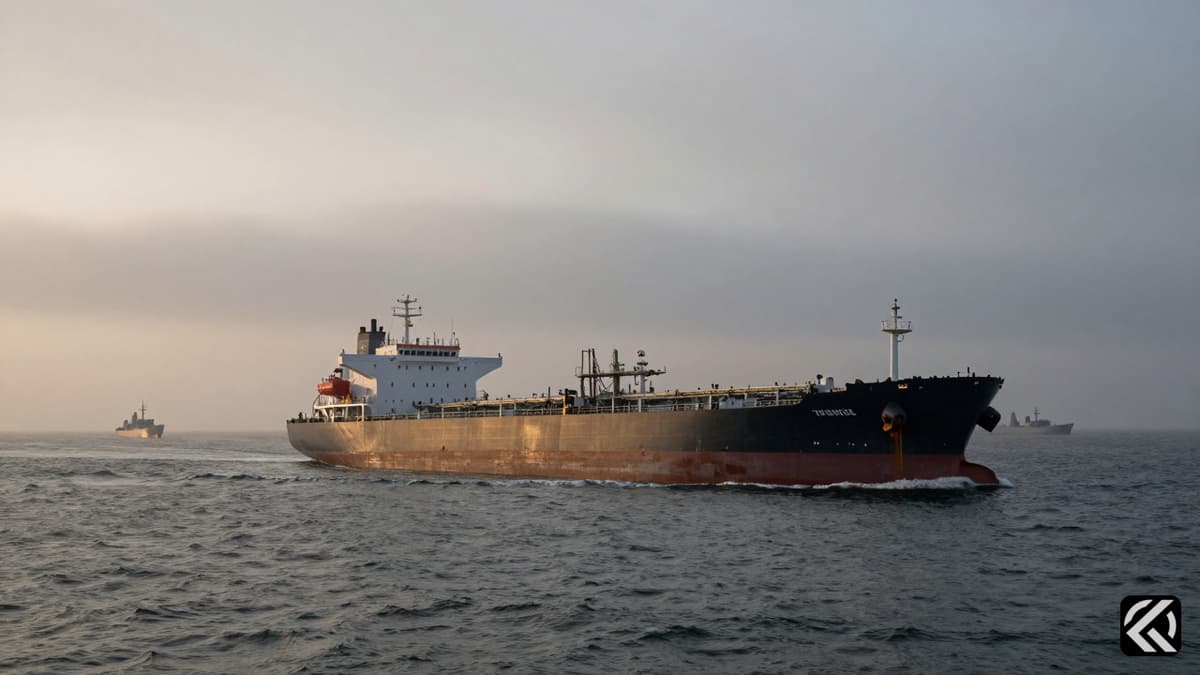
Tensions escalate as Iran maintains its naval blockade of the Strait of Hormuz during fragile US-Iran ceasefire talks, sending oil prices soaring and global markets reeling from uncertainty.
The geopolitical landscape shifted dramatically this week as Iran reaffirmed its refusal to reopen the Strait of Hormuz, contingent upon the lifting of the ongoing US naval blockade. This stance complicates fragile diplomatic efforts, as US-Iran ceasefire talks in Pakistan appear increasingly distant despite the extension of a temporary truce. The standoff has triggered immediate economic repercussions, with global markets reacting to the uncertainty and the potential for prolonged regional instability.
In a move that intensified existing tensions, Iran announced the seizure of two ships attempting to cross the strategic waterway and fired upon a third. This action occurred on Wednesday, April 22, 2026, just a day after US President Donald Trump extended the ceasefire to allow more time for Pakistani-brokered negotiations. While the White House stated that these seizures did not violate the ceasefire terms, Iranian officials, including Parliament Speaker Mohammad Bagher Ghalibaf, argued that a complete ceasefire is meaningless if it is not honored through the end of the naval blockade. Ghalibaf, who led Tehran’s delegation in the first round of talks in Islamabad, declared that reopening the strait was impossible amid what Tehran viewed as a blatant violation of the truce.
The economic fallout from the standoff was immediate and severe. On Thursday, April 23, 2026, Asian stocks fell and oil prices rose sharply. Crude prices jumped as much as four percent in early Asian business after global security monitors and Iran’s Revolutionary Guards confirmed the seizure of the vessels. The price of Brent crude oil, the international standard, nosed over $100 per barrel, marking a 35% increase from prewar levels. This oil price surge has sent gas prices skyrocketing far beyond the Middle East region, raising the cost of food and a wide array of other products globally.
The European Union’s impact has been particularly acute. Dan Jørgensen, the European Union energy commissioner, warned of lasting impacts for consumers and businesses, likening the current disruption to other major energy crises over the last half-century. He stated that the disruption is costing Europe around 500 million euros ($600 million) each day. Despite these alarming figures, stock markets have so far appeared to shrug off the immediate price spikes, though the potential for long-term instability remains high.
Diplomatic channels are struggling to bridge the gap between the conflicting narratives of Washington and Tehran. A second round of talks between Israel and Lebanon was set to start on Thursday in Washington, aimed at extending a fragile 10-day ceasefire that began last week. However, prospects for broader regional de-escalation seem dubious as the Islamic Republic accused the Americans of a “lack of good faith” in negotiations.
Israel’s involvement in the broader conflict continues to be a flashpoint. In southern Lebanon, three separate Israeli strikes killed at least six people and wounded others, according to local authorities. Israel denied carrying out one of the strikes and did not immediately comment on the others. These attacks occurred as Israeli and Lebanese ambassadors prepared for a new meeting in Washington, highlighting the interconnected nature of the regional conflicts.
Meanwhile, the Trump administration has reportedly developed a “naughty and nice” list categorizing NATO allies according to their contributions. This initiative, viewed as an effort to reward or penalize nations based on their support for the US military engagement with Iran, was prepared in anticipation of NATO Secretary General Mark Rutte’s diplomatic visit to Washington DC. A European diplomat informed Politico that the initiative appears to be an expansion of a concept introduced by US Secretary of War Pete Hegseth in December.
The standoff between the US and Iran has effectively choked off nearly all exports through the strait, a critical artery where 20% of the world’s traded oil passes in peacetime. With no end in sight, Iranian media reported that the paramilitary Revolutionary Guard was bringing the two seized ships to Iran, marking a further escalation. U.S. Central Command (CENTCOM) said late Wednesday, April 22, 2026, that it had also “directed 31 vessels to turn around or return to port” as part of its own “blockade against Iran”.
Iran’s position remains firm. The Islamic Republic’s vow not to reopen the Strait of Hormuz so long as a US naval blockade remained in place was held into Thursday, despite the ceasefire extension. As the clock ticked for a return to war that has engulfed the region, Iran said it welcomed the efforts by Pakistan but made no other comment on Mr. Trump’s announcement. The refusal to engage in full diplomatic normalization while maintaining military pressure suggests that the current truce is merely a pause rather than a resolution.
Amidst the geopolitical turmoil, Iran has also taken internal measures to assert its sovereignty and punish perceived enemies. Iran executed a man convicted of links to both the exiled Opposition group Mujahideen-e-Khalq and Israel’s intelligence service, the judiciary’s news outlet Mizan reported on Thursday, April 23, 2026. Mizan identified the man as Soltanali Shirzadi Fakhr, saying he had been a long-time member of the MEK and was found guilty of cooperating with Israeli intelligence. His death sentence was upheld by the Supreme Court and carried out after legal procedures were completed, signaling Tehran’s determination to suppress internal dissent even as it confronts external pressures.
The combination of military posturing, diplomatic stalemate, and economic disruption creates a volatile environment with no clear path to de-escalation. The world watches closely as the Strait of Hormuz remains a focal point of conflict, with the potential for further escalation threatening global energy security and economic stability. The coming weeks will be critical in determining whether the current ceasefire holds or gives way to a broader conflict.
The current stalemate in the Strait of Hormuz, coupled with the failure of US-Iran ceasefire talks to produce immediate diplomatic breakthroughs, points to a prolonged period of heightened tension. As oil prices continue to climb and global supply chains face disruption, the economic pressure on consumer nations will likely intensify diplomatic efforts, but only if both sides are willing to compromise on core demands. If the naval blockade persists without reciprocal concessions from Tehran, the risk of a full-scale regional war will remain critically high, with severe long-term consequences for global energy markets and international relations.
Jun 8, 2026 00:51 UTC
Trump Claims Iran Nuclear Deal Imminent Despite Diplomatic Fractures
Jun 8, 2026 00:47 UTC
Iran Fires Missiles at Israel After Beirut Strike
Jun 7, 2026 22:00 UTC
US, Iran Peace Hops Fade 100 Days Into War
Jun 7, 2026 20:57 UTC
Iran Strikes Israel: IRGC Promises Week of Continuous Offensive
Jun 8, 2026 02:28 UTC
Trump Walks Out of Meet the Press After Rejecting Evidence Demands


