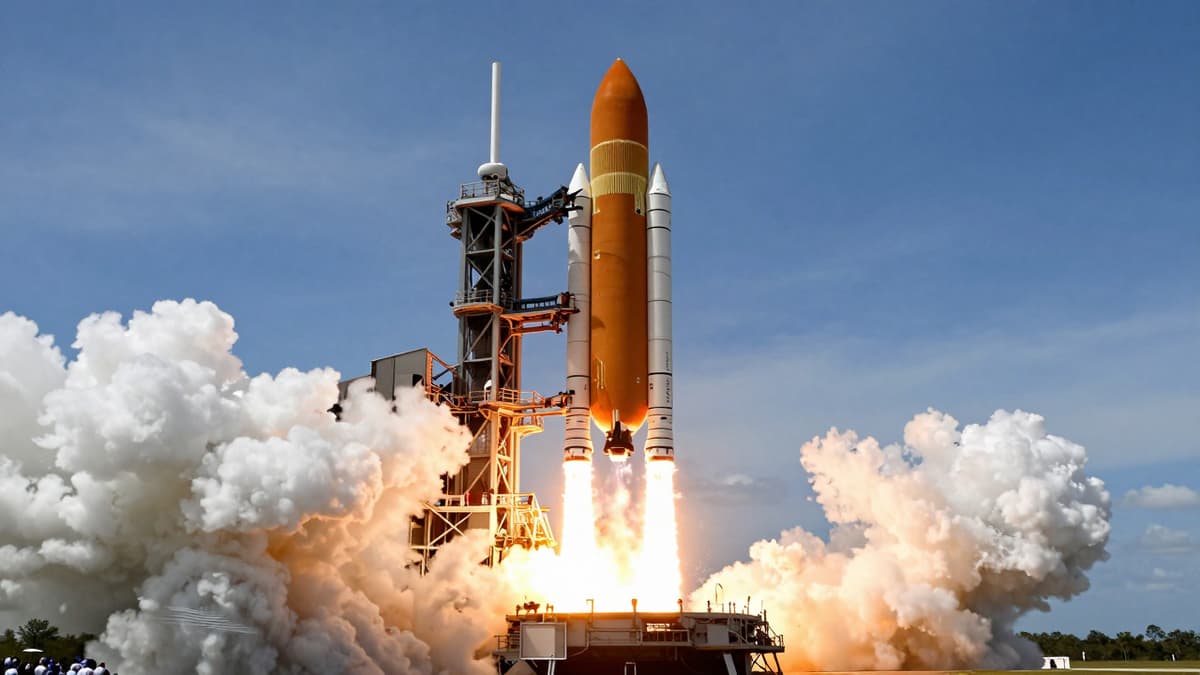
A historic moment unfolds as four astronauts blast off on the Artemis II mission, marking the first crewed lunar journey in half a century.
Four astronauts blasted off aboard a massive NASA rocket on Wednesday, April 1, 2026, on a long-anticipated journey around the Moon. This event marks the first crewed lunar flyby in more than 50 years, signaling a new era for space exploration.
With an intense roar that reverberated far beyond the launchpad, the enormous orange-and-white rocket carried three Americans and one Canadian away from Florida's Kennedy Space Centre at approximately 6:35 p.m. local time. The mission, identified as Artemis II, uses the powerful Space Launch System (SLS) rocket and the crew capsule is called Orion. An AFP journalist onsite described the scene, noting the scale of the operation and the emotional weight of the moment.
The trajectory is set to take the crew on a free-return path around the far side of the moon. They will reach a distance of around 7,500 km from the moon's surface before the earth's gravity pulls them back. The entire journey is designed to last a little over a week, culminating in a splashdown in the Pacific Ocean. During the launch, the excitement was palpable, with a spectator yelling, "We're going to the Moon!"
Read: Artemis II, the international space race, and what is at stake for the U.S.
The mission does not plan to land on the moon. Instead, NASA is flying it to prove that the whole system - from the ground teams to the rocket and its crew - works as designed. This is a crucial validation step. The processes to land humans on the moon are ready only if this specific mission succeeds, ensuring the safety and functionality of the technology.
The core of this mission relies on the Space Launch System, an engine of immense power designed to push the far beyond low Earth orbit. The SLS will propel Orion into a free-return trajectory, a safe path that allows the spacecraft to circle the moon and return to Earth without needing complex engine maneuvers during the outbound leg. This trajectory is critical for the safety of the crew during the flyby, ensuring that if any major system failure occurs, Earth's gravity can pull the spacecraft back naturally.

The Orion spacecraft, carrying the three American and one Canadian astronauts, represents the next generation of human spaceflight vehicles. It is designed to sustain a crew for days in deep space, providing life support and protection from radiation. The launch from Kennedy Space Centre in Florida places the crew on a path that takes them 7,500 km from the lunar surface. This distance allows for a close approach where the astronauts can witness the far side of the moon, a region that has never been seen by a human crew before.
The historical significance cannot be overstated. For more than 50 years, no crewed mission has flown to the Moon. This gap in history makes the Artemis II mission a pivotal moment. It is not just about reaching a destination; it is about proving that the United States and its international partners can send humans safely to deep space and return them home. The mission serves as a comprehensive test of the entire ecosystem required for lunar landings. From the ground teams managing the launch to the rocket's propulsion and the crew's survival, every component must function perfectly.
The success of this mission will validate the processes necessary for future landings. If the Space Launch System and Orion perform as designed during this flyby, the path will be clear for subsequent missions to attempt landing on the lunar surface. This is the foundational step. Without this proof, no landing can proceed safely. The mission is a rigorous test of engineering, logistics, and human endurance.
As the Orion spacecraft embarks on this journey, it faces the unique challenges of deep space travel. The crew will spend a little over a week away from Earth, enduring the silence and vastness of space. The capsule must maintain its integrity while orbiting the far side of the moon, a region that blocks direct communication with Earth for periods of time. Ground teams must rely on automated systems and pre-planned protocols to manage the spacecraft during these blackout periods.
The return to Earth is equally critical. The trajectory is designed to bring the spacecraft back to the Pacific Ocean for a splashdown. This landing method is a proven technique for returning astronauts from deep space missions. It requires precise navigation to ensure the capsule enters the atmosphere at the correct angle and speed, minimizing the stress on the structure and the crew.
The presence of an international crew, including one Canadian astronaut, highlights the collaborative nature of modern space exploration. The mission demonstrates that the United States can work seamlessly with international partners to achieve ambitious goals. The joint effort underscores the shared desire to expand human presence beyond our planet.
The immediate response to the launch was one of jubilation. Spectators at Kennedy Space Centre celebrated the historic moment, with cheers echoing as the rocket ascended. The intense roar of the engines signaled the beginning of a journey that could change the trajectory of human history. The mission is a testament to decades of planning, engineering, and dedication.
The Artemis II mission launches a new chapter in space exploration, focusing on the validation of the entire system. The mission does not involve landing on the Moon, but the knowledge gained is essential for that future goal. By proving that the Space Launch System and the Orion spacecraft work together as designed, NASA ensures that the processes for landing humans are ready.
If this mission succeeds, the next logical step will be to plan a landing. The data collected on crew health, vehicle performance, and system reliability will inform the designs of future lunar landers and habitats. The success of this flyby will likely trigger the authorization of subsequent missions that will attempt to set foot on the lunar surface.
The long-term impact of this mission extends beyond just the United States. It re-establishes the nation's leadership in space exploration and sets a precedent for international cooperation. The return to the Moon after a half-century gap is a powerful symbol of human ingenuity and the relentless pursuit of knowledge.
The Artemis II mission marks a definitive turning point in human spaceflight. By successfully launching four astronauts on a journey around the Moon, the United States has validated the core technologies required for deep space exploration. The Space Launch System proved its capability to propel the Orion spacecraft on a complex trajectory, while the crew demonstrated the resilience needed for extended space travel.
Looking ahead, the success of this mission will likely accelerate plans for lunar landings. The data gathered will be instrumental in refining the systems used for future missions. As the crew returns to Earth via the Pacific Ocean, the legacy of Artemis II will be the confirmation that human beings can travel to and from the Moon safely. This milestone paves the way for sustained presence on the lunar surface, transforming the Moon from a distant destination into a reachable outpost for future generations.
Jun 8, 2026 02:17 UTC
Magnitude 7.8 Quake Shakes Philippines, Urging Immediate Evacuations
Join 50,000+ readers getting the global briefing every morning.
No spam. Unsubscribe anytime.
Jun 8, 2026 02:17 UTC
Magnitude 7.8 Quake Shakes Philippines, Urging Immediate Evacuations
Jun 8, 2026 00:51 UTC
Trump Claims Iran Nuclear Deal Imminent Despite Diplomatic Fractures
Jun 8, 2026 00:47 UTC
Iran Fires Missiles at Israel After Beirut Strike
Jun 7, 2026 22:38 UTC
Congress Party Claims Unity for INDIA Bloc Delhi Meeting