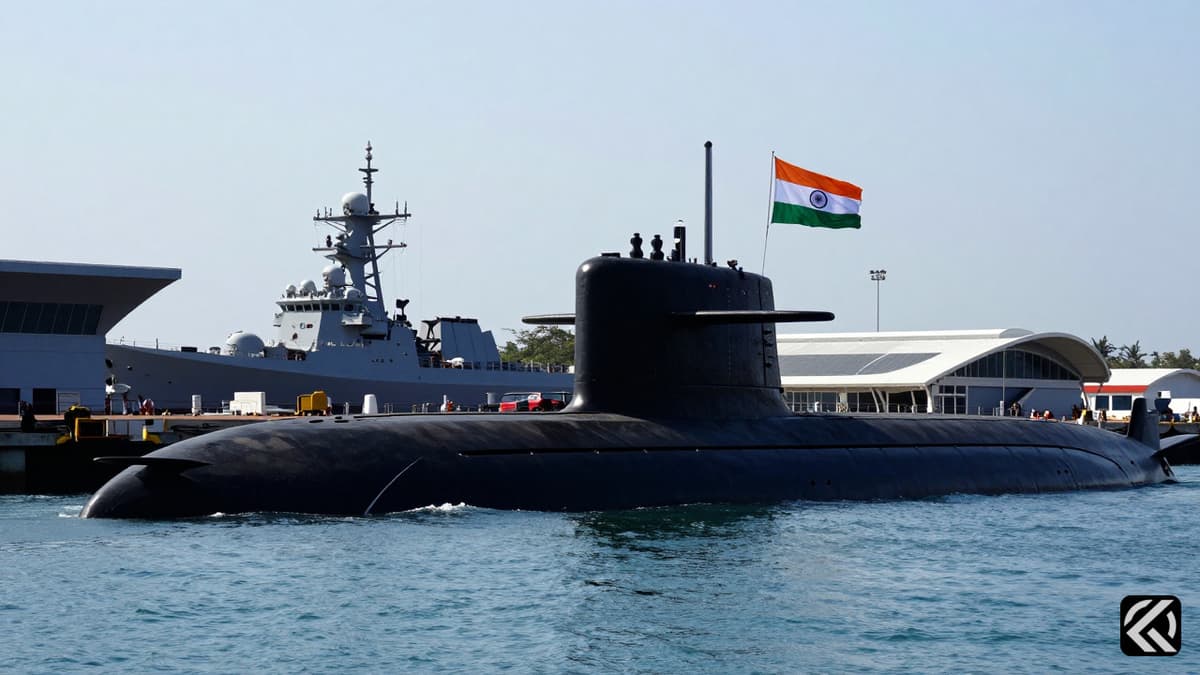
India has quietly added its third nuclear deterrent with the commissioning of the INS Aridhaman, a powerful new submarine designed to carry advanced ballistic missiles for national security.
Defence Minister Rajnath Singh formally commissioned the country's third nuclear submarine, INS Aridhaman (S4), at Visakhapatnam on April 3. This event marks a significant expansion of the nation's strategic defense capabilities. The ceremony was brief and kept under wraps, yet the minister acknowledged the launch through a cryptic social media post.
The commissioning was executed quietly, with sources indicating the event was not made public until the minister dropped hints. Despite the secrecy, the strategic importance was clear. Mr. Singh described the vessel on the social media platform X as "It's not words but power, 'Aridhaman'!" This subtle acknowledgment confirmed the vessel's induction into the fleet while maintaining operational security protocols.
The vessel, classified as a Submersible Ship Ballistic Nuclear (SSBN), falls under the domain of the Strategic Forces. It is a critical component of the country's nuclear triad, which includes the ability to launch nuclear-tipped missiles from air, land, and sea. India now joins an elite group of nations, alongside the U.S., Russia, China, and France, possessing this comprehensive deterrent capability.
While the first Arihant-class submarine was launched in July 2009 and quietly commissioned in 2016, and the second, INS Arighaat, was commissioned in August 2024, the third vessel represents a technological leap. INS Aridhaman and its successor, S4 (potentially named Arisudan), are distinct from their predecessors due to their increased size. While the initial boats were approximately 6,000 tonnes, these newer vessels displace about 7,000 tonnes.
This increase in displacement allows for a significantly larger payload of strategic weaponry. Compared to the earlier models, INS Aridhaman will carry up to 24 K-15 Sagarika missiles, eight K-4 missiles, or K-5 missiles, which are capable of being nuclear-tipped. This is a substantial upgrade from the Arihant and Arighaat, which can carry about twelve K-15 Sagarika missiles or four K-4 missiles.
The K-4 missiles, developed specifically for this platform, boast a range of approximately 3,500 km. These are nuclear-capable submarine-launched ballistic missiles (SLBMs) designed to extend the reach of India's deterrent force. The inclusion of these advanced munitions on the larger hull of the Arihant-class SSBN ensures a more flexible and potent deterrent posture against potential threats.
The project, initially known as the Advanced Technology Vessel (ATV), is being executed by the Ship Building Centre (SBC) in Visakhapatnam, where the commissioning ceremony took place. The submarine had already undergone extensive sea trials prior to the event. Navy Chief Admiral Dinesh Tripathi had previously indicated in December that the vessel was in its final stages of trials and ready for commissioning, a timeline that the April 3 event confirmed.
The commissioning of INS Aridhaman coincided with Defence Minister Singh's presence in Visakhapatnam for a separate but related event: the commissioning of the stealth guided-missile frigate INS Taragiri. This dual focus highlights the broader modernization drive within the Indian Navy. The Navy sources noted that the commissioning of INS Aridhaman was on the cards as soon as the sea trials were successfully concluded, ensuring the vessel was operationally ready before its formal induction.
Looking beyond the current fleet, the Indian Navy is planning to indigenously build a few SSNs, or nuclear-powered attack submarines. At least two of these new vessels are expected to be commissioned between 2036 and 2039. This long-term plan indicates a sustained commitment to maintaining and expanding the nuclear triad. The Arihant-class program continues to evolve, with the current INS Aridhaman representing a critical intermediate step toward a fully robust undersea nuclear deterrent.
The quiet nature of the ceremony reflects the sensitive nature of nuclear assets. The Arihant-class SSBN program remains one of the most closely guarded projects in the country. By successfully commissioning the third boat, India reinforces its status as a nuclear power with a credible second-strike capability. The ability to carry up to 24 K-15 missiles or eight K-4 missiles from a submerged platform ensures that the deterrent remains hidden and effective, a cornerstone of national security strategy.
As the vessel enters service, it solidifies the nation's strategic footprint in the region. The successful transition from the 6,000-tonne models to the 7,000-tonne INS Aridhaman and its future counterpart, S4*, demonstrates a maturation in indigenous submarine design. The K-4 missiles and the K-5 potential further enhance this capability, ensuring that the underwater leg of the nuclear triad remains formidable. With the S4* currently undergoing sea trials, the pipeline for future submarines remains active, promising continued strengthening of the fleet.
The commissioning of the INS Aridhaman marks a pivotal moment in India's defense trajectory, transitioning the nation's nuclear capabilities from a developing framework to a mature, multi-tiered system. With the vessel now active, the Indian Navy possesses a highly mobile, hidden, and potent deterrent capable of projecting power across vast distances using advanced K-4 missiles. This development, combined with the upcoming construction of SSNs, suggests a future where India's naval dominance and strategic autonomy are significantly entrenched, reducing reliance on external threats and ensuring a stable deterrence posture against regional and global challenges.
Jun 8, 2026 00:51 UTC
Trump Claims Iran Nuclear Deal Imminent Despite Diplomatic Fractures
Jun 8, 2026 00:47 UTC
Iran Fires Missiles at Israel After Beirut Strike
Jun 7, 2026 22:00 UTC
US, Iran Peace Hops Fade 100 Days Into War
Jun 7, 2026 20:57 UTC
Iran Strikes Israel: IRGC Promises Week of Continuous Offensive
Jun 8, 2026 02:28 UTC
Trump Walks Out of Meet the Press After Rejecting Evidence Demands


