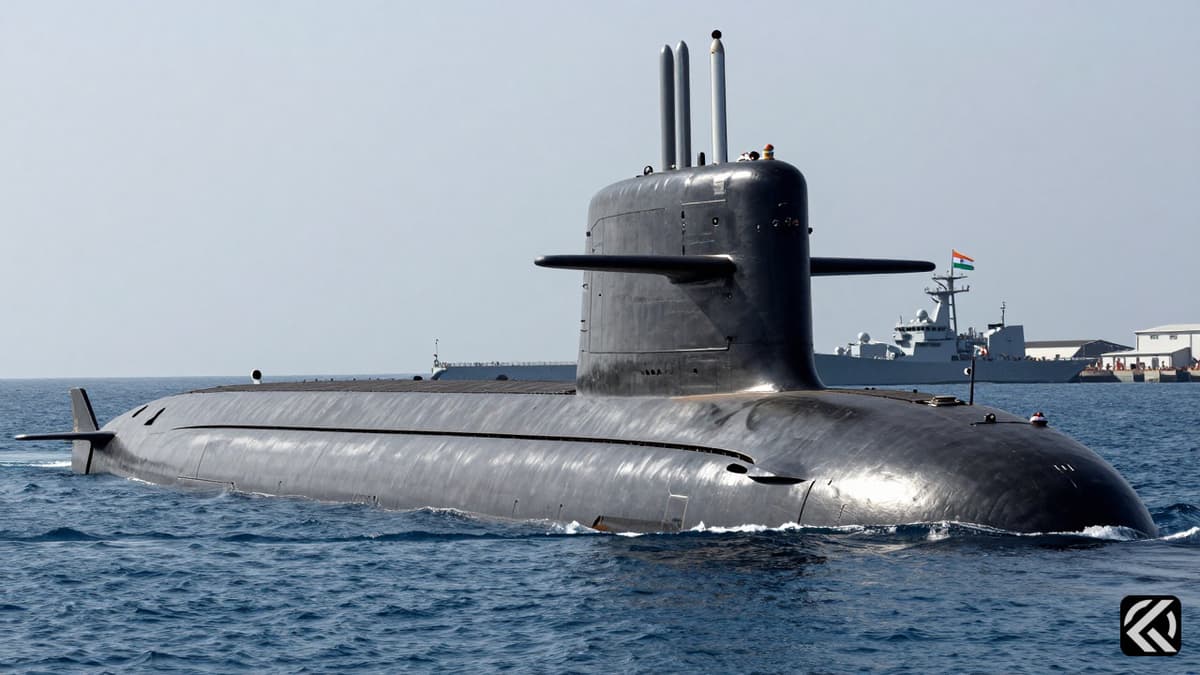
India significantly bolsters its maritime deterrent with the formal commissioning of the advanced INS Aridhaman submarine at Visakhapatnam, a move quietly executed by the Defence Minister to enhance strategic power.
The Defence Minister, Rajnath Singh, presided over a brief yet historic ceremony to formally commission the country's third nuclear submarine, INS Aridhaman (S4). The event took place on Friday, April 3, 2026, at the Ship Building Centre in Visakhapatnam. This strategic vessel, part of the Arihant-class of Submersible Ship Ballistic Nuclear (SSBNs), was officially integrated into the naval fleet, marking a critical milestone in India's defense capabilities.
While the event was kept under wraps, with sources indicating the commissioning was carried out quietly, the Defence Minister acknowledged the development through a cryptic social media message. He posted on 'X', stating, "It's not words but power, 'Aridhaman'!" This subtle yet powerful confirmation coincided with his visit to Visakhapatnam, where he was also present for the commissioning of the stealth guided-missile frigate INS Taragiri.
The commissioning of INS Aridhaman was widely anticipated by the Navy, as the submarine had already completed extensive sea trials. The vessel falls under the domain of the Strategic Forces and forms a crucial component of the country's nuclear triad. This triad enables India to launch nuclear-tipped missiles from air, land, and sea, a capability currently shared only by the U.S., Russia, China, and France.
The project, initially launched as the Advanced Technology Vessel (ATV) project, is executed by the Ship Building Centre in Visakhapatnam. The first boat of this class was launched in July 2009 and quietly commissioned in 2016. The second indigenously built SSBN, INS Arighaat, was commissioned in August 2024. While the first two vessels, Arihant and Arighaat, are smaller units of about 6,000 tonnes, INS Aridhaman and its successor, the S4*, are significantly larger, weighing approximately 7,000 tonnes.
In terms of offensive capability, INS Aridhaman represents a substantial upgrade over its predecessors. Compared to Arihant and Arighaat, which can carry about twelve K-15 Sagarika missiles or four K-4 missiles, the new vessel boasts enhanced firepower. INS Aridhaman is designed to carry up to 24 K-15 Sagarika missiles, eight K-4 missiles, or K-5 missiles, all of which can be nuclear-tipped. The K-4 missiles, developed as submarine-launched ballistic missiles (SLBMs), possess a range of approximately 3,500 km.
Navy Chief Admiral Dinesh Tripathi had previously indicated in December that INS Aridhaman was in the final stages of trials and would be commissioned soon. His prediction proved accurate as the vessel was formally inducted into the fleet. The successful commissioning underscores the progress of India's indigenous defense technology and its ability to independently produce and deploy advanced nuclear assets.
Beyond the induction of the third submarine, the Navy is also planning to indigenously build a few SSNs, or nuclear-powered attack submarines. According to current projections, at least two of these attack submarines are expected to be commissioned between 2036 and 2039. Additionally, the S4* vessel, currently undergoing sea trials and potentially named Arisudan, represents the next iteration in this class of strategic deterrence.
The formal induction of INS Aridhaman solidifies India's position as a nation with a robust, tri-component nuclear deterrent, ensuring a credible minimum deterrence posture. The addition of this larger, more heavily armed submarine to the strategic forces fleet significantly enhances the country's sea-based nuclear strike capability. With the K-4 and K-5 missiles capable of delivering nuclear payloads over vast distances, the strategic depth of India's defense apparatus is notably expanded.
Looking ahead, the successful commissioning of this vessel sets a precedent for the continuation of the ATV project. The ongoing sea trials of the S4* (Arisudan) suggest that the fleet is on a trajectory toward even greater autonomy and firepower. Furthermore, the planned development of nuclear-powered attack submarines (SSNs) by 2036-39 indicates a long-term vision for a dominant underwater presence. This progression from the initial 2009 launch of the first ATV to the current induction of the third and fourth-class submarines demonstrates a sustained commitment to indigenous technological advancement. As these assets are integrated, India's strategic triad will become increasingly formidable, ensuring national security through a balanced and capable naval wing capable of global reach and rapid response.
Jun 8, 2026 00:51 UTC
Trump Claims Iran Nuclear Deal Imminent Despite Diplomatic Fractures
Jun 8, 2026 00:47 UTC
Iran Fires Missiles at Israel After Beirut Strike
Jun 7, 2026 22:00 UTC
US, Iran Peace Hops Fade 100 Days Into War
Jun 7, 2026 20:57 UTC
Iran Strikes Israel: IRGC Promises Week of Continuous Offensive
Jun 8, 2026 02:28 UTC
Trump Walks Out of Meet the Press After Rejecting Evidence Demands


