
Section
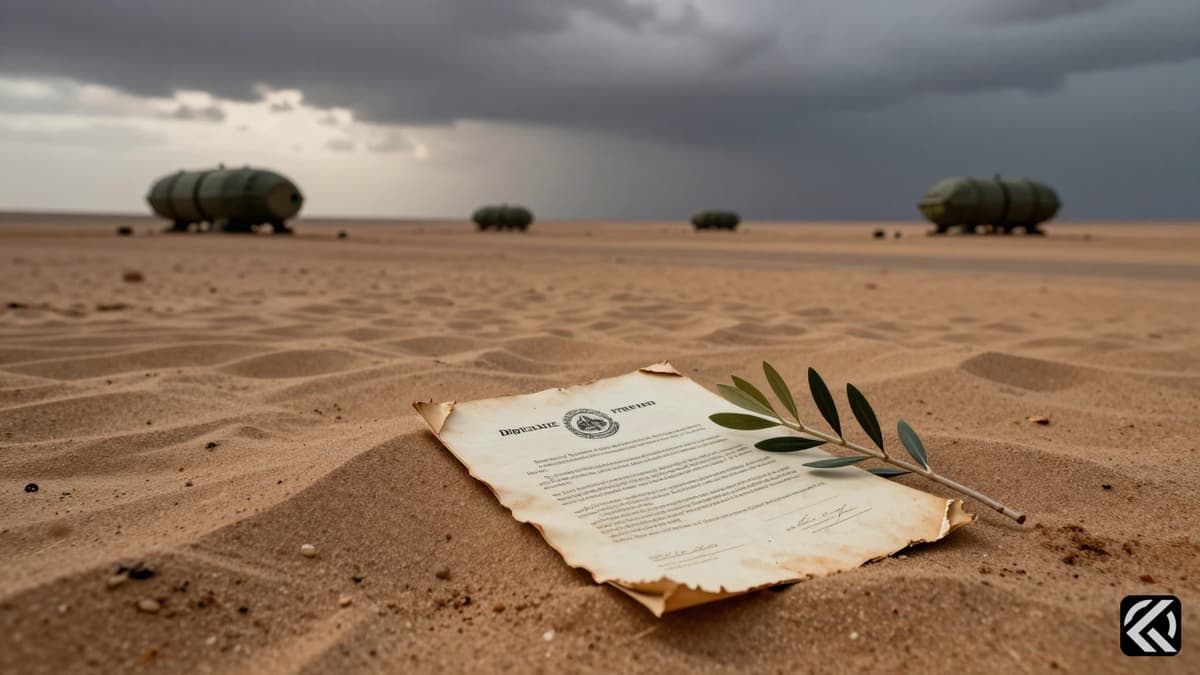
The U.S. military conducted self-defense strikes against Iranian missile sites even as President Trump insisted negotiations are proceeding smoothly, adding complexity to the emerging deal.
The U.S. military executed strategic “self-defence” strikes in southern Iran on Monday, targeting missile launch sites and vessels allegedly placing mines, even as President Donald Trump asserted on social media that diplomatic negotiations were “proceeding nicely.” This military action was described by U.S. Central Command spokesman Capt. Tim Hawkins as a necessary measure “to protect our troops from threats posed by Iranian forces,” while emphasizing that the U.S. is “using restraint during the ongoing ceasefire.” Despite the kinetic operations, the administration is simultaneously pushing for a broader diplomatic framework that includes Abraham Accords expansion as a condition for ending the Iran war.
Further details regarding the specific nature of the Iranian threats and the immediate implications for the ceasefire remain unclear. However, the juxtaposition of military strikes and diplomatic overtures highlights the complex strategy being employed by the U.S. administration. Earlier in the day, President Trump outlined ambitious requirements for any potential agreement to end the conflict, suggesting that several additional nations must join the Abraham Accords to solidify regional stability.
President Trump took to social media to declare that any successful deal to end the Iran war must include a mandate for countries such as Saudi Arabia and Pakistan to join the Abraham Accords. These agreements, originally brokered during Trump's first term, were designed to normalize relations between Israel and several Arab nations. Trump specifically pointed to Saudi Arabia, Qatar, Pakistan, Turkey, Egypt, and Jordan as nations that should “immediately” sign on. He argued that after the significant effort the United States has expended to assemble this “very complex puzzle,” it should be mandatory for these countries to simultaneously sign the accords.
Bahrain and the United Arab Emirates were the inaugural signatories in 2020, followed by Sudan, Morocco, and most recently, Kazakhstan. The accords are framed by the administration as a pathway toward full diplomatic ties with Israel, promoting cooperation across West Asia and North Africa. Trump indicated that while he would accept if one or two countries declined, the majority should be willing to participate. He noted that Egypt and Jordan already formally recognize Israel through long-standing peace treaties, and Turkey established recognition in 1949, making their participation less diplomatically novel than that of Saudi Arabia or Pakistan.
The proposal has already sparked criticism from fellow Republicans who favor a harder line on Iran, suggesting that expanding the accords could introduce new diplomatic complications to the negotiations. A significant hurdle remains the position of Saudi Arabia, which has historically maintained that any normalization deal with Israel requires a clear path for Palestinian statehood. This condition is also key for Pakistan, which does not currently maintain diplomatic relations with Israel.
Islamabad-based analyst Syed Mohammad Ali stated that Pakistan's position on Israel remains unchanged despite the latest U.S. proposals. Masood Khan, Pakistan's former Ambassador to the United States, commented that it remains to be seen how workable the proposal might be for the countries on Trump's list. Khan noted that invoking the Abraham Accords at this stage gives a “altogether new dimension to the diplomatic and mediatory processes” because the issue was not previously on the agenda. He pointed out that Trump is facing domestic pressure to strike a favorable deal, which may influence the urgency of these demands.
Despite the criticism and the military strikes, Khan expressed confidence in the diplomatic track, stating, “the diplomatic track is still working, and I believe Pakistan is very much at the center of it, supported by regional countries.” President Trump mentioned that he raised the Abraham Accords plan with leaders during negotiations on Saturday, May 23, 2026. He even suggested that Iran itself could eventually sign on to the accords if an agreement is reached, further complicating the regional dynamic.
The U.S. military’s decision to carry out these strikes while negotiations are reportedly active underscores the delicate balance between coercion and diplomacy. Capt. Hawkins’ emphasis on restraint suggests the administration is attempting to limit escalation while applying pressure. However, the addition of the Abraham Accords expansion as a non-negotiable element for the Iran deal introduces a layer of complexity that may deter potential signatories who are not ready to normalize relations with Israel.
The emerging Iran deal now faces the dual challenge of addressing immediate security threats through military action and navigating the intricate web of regional diplomatic expectations set by the Abraham Accords. The involvement of nations like Pakistan and Saudi Arabia, which have distinct geopolitical constraints and relationships with Israel, adds significant weight to the outcome. If these countries refuse to join the accords as part of the Iran settlement, the deal may stall, leaving the region in a state of uncertain equilibrium.
The combination of military strikes and high-level diplomatic demands indicates that the United States is leveraging both force and negotiation to reshape the Middle East. The insistence on expanding the Abraham Accords alongside any Iran settlement suggests a long-term strategy to isolate Iran diplomatically by integrating its neighbors into a U.S.-led security framework. If Saudi Arabia or Pakistan resist due to the Palestinian statehood requirement or lack of relations with Israel, the Iran war may persist in a protracted stalemate. Conversely, if these nations join, it could lead to a significant realignment of power in West Asia, potentially reducing Iranian influence but increasing regional tensions regarding the Palestinian issue. The coming weeks will determine whether military pressure and diplomatic conditionality can successfully bridge the gap between conflicting regional interests.
Jun 11, 2026 12:59 UTC
US Strike on Settebello Kills Indian Sailors Amid Strait of Hormuz Tensions
Jun 11, 2026 12:49 UTC
Air India Flight 171 Crash Sparks Debate Over Boeing 787 Dreamliner Faults
Jun 11, 2026 08:51 UTC
US-Iran Conflict: Indian Seafarers Killed in Gulf Strike
Jun 11, 2026 18:04 UTC
Healey Quits Government Over Defence Spending Dispute


