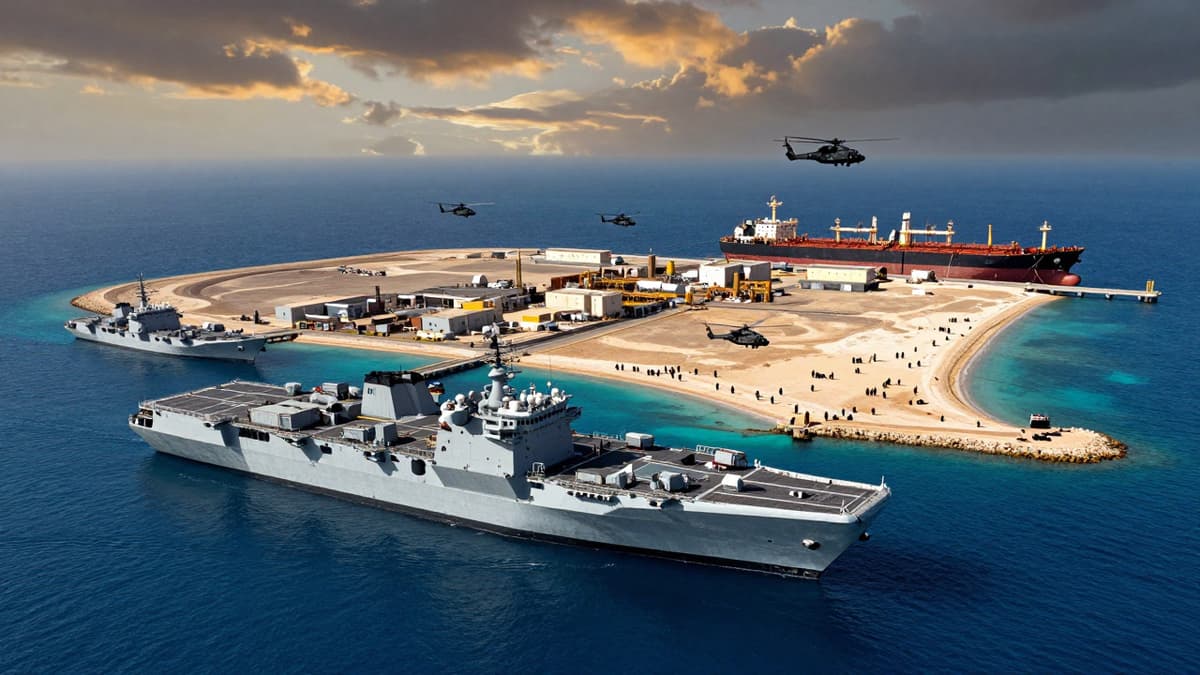
As US forces deploy near the Persian Gulf, speculation mounts over a potential ground assault on Kharg Island to force Iran to reopen vital oil shipping lanes.
Even as President Donald Trump has declared the "war has been won" with Iran, significant military assets are moving toward the region. Amphibious warships, landing craft, and thousands of Marines and sailors are currently being deployed to the Persian Gulf area. This massive movement has caused speculation to swirl regarding whether the United States plans to capture Kharg Island, a tiny coral outcrop off Iran's coast. This island serves as an economic lifeline for Tehran, handling roughly 90% of the country's crude oil exports.
The deployment of these forces has raised questions about the feasibility and risks of a potential ground operation. Experts have questioned whether seizing the tiny but strategic island would provide Washington enough leverage to force Iran to reopen the Strait of Hormuz amid a spiraling global energy crisis. While the island is described by US officials as the "nexus for all the Iranian oil supply," the tactical complexities of such a mission remain a subject of intense debate.
What is Kharg Island?
Kharg Island is a five-mile stretch of land off the Iranian coast, described as roughly a third of the size of Manhattan. Its long jetties jutt into waters deep enough to accommodate oil supertankers, making the island a critical site for oil distribution. The island has long been key to Iran's economy. A declassified CIA document from 1984 published online stated the facilities are "the most vital in Iran's oil system, and their continued operation is essential to Iran's economic well-being."
Storage capacity on Kharg is estimated at roughly 30 million barrels. According to trade intelligence firm Kpler, about 18 million barrels of crude are currently stored there. Alternative export routes that bypass the Strait of Hormuz exist, but they are limited. The International Energy Agency (IEA) notes that these routes have not been robustly tested on a large scale. For example, in 2021, Iran inaugurated the Jask oil terminal, allowing crude oil to be transported to Jask on the Gulf of Oman just east of the strait. However, the IEA said the terminal is not considered a viable export option for Iranian crude.
Earlier this month, Israeli opposition leader Yair Lapid declared that destroying the terminal would "cripple Iran's economy and topple the regime." He stated that Israel "must destroy all of Iran's oil fields and energy industry on Kharg Island."
How risky would a US amphibious attack be?
Two Marine Expeditionary Units (MEU), which specialize in rapid-response amphibious landings, raids, and assault missions from Navy amphibious ships, have recently deployed to the Middle East. Previous military exercises involving MEU have seen the spectacle of attack helicopters in the skies, troops on the beach, and huge assault ships in the water. James Stavridis, NATO's former supreme allied commander, said Tuesday the ships of a MEU "pack a lot of combat capability."
However, he cautioned that before any ground operation, they would have to pass through the Strait of Hormuz and to the northern part of the gulf, contending with Iranian drones, ballistic missiles, and mines in the waterway. Stavridis wrote in a Bloomberg article that "Once in position off Kharg, the Marines would need ironclad air and sea superiority over at least 100 miles around the island."
A US amphibious attack faces significant risks. One significant risk is that Iran could strike the amphibious ships. Another concern is the fate of the island's population, estimated to be in the thousands and almost all oil workers, who would need to be "contained" or evacuated. Stavridis also questioned the strategic leverage that such an operation would give Washington. "If the idea is to then bargain with Tehran for an opening of the Strait of Hormuz, it is unclear that the remaining leaders of the regime would be cowed by the threat of losing Kharg," Stavridis said. "They might balk at agreeing to give up anything for Kharg."
Alongside potential US casualties, Richard Haass, former president of the Council on Foreign Relations think tank, said last week any mission on Kharg would likely "further erode US missile stockpiles." The exact reason why the US is weighing seizing Kharg is unclear, but Haass said it would "likely be seen by many there and around the world as a US attempt to seize Iranian oil."
Has Iran been preparing for a potential US attack?
Iran's Parliament Speaker Mohammad Bagher Ghalibaf said on Wednesday that "Iran's enemies, with the support of one of the regional countries" are preparing to occupy one of the country's islands, without directing naming the island. "All enemy movements are under the full surveillance of our armed forces. If they step out of line, all the vital infrastructure of that regional country will, without restriction, become the target of relentless attacks," Ghalibaf posted on X on Wednesday. Earlier Wednesday, Ghalibaf said, "We are closely monitoring all US movements in the region, especially troop deployments."
According to multiple people familiar with US intelligence reporting on the issue, Iran has been laying traps and moving additional military personnel and air defenses to Kharg Island in recent weeks. The island already has layered defenses, and the Iranians have moved additional shoulder-fired, surface-to-air guided missile systems known as MANPADs there in recent weeks. Iran has also been laying traps including anti-personnel and anti-armor mines around the island, the sources said, including on the shoreline.
Has the US attacked the island before?
Yes. Earlier this month, Trump said the US had bombed "every military target" on the island and threatened to attack its oil infrastructure if Iran continued blocking ships from traversing the Strait of Hormuz. Video posted to Truth Social and geolocated by CNN showed US strikes on the island's airport facilities, with large explosions and black smoke visible throughout the footage. Trump said on the same day that Kharg was "not high on the list, but it's one of so many different things, and I can change my mind in seconds."
But as far back as 1988, decades before he was elected, Trump has talked about invading the island. "One bullet shot at one of our men or ships and I'd do a number on Kharg Island. I'd go in and take it," he told The Guardian in an interview at the time. White House officials believe taking Kharg Island would "totally bankrupt" Iran's Islamic Revolutionary Guard Corps, according to one official, and could potentially lead to a swift end of the war. But many inside the administration are wary of such a move, particularly given it would require a significant number of ground troops to achieve.
How are regional players reacting?
Gulf allies are privately urging the Trump administration against prolonging the war by putting boots on the ground to occupy Kharg Island, a senior Gulf official said. The concern is that occupying the island with US troops would result in high casualties, likely triggering Iranian retaliation against Gulf countries' infrastructure and prolonging the conflict, the senior Gulf official said. Iranian officials have warned as much.
Islamic Revolutionary Guard Corps Navy chief, Alireza Tangsiri - who Israel claimed to have killed on Thursday - said last November that Iran's islands across the Persian Gulf are "fortified strongholds." "If an enemy makes a mistake, it will receive a decisive response there," Tangsiri said.
The strategic calculus surrounding a potential seizure of Kharg Island remains fraught with uncertainty. While White House officials hypothesize that taking the island could "totally bankrupt" the Islamic Revolutionary Guard Corps, the consensus among military experts and regional allies suggests the costs may outweigh the benefits. The presence of thousands of oil workers on the island complicates any ground operation, necessitating containment or evacuation efforts while simultaneously engaging fortified Iranian defenses. If the United States proceeds with a ground assault, the likelihood of significant US casualties increases, which could trigger the "decisive response" promised by Iranian commanders and lead to prolonged Iranian retaliation against Gulf infrastructure. Consequently, while the operation might temporarily disrupt oil exports, it risks eroding US missile stockpiles and solidifying regional opposition rather than forcing a diplomatic opening of the Strait of Hormuz.
Jun 8, 2026 02:17 UTC
Magnitude 7.8 Quake Shakes Philippines, Urging Immediate Evacuations
Jun 8, 2026 00:51 UTC
Trump Claims Iran Nuclear Deal Imminent Despite Diplomatic Fractures
Jun 8, 2026 00:47 UTC
Iran Fires Missiles at Israel After Beirut Strike
Jun 7, 2026 22:00 UTC
US, Iran Peace Hops Fade 100 Days Into War
Jun 8, 2026 04:15 UTC
Trump Urges Netanyahu to Halt Iran Strike for Peace


