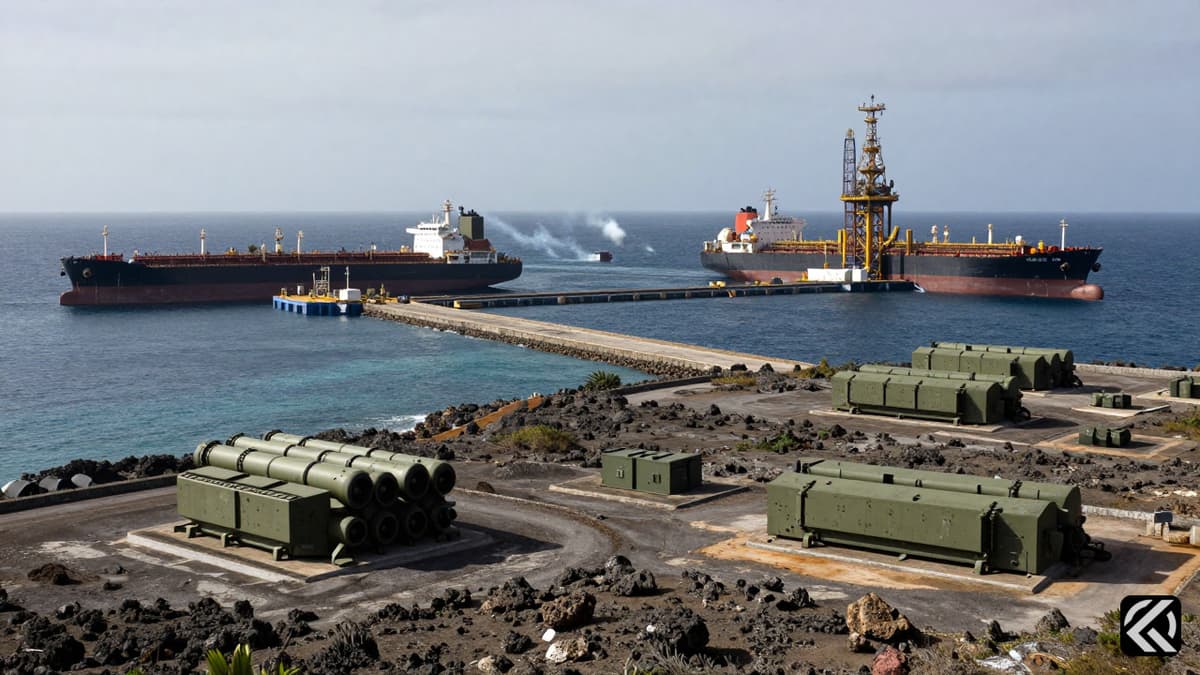
The US has confirmed military strikes on Kharg Island, targeting Iranian defense infrastructure without hitting oil facilities, escalating tensions ahead of the Strait of Hormuz deadline.
The United States has confirmed it conducted military strikes against Iranian military targets on Kharg Island, a critical hub for the nation's oil exports. Despite the location's significance to the global energy market, officials clarify that the recent attacks did not target oil facilities directly. This action comes as a high-stakes deadline looms for Iran to open the Strait of Hormuz.
Vice President JD Vance acknowledged the successful execution of the US strikes on the island but emphasized that the operation does not represent a shift in strategy. These events occur immediately preceding a Tuesday night deadline set by President Donald Trump, requiring Iran to clear the passage of ships in the Strait of Hormuz. While the specific nature of the targets remains undisclosed beyond military assets, the strike serves as a clear signal of military readiness without crossing into the direct destruction of economic infrastructure.
Kharg Island, a coral outcrop off the Iranian coast, is often described by US officials as the "nexus for all the Iranian oil supply." The island features long jetties extending into waters deep enough to accommodate massive oil supertankers, making it a critical site for oil distribution. It has served as an economic lifeline for Tehran for decades, handling roughly 90% of the country's crude oil exports. A declassified CIA document from 1984 explicitly labeled the facilities as "the most vital in Iran's oil system," noting that their continued operation is essential to the nation's economic well-being.
While alternative export routes exist, the International Energy Agency (IEA) notes they are limited and have not been robustly tested on a large scale. For instance, in 2021, Iran inaugurated the Jask oil terminal on the Gulf of Oman. However, the IEA stated this terminal is not considered a viable export option for Iranian crude, leaving Kharg Island as the primary chokepoint for the nation's economy. The island's storage capacity is estimated at roughly 30 million barrels, with trade intelligence firm Kpler reporting that about 18 million barrels of crude are currently stored there.
The potential for destruction has been a topic of high-level discussion, with Israeli opposition leader Yair Lapid declaring that Israel "must destroy all of Iran's oil fields and energy industry on Kharg Island." Lapid warned earlier that destroying the terminal would "cripple Iran's economy and topple the regime." Despite such rhetoric, current US actions have focused strictly on military targets.
Intelligence suggests that Iran anticipated the possibility of such an offensive. In March, Iran's Parliament Speaker Mohammad Bagher Ghalibaf stated that "Iran's enemies, with the support of one of the regional countries" were preparing to occupy one of the country's islands. While he did not name the island, subsequent reports confirm the focus was on Kharg Island. Multiple sources familiar with US intelligence reporting indicate that Iran laid traps and moved additional military personnel and air defenses to the island in recent weeks to prepare for a potential US operation to take control of it.
The island already possessed layered defenses, but Iranian forces have moved additional shoulder-fired, surface-to-air guided missile systems known as MANPADs there in recent weeks. These defensive maneuvers highlight the strategic importance placed on the island by the Iranian government.
The US had previously struck Kharg Island in March, with US Central Command stating at the time that 90 targets had been hit, including "naval mine storage facilities, missile storage bunkers, and multiple other military sites." Video footage posted to Truth Social and geolocated by CNN showed US strikes on the island's airport facilities, with large explosions and black smoke visible throughout the footage. President Trump remarked on that occasion that Kharg was "not high on the list, but it's one of so many different things, and I can change my mind in seconds," threatening to attack oil infrastructure if Iran continued blocking ships from traversing the Strait of Hormuz.
The strategic debate surrounding Kharg Island extends back decades, long before the current administration. President Trump discussed the possibility of invading the island as far back as 1988, stating in an interview with The Guardian, "One bullet shot at one of our men or ships and I'd do a number on Kharg Island. I'd go in and take it." This historical context underscores the island's value as a strategic military objective.
White House officials believe that taking Kharg Island would "totally bankrupt" Iran's Islamic Revolutionary Guard Corps, according to one official, and could potentially lead to a swift end of the war. However, this aggressive stance is countered by caution within the administration. Many inside the administration are wary of such a move, particularly given it would require a significant number of ground troops to achieve. The current approach involves targeted strikes rather than a full-scale occupation, balancing the need to pressure Iran with the logistical and human costs of a ground invasion.
As the deadline for the Strait of Hormuz approaches, the situation remains volatile. The distinction made by US officials between striking military targets and leaving oil facilities intact suggests a calibrated approach intended to apply pressure without causing a total economic collapse that could trigger an even broader conflict. The ongoing presence of US forces and the heightened state of Iranian defenses indicates that the region is on a precipice, with the status of Kharg Island serving as a critical flashpoint in the unfolding geopolitical drama.
The confirmed US strikes on Kharg Island have disrupted military storage and defense capabilities without targeting the oil export infrastructure that powers the Iranian economy. Based on the deployment of additional MANPADs and the strategic warnings issued by both sides, the immediate future suggests a continued high-alert status in the region. The administration's hesitation regarding a ground invasion implies that future actions will likely remain in the realm of air strikes and diplomatic pressure rather than a full territorial occupation. If Iran fails to comply with the deadline to open the Strait of Hormuz, the likelihood of further, more expansive strikes on military assets increases significantly, potentially destabilizing the delicate balance of power in the Persian Gulf.
Jun 8, 2026 00:51 UTC
Trump Claims Iran Nuclear Deal Imminent Despite Diplomatic Fractures
Jun 8, 2026 00:47 UTC
Iran Fires Missiles at Israel After Beirut Strike
Jun 7, 2026 22:00 UTC
US, Iran Peace Hops Fade 100 Days Into War
Jun 7, 2026 20:57 UTC
Iran Strikes Israel: IRGC Promises Week of Continuous Offensive
Jun 8, 2026 02:28 UTC
Trump Walks Out of Meet the Press After Rejecting Evidence Demands


