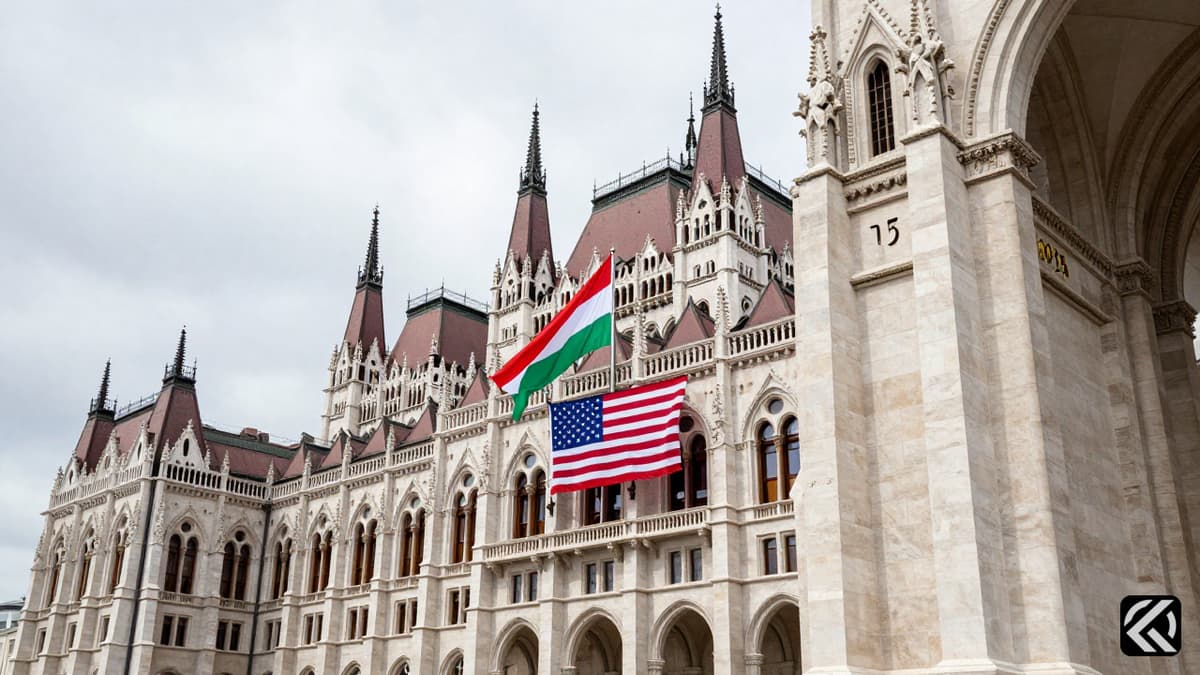
Amidst tight polling against Péter Magyar, US Vice-President JD Vance traveled to Budapest to publicly endorse Viktor Orbán, framing the election as a battle against EU interference.
Five days before Hungarians vote in a pivotal election that could end Viktor Orbán's 16-year tenure, US Vice-President JD Vance intervened to provide a strong endorsement to the prime minister. Arriving in Budapest for the first top-level US visit in two decades, Vance stood beside Orbán to explicitly state his support, even as he delivered a scathing attack on the European Union's role in the campaign.
Vance admitted the US would work with any future administration but emphasized his presence was specifically "to help him in this campaign cycle." This move came as Orbán faces his toughest challenge in a nearly 40-year political career, with his main rival, Péter Magyar of the Tisza party, leading in most opinion polls. The veteran prime minister, a close ally of the Trump administration and Vladimir Putin, is now defending against a last-ditch effort to unseat him.
Following talks with Orbán, Vance launched a bitter attack on the European Union and Ukraine. He accused the EU of "one of the worst examples of foreign election interference" he has ever encountered, alleging that bureaucrats in Brussels "hate this guy" and that their actions have been "truly disgraceful." Vance also repeated unsubstantiated claims that Ukrainian intelligence services attempted to influence the outcome, though he offered no specific details on these allegations.
Péter Magyar responded to the visit by welcoming Vance, stating his party views the US as a prominent partner should they come to power, serving as both a NATO ally and an economic partner. However, the incident has heightened tensions with Brussels, where leaders have been frustrated by Orbán's veto on billions of euros in essential funding for Ukraine, an agreement he previously accepted in December. German Chancellor Friedrich Merz described the veto as a "gross act of disloyalty," yet they have carefully avoided directly intervening in the election campaign.
The timing of the visit, scheduled just before the April 12 vote, underscores the high stakes. Vance's rhetoric mirrored a speech he gave in Munich in February 2025, where he similarly accused European leaders of restricting free speech. His arrival was facilitated by Foreign Minister Péter Szijjártó, who characterized the friendship between Orbán and President Donald Trump as having created a "new golden age" in relations.
The relationship between Washington and Budapest is deeply rooted in the Trump-Orbán friendship dating back to 2016, when Orbán was the sole EU leader to support Trump. In October 2024, Orbán secured a personal exemption for Hungary from US sanctions on Russian oil giants Rosneft and Lukoil. Trump clarified that this was a personal deal, implying a successor would need to re-apply if Orbán lost the upcoming election. Hungary remains almost alone in the EU for defying calls to reduce reliance on Russian fossil fuels, depending heavily on oil via the Druzhba pipeline and gas via TurkStream.
However, these energy supplies have become problematic. No oil has reached Hungary through the Druzhba pipeline since late January following a Russian attack on western infrastructure, with Orbán blaming Ukraine for the failure to restore it. To prevent shortages, Hungary has released fuel reserves and imported non-Russian oil via a Croatian pipeline. Simultaneously, the government has faced scandals involving leaked private conversations between Szijjártó and Russian officials, where the Foreign Minister allegedly lobbied for Russian sanctions relief.
The opposition has further accused Orbán of staging a recent incident where explosives were found near the TurkStream pipeline, labeling it a terror attack to boost re-election chances. While Serbia and pro-government media blamed Ukraine, Kyiv dismissed the claim as a Russian false-flag operation. Former intelligence sources and Péter Magyar have suggested the event was a coordinated effort between Budapest and Belgrade.
As the election approaches, Orbán faces accusations of running a "hybrid regime of electoral autocracy" and being the most corrupt nation in the EU according to Transparency International. Big state projects have reportedly been awarded to his inner circle, and main media companies have been consolidated by his allies, complicating the path to re-election for the prime minister.
The US Vice-President's visit and subsequent rhetoric suggest a continued deepening of bilateral ties regardless of the election outcome, provided Orbán maintains his alignment with Trump's interests. If Orbán secures re-election, the exemption from sanctions on Russian oil and the expansion of US LNG and nuclear technology imports are likely to proceed, solidifying a unique energy and economic partnership within the EU. However, should Péter Magyar win, the immediate re-application for sanctions relief and a potential shift in foreign policy toward a more conventional pro-EU stance could create significant friction. The ongoing accusations of corruption and the strained relationship with Brussels mean that the next administration will face immediate pressure to address transparency concerns while navigating complex energy security needs amidst the broader geopolitical conflict. The legacy of this election will likely define the future stability of US-Hungarian relations and the cohesion of EU foreign policy on Russia.
Jun 8, 2026 00:51 UTC
Trump Claims Iran Nuclear Deal Imminent Despite Diplomatic Fractures
Jun 8, 2026 00:47 UTC
Iran Fires Missiles at Israel After Beirut Strike
Jun 7, 2026 22:00 UTC
US, Iran Peace Hops Fade 100 Days Into War
Jun 7, 2026 20:57 UTC
Iran Strikes Israel: IRGC Promises Week of Continuous Offensive
Jun 8, 2026 02:28 UTC
Trump Walks Out of Meet the Press After Rejecting Evidence Demands


