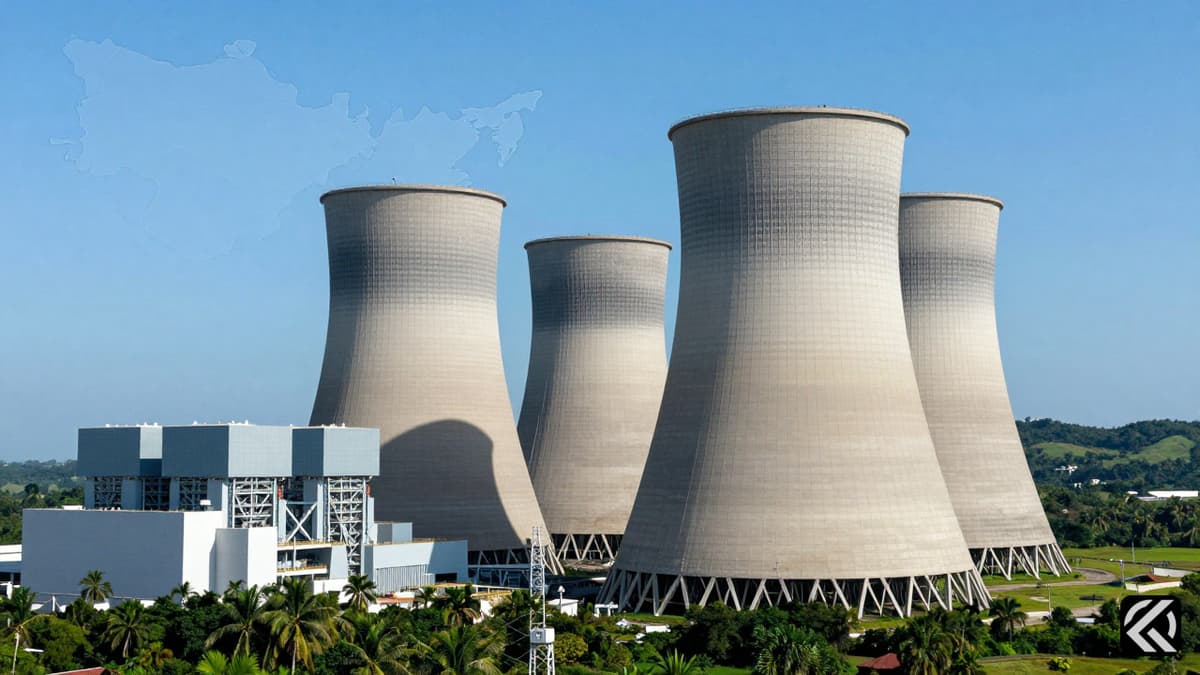
India's advanced fast breeder reactor reaches criticality, marking a historic step toward energy independence and leveraging the country's vast thorium reserves.
On Monday, India's most advanced nuclear facility reached a critical milestone that marks a major leap for the country's atomic energy efforts. The prototype fast breeder reactor (PFBR) located at Kalpakkam in Tamil Nadu achieved criticality, the precise stage where a nuclear chain reaction can continue on its own without external intervention. This development positions the nation to significantly cut its dependence on imported uranium while advancing its long-term nuclear energy programme.
The achievement was immediately recognized by national leadership. Prime Minister Narendra Modi described the event as "a proud moment for India" and "a defining step" in the country's scientific evolution. In a statement posted on the platform X, Modi emphasized that the reactor's ability to produce more fuel than it consumes reflects the nation's deep scientific capability and engineering strength. He noted that this is a decisive move toward harnessing the country's vast thorium reserves, which are central to the third stage of India's unique three-stage strategy.
The fast breeder reactor represents a technological departure from standard power generation methods. Unlike the pressurised heavy water reactors used globally and within India, which rely primarily on uranium and generate plutonium as waste, the PFBR utilizes that ejected plutonium as fuel. Designed and developed by the Indira Gandhi Centre for Atomic Research (IGCAR), the 500 megawatt electrical (MWe) reactor can produce more fissile material than it consumes. By converting Uranium-238 into plutonium, the system creates a self-sustaining cycle that allows India to extract greater energy from its limited uranium reserves.
Paul Norman, a professor of nuclear physics at the University of Birmingham, explained the global significance of this technology. He noted that such systems can theoretically increase nuclear fuel reserves by utilizing "all of the uranium" rather than just a small fraction. Furthermore, the technology can be adapted for thorium-based systems. Given that global thorium reserves are four times larger than uranium reserves, this offers a massive potential boost in available fuel. For India specifically, the equation is even more striking; while the country holds only about 1-2 percent of the world's uranium, it possesses more than 25 percent of the world's thorium.
The road to this milestone was long. Construction of the PFBR officially began in 2004 after multiple delays, though the scientific importance of the fast reactor programme was highlighted by scientists decades prior. An October 1996 report by Indian scientists Shivram Baburao Bhoje and Perumal Chellapandi underscored the necessity of the programme due to India's growing electricity demand. As the world's third-largest energy consumer, India's energy needs are projected to grow alongside its economy.
The reactor is designed to facilitate the transition from the second stage of India's nuclear plan to the third. In the second stage, fast breeder reactors use uranium and plutonium waste to generate electricity, producing a lighter isotope of uranium called uranium-233. This fissile material, along with thorium, is destined to fuel the third-stage reactors. These future reactors would be fed with India's abundant thorium, creating a cycle where waste is also recyclable as fuel.
Koroush Shirvan, a professor at the Massachusetts Institute of Technology, offered a cautious perspective on the global context. He noted that while other nations including the US, France, UK, Japan, China, and Russia have worked on fast breeder technology, only Russia currently operates a commercial version. Shirvan pointed out that challenges with reactor materials, reprocessing, and economics have historically hindered large-scale deployment. He also highlighted that India took over 20 years from the start of construction to reach this milestone, whereas China recently built a slightly larger reactor in just six years.
Despite the timeline, the strategic implications remain profound. If India successfully turns this prototype success into a commercial model, it could inspire other nations to adopt similar technologies. The ultimate goal is to reduce the need for naturally found uranium significantly, using thorium for much of its nuclear energy needs. Currently, nuclear energy represents only 3 percent of India's energy mix, but the government aims to raise this dramatically from 8,180MW in 2024 to 100GW by 2047.
This achievement solidifies India's status as a technological leader in nuclear innovation, distinguishing it as the second country to develop a commercial fast breeder reactor. The successful transition to criticality validates the nation's strategy to utilize plutonium waste and limited uranium to sustain its power grid. Looking ahead, the full operationalization of this reactor is expected to pave the way for the large-scale deployment of thorium-based reactors, which could fundamentally alter India's energy landscape. While experts urge acceleration in construction timelines to match global competitors, the successful demonstration of this technology provides a proven pathway to energy independence. The world will watch closely as India attempts to replicate this success commercially, potentially offering a new model for nuclear sustainability globally.
Jun 8, 2026 00:51 UTC
Trump Claims Iran Nuclear Deal Imminent Despite Diplomatic Fractures
Jun 8, 2026 00:47 UTC
Iran Fires Missiles at Israel After Beirut Strike
Jun 7, 2026 22:00 UTC
US, Iran Peace Hops Fade 100 Days Into War
Jun 7, 2026 20:57 UTC
Iran Strikes Israel: IRGC Promises Week of Continuous Offensive
Jun 8, 2026 02:28 UTC
Trump Walks Out of Meet the Press After Rejecting Evidence Demands


