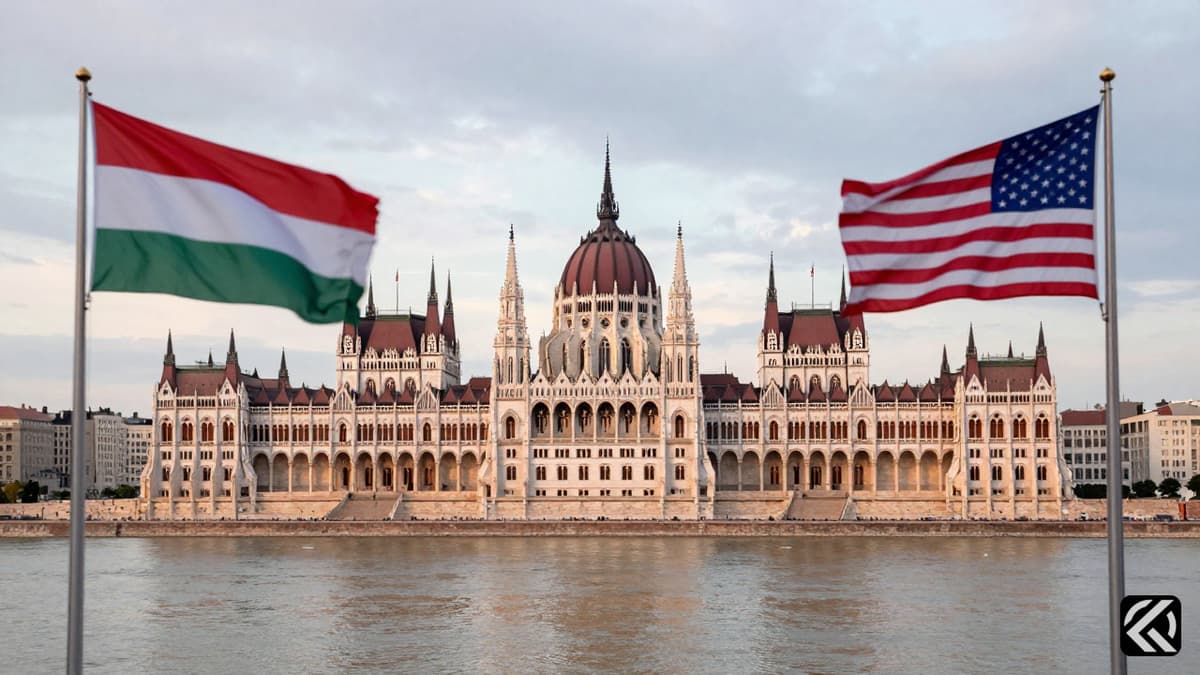
Amidst rising tensions with Iran, VP Vance travels to Budapest to bolster PM Orbán, highlighting shared values and critical diplomatic efforts as Hungary faces a pivotal election.
Vice President JD Vance arrived in Budapest this week, a move that stands out as highly unusual given the proximity to a major national election. While the official purpose of the trip is to deepen ties with the 10 million citizens of Hungary, the political calculus inside the country suggests a different narrative. The visit is widely interpreted as a direct effort to boost the campaign of Prime Minister Viktor Orbán, whose hold on power faces its most significant challenge in years.
This decision by the White House comes at a volatile juncture in international relations. The United States is currently engaged in a raging war with Iran, with gas prices climbing and spending battles continuing to divide Capitol Hill. VP Vance will be in Hungary on Tuesday evening, precisely when the expiration of President Donald Trump's ultimatum for Iran is due. The ultimatum demanded the reopening of the Strait of Hormuz or face massive attacks on power plants and water facilities. Consequently, Vance's presence is viewed as a signal of the lengths the administration is willing to go to assist an embattled ally, especially as he remains at the center of ongoing efforts to broker an end to the conflict, which has now entered its sixth week.
The relationship between the two administrations has grown remarkably close in recent years, with Orbán describing the current period as a "golden era" of US-Hungary relations. During a joint press conference on Tuesday, Vance underscored the "moral cooperation" between the nations, explicitly referencing the shared "Christian civilization and Christian values." This alignment is significant given the administration's criticism of traditional American allies in Europe, with Vance previously claiming that European leaders were suppressing free speech and losing control of immigration.
Vance addressed Orbán directly during their bilateral meeting, stating, "the president loves you, and so do I." He further hailed the Prime Minister as "one of the only true statesmen in Europe," praising his unique combination of diplomatic skill and wisdom. These comments reflect the administration's praise for Orbán's approach to ending Russia's war in Ukraine, a stance that analysts suggest favors Moscow. Vance reiterated that Trump and Orbán are likely the two leaders who have done the most to end that destructive conflict.
The political stakes for Orbán are high. Despite a US administration that has hailed him as a model for Europe and endorsed him as a "truly strong and powerful Leader," the Prime Minister is trailing in polls behind the opposition ahead of Sunday's contest. Vance's JD Vance Hungary visit highlights the administration's strategic focus on a figure whose policies on immigration, the justice system, and press attacks mirror the blueprint for Trump's second term. The Prime Minister has cultivated strong ties with Trump's MAGA movement, sharing a disdain for Europe's liberal democracies and championing national sovereignty.
While the US endorsement is high-profile, it has not yet appeared to move the needle in Hungarian public opinion. Orbán faces rising criticism over corruption and a largely stagnant economy during his 16-year tenure. Recent data from the 21 Research Centre indicates that the center-right Tisza party is widening its lead over Orbán's Fidesz. One survey from late March showed Tisza enjoying support from 56% of decided voters compared to 37% for Fidesz, with 26% of respondents still undecided. This uncertainty makes the outcome of the election far from certain, despite Trump's long-standing wariness of backing candidates where success is not guaranteed.
The context of the Viktor Orbán US election is further complicated by new strains between Washington and the rest of Europe. President Trump has repeatedly signaled a reconsideration of American commitment to NATO after alliance leaders refused his demands to send naval assets to reopen the Strait of Hormuz. In response, Orbán has positioned himself as a key ally, discussing with Vance issues ranging from "migration, gender ideology, family policy, and global security." This alignment has drawn him support from a global hard-right movement, including leaders like Marine Le Pen, Giorgia Meloni, and Javier Milei, who recently endorsed his bid for a fifth term.
Prior to Vance's arrival, Secretary of State Marco Rubio visited Budapest in February, explicitly stating that Trump is deeply committed to Orbán's success because "your success is our success." However, the Trump administration has maintained a cautious distance, with the President posting multiple times about the endorsement but not visiting Budapest in the final stretch of the campaign himself. Vance's trip, therefore, fills a critical gap, engaging in a speech on the "rich partnership" between the nations and discussing energy, technology, and defense cooperation.
The administration's push to broker peace in the Middle East remains a central pillar of Vance's mission. Although speculation mounted that Vance might add a stop to engage with Iranian officials during his trip, he focused his efforts on reinforcing the alliance with Hungary. The Iran Strait of Hormuz crisis looms large, with the potential for massive attacks on Iranian infrastructure if the ultimatum is not met. As the deadline approaches, Vance's role as a negotiator and his strong showing of support for Orbán underscores the complex interplay between domestic Hungarian politics and global security imperatives.
The immediate aftermath of the JD Vance Hungary visit will likely deepen the ideological rift between the Trump administration and traditional European allies, while solidifying a new axis of conservative governance. Given the administration's consistent praise for Orbán's stance on the Ukraine war and the shared emphasis on hard borders and traditional values, future cooperation on security and economic issues is expected to intensify regardless of the election's outcome. However, the polling data suggests that Washington's influence may have limits in shifting the narrative on the ground, particularly amidst accusations of corruption and economic stagnation. As the ultimatum regarding the Strait of Hormuz expires, the diplomatic capital Vance has spent in Budapest may serve as a critical buffer, ensuring that even if Orbán faces a tighter race, the strategic partnership remains resilient against external threats and internal criticism.
Jun 8, 2026 00:51 UTC
Trump Claims Iran Nuclear Deal Imminent Despite Diplomatic Fractures
Jun 8, 2026 00:47 UTC
Iran Fires Missiles at Israel After Beirut Strike
Jun 7, 2026 22:00 UTC
US, Iran Peace Hops Fade 100 Days Into War
Jun 7, 2026 20:57 UTC
Iran Strikes Israel: IRGC Promises Week of Continuous Offensive
Jun 8, 2026 02:28 UTC
Trump Walks Out of Meet the Press After Rejecting Evidence Demands


