Section
Twelve days after her tragic death, Twisha Sharma was cremated in Bhopal following a second autopsy, as her family seeks justice in a high-profile dowry harassment case.
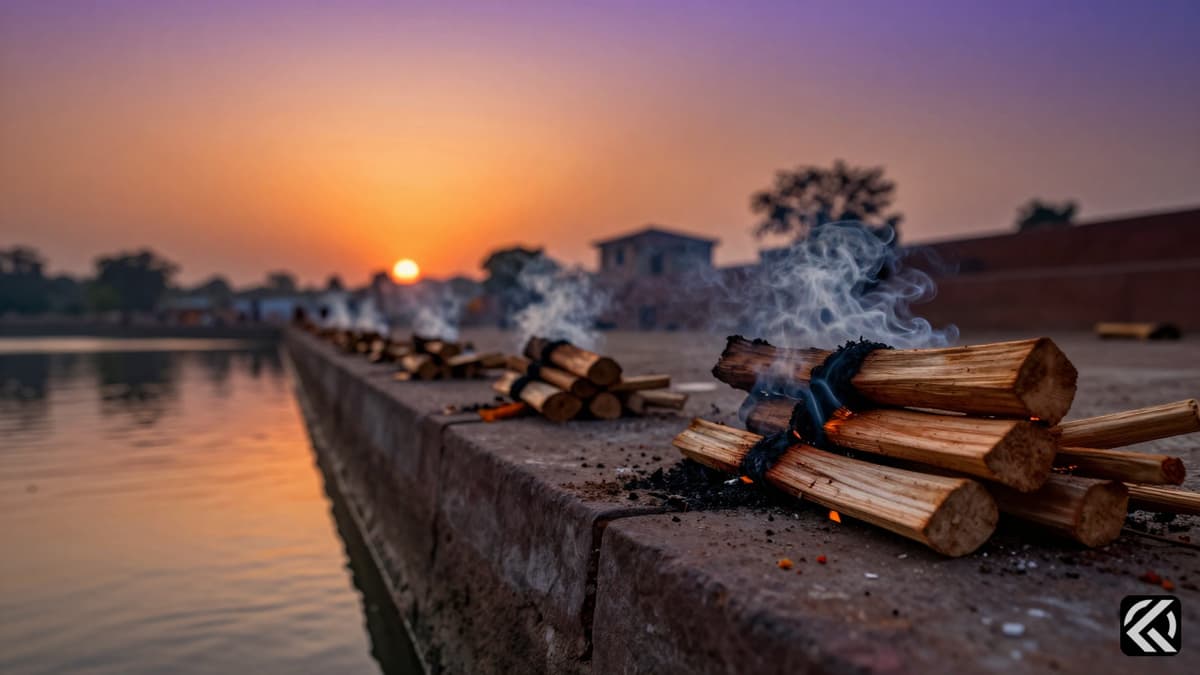
Twisha Sharma’s last rites were performed in Bhopal on Sunday, marking the final farewell 12 days after she was found dead at her marital home. The cremation took place at Bhadbhada Vishram Ghat, hours after a second autopsy was conducted by an expert panel from AIIMS New Delhi.
The ceremony drew dozens of ex-servicemen, relatives, and locals paying their respects. Her brother, Major Harshit Sharma, performed the rituals while her mother remained inconsolable. This event follows the Supreme Court’s recent intervention and the arrest of her husband, Samarth Singh, who is currently in police custody.
The atmosphere at the ghat was heavy with grief and unresolved questions. Major Harshit Sharma described the difficulty of identifying the body due to the passage of time and the previous autopsy. He noted that while changes in the body made identification challenging, birthmarks and other features confirmed her identity. The report from the second post-mortem, carried out by the AIIMS New Delhi team, is still awaited.
Her father, Navnidhi Sharma, expressed profound loss, describing Twisha Sharma as someone who cared for her parents with the devotion of a mother. He thanked the Supreme Court for registering a suo motu case, stating that the proceedings would set a precedent and restore faith in the judicial process. He believed that despite the uncertainty, justice would prevail.
The case is complicated by serious allegations from the family. They claim procedural lapses, institutional bias, and evidence tampering. Specifically, they accuse the victim’s mother-in-law, Giribala Singh, a retired judge, of using her influence to weaken the probe. Mrs. Singh is listed as an accused in the case and has publicly alleged that Twisha Sharma had a drug addiction. The family disputes this, pointing to the first post-mortem conducted by doctors from AIIMS Bhopal, where Mrs. Singh’s sister is a senior doctor, as biased.
On May 22, the Madhya Pradesh High Court allowed the second impartial examination, which was subsequently carried out by the AIIMS panel. Meanwhile, the Bhopal Police’s Special Investigation Team (SIT), along with forensic experts, visited Mrs. Singh’s house to inspect the crime scene. This marks the first official inspection of the location where Twisha Sharma died.
The police are currently interrogating Samarth Singh, a lawyer, who was arrested on May 22 after failed attempts to surrender before a Jabalpur court. Deputy Commissioner of Police Vikas Sehwal stated that items are being seized based on information obtained from questioning Mr. Singh. Statements from family members and doctors have already been recorded. A team is scheduled to attend a High Court hearing in Jabalpur on Monday.
Mrs. Singh, who is currently out on anticipatory bail, has not yet been questioned by the investigating team. She was asked to appear before the High Court on May 25. Her absence from the cremation ceremony has been noted, contrasting with the large turnout of supporters and family members.
The involvement of the Supreme Court has intensified public interest in the case. A three-judge Bench comprising Chief Justice of India Surya Kant and Justices Joymalya Bagchi and Vipul M. Pancholi took note of the matter. The family alleges that Mrs. Singh contacted more than 40 senior government and judicial officers to interfere with the investigation.
Lawyers for the victim’s family have questioned the continued occupancy of the death house by the in-laws, raising suspicions of evidence destruction and planting of contraband. The police are now tasked with verifying these claims alongside the ongoing interrogation of Samarth Singh.
The second autopsy by AIIMS New Delhi is critical to establishing the true cause of death. While the first report was contested, the expert panel from the national capital aims to provide an impartial medical assessment. The family’s demand for transparency has been partially met through the High Court’s order and the Supreme Court’s suo motu cognisance.
As the investigation continues, the community awaits the final reports. The case has highlighted issues surrounding dowry harassment and the challenges faced by victims’ families in combating influential adversaries. The outcome could set a significant legal precedent regarding the handling of such cases and the protection of evidentiary integrity.
The cremation of Twisha Sharma marks a poignant closure for her family, yet the legal battle is far from over. With the husband in custody and the mother-in-law facing allegations of interference, the judicial system is under scrutiny. The upcoming reports from AIIMS New Delhi and the High Court hearings will determine the trajectory of the trial. This case underscores the urgent need for robust protections against dowry-related violence and the preservation of impartial investigations in high-profile legal disputes.
Jun 11, 2026 17:21 UTC
Bangladesh Opposition Mobilizes Against India-Bangladesh Border Push-Ins and BSF Killings
Join 50,000+ readers getting the global briefing every morning.
No spam. Unsubscribe anytime.
Jun 11, 2026 17:40 UTC
Boelter Pleads Guilty in Minnesota Political Assassinations
Jun 11, 2026 17:21 UTC
Bangladesh Opposition Mobilizes Against India-Bangladesh Border Push-Ins and BSF Killings
Jun 11, 2026 17:21 UTC
John Healey Quits as UK Defence Secretary Over Funding Dispute
Jun 11, 2026 16:19 UTC
UK Defence Secretary John Healey Quits Over Funding Dispute