Section
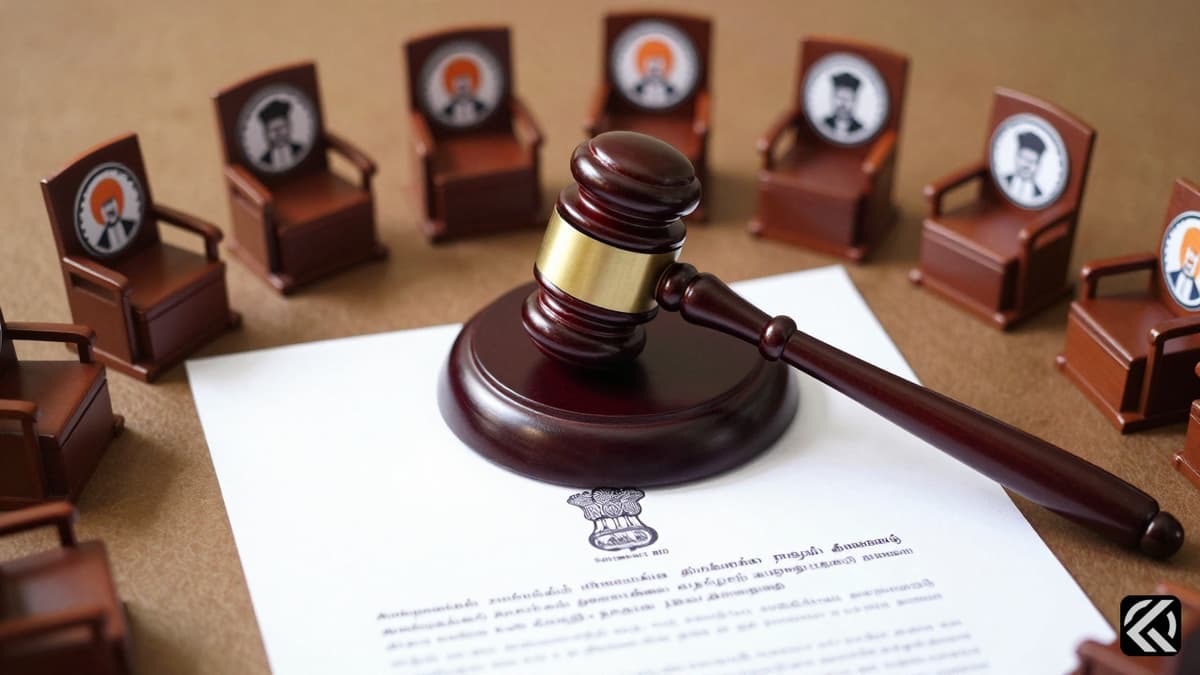
Tamil Nadu Assembly elections 2026 witness a historic shift as C. Joseph Vijay’s TVK claims government formation with crucial Congress backing.
The Governor of Tamil Nadu, Rajendra Vishwanath Arlekar, has issued a directive to Tamilaga Vettri Kazhagam (TVK) president C. Joseph Vijay to substantiate his claim of forming the next state government. This demand comes in the wake of the recent Assembly results, where Vijay’s party secured 108 seats. To secure the confidence of the 234-member Assembly, the constitutional majority stands at 118 seats. The Governor, who recently arrived in Chennai from Kerala, insisted that Vijay must present tangible proof of support from at least seven additional legislators before being formally invited to the Chief Minister’s post. This strict requirement underscores the legal necessity for the Governor to satisfy himself regarding the numerical strength of any coalition government, especially when the cumulative strength of the opposing fronts remains significant.
In a dramatic turn of events during the Tamil Nadu Assembly elections 2026, the Indian National Congress has officially snapped its over two-decade-old alliance with the Dravida Munnetra Kazhagam (DMK). Instead, the Congress has extended its support to the TVK. This decision marks a significant realignment in Tamil Nadu’s political landscape. Sources indicate that the Congress could be offered two Cabinet berths in the proposed coalition government. The move was justified by AICC in-charge for Tamil Nadu, Girish Chodankar, who described the partnership as being "founded on mutual respect, appropriate share, and shared responsibility." The Congress leadership emphasized that this alliance is not limited to just forming the current government but is also aimed at securing future victories in local bodies, the Lok Sabha, and the Rajya Sabha elections.
The numerical calculus behind this new alliance reveals a tight race. The TVK won 108 seats in the recent election. However, C. Joseph Vijay holds two legislative seats and must resign one of them to join the Assembly. One of his seats would be taken by the Speaker, who is only permitted to vote in the event of a tie. Consequently, the TVK’s internal strength effectively becomes one seat less than its total win count. With the Congress party, which won five seats as part of the previous DMK alliance, now switching sides, the total count for the TVK-led coalition rises to 111. Despite this boost, the coalition remains seven seats short of the 118-mark required for a majority. This deficit forces the TVK to actively court other smaller parties to secure their backing.
The opposition parties have reacted swiftly to these developments. AIADMK senior leader K.P. Munusamy categorically dismissed rumors that his party would support the TVK. Following a meeting of legislators and functionaries chaired by party general secretary Edappadi K. Palaniswami, Munusamy told journalists that such reports were "not true." This denial is crucial because the AIADMK front currently holds 53 legislators. While the current DMK front holds 68, the AIADMK’s refusal to join the TVK coalition keeps the political arithmetic tight and prevents any immediate single front from claiming an overwhelming majority without further negotiations.
Other smaller allies of the DMK have adopted a wait-and-watch approach. The Communist Party of India (Marxist), the CPI, and the Viduthalai Chiruthaigal Katchi, which each won two seats, stated that the TVK had approached them separately. However, leaders from these parties indicated that they would only make a final decision after holding internal party meetings in due course. In contrast, the Indian Union Muslim League, another DMK ally with two legislator-elects, had earlier announced it would not extend support to the TVK, citing ideological differences or prior commitments.
The Congress party’s decision to support the TVK comes with specific conditions. Girish Chodankar released a statement emphasizing that the support is conditional upon the TVK keeping out any "communal forces that do not believe in the Constitution of India." This condition highlights the Congress’s intent to position itself as a guardian of constitutional secularism within the new alliance. Chodankar further stated that both Vijay and Congress leader Rahul Gandhi have jointly pledged to respect the historic verdict of the Tamil Nadu people. The goal is to establish a secular and progressive government that fulfills the promises made to the people, particularly the youth of the state. The alliance is also framed as a move to revive Kamaraj’s legacy while adhering to Periyar’s social justice ideals and Dr. B.R. Ambedkar’s constitutional values.
The dissolution of the 16th Tamil Nadu Legislative Assembly with effect from May 5, 2026, sets the stage for intense negotiations. As top government officials met with Vijay at his Foreshore Estate residence to extend greetings, the transition of power appears imminent but contingent on bridging the seven-seat gap. The TVK must now rapidly secure the remaining seven legislators from non-aligned groups or defectors to cross the majority threshold. If successful, this will mark the first time the TVK forms a government, fundamentally altering the Dravidian political dynamics. The Congress’s entry into the fold suggests a strategic pivot by the national party to maintain influence in South India, potentially at the expense of the DMK’s regional dominance. Long-term, this realignment could redefine coalition politics in Tamil Nadu, making smaller parties critical kingmakers in future assemblies. The next few days will determine whether the TVK can consolidate enough support to govern effectively or if the political vacuum will lead to further instability.
Jun 11, 2026 12:59 UTC
US Strike on Settebello Kills Indian Sailors Amid Strait of Hormuz Tensions
Jun 11, 2026 12:49 UTC
Air India Flight 171 Crash Sparks Debate Over Boeing 787 Dreamliner Faults
Jun 11, 2026 08:51 UTC
US-Iran Conflict: Indian Seafarers Killed in Gulf Strike
Jun 11, 2026 18:04 UTC
Healey Quits Government Over Defence Spending Dispute