
Section
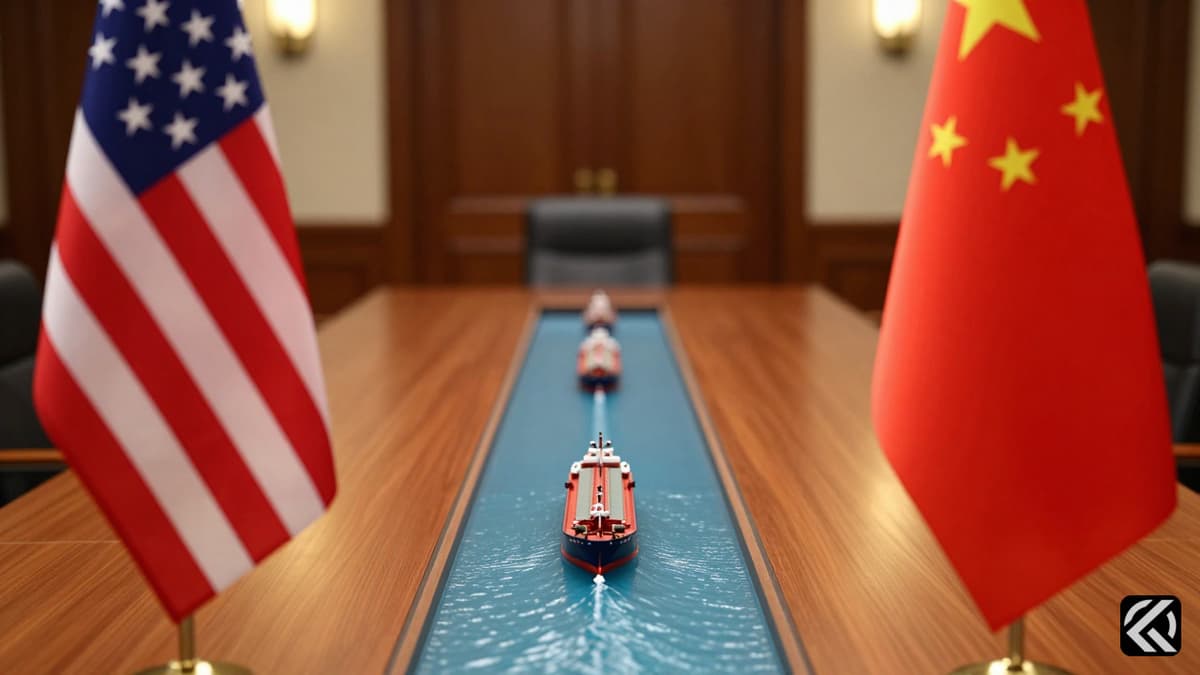
As US President Donald Trump lands in Beijing, the world watches as the US-China trade summit unfolds under the shadow of the Iran Strait of Hormuz crisis, reshaping global economic alliances.
US President Donald Trump arrived in Beijing’s capital on Wednesday, greeted by a ceremony of pomp and pageantry for a high-stakes visit that carries significant global consequences. As the world’s two largest economies reframe their relationship, this trip marks a critical moment for bilateral ties, yet it is overshadowed by the ongoing conflict with Iran. The president’s delegation includes top officials and more than a dozen business leaders, underscoring the commercial weight of the US-China trade summit.
The visit was originally delayed in March by Trump, who had hoped a war with Iran would resolve in weeks. However, with a peace deal remaining elusive and the ceasefire described as being on “massive life support,” the president moved forward, citing his duties as a leader. A senior US official noted that the conflict is now more “active” than when the trip was initially postponed, justifying the continued engagement.
During the summit, Trump is expected to meet with Chinese leader Xi Jinping to discuss thorny issues including technology, trade, and Taiwan. However, observers note that the Iran Strait of Hormuz crisis is likely to dominate the conversation. The US continues its blockade on the Strait of Hormuz, a chokepoint vital to oil trade, which has major implications for China, the largest consumer of Iranian oil. The leaders’ meeting follows closely after Iran’s foreign minister Abbas Araghchi traveled to Beijing, highlighting the close ties between Tehran and Beijing.
Trump is expected to encourage Xi to push Iran to reopen the strait and agree to a peace deal. “I would expect the president to apply pressure,” a US official said, referencing recent sanctions targeting individuals and companies enabling Iran’s efforts to secure arms. Some US officials have expressed concern that Xi holds the cards in this meeting, potentially using leverage to advance Beijing’s goals regarding Taiwan. Trump himself admitted to reporters, “He’ll bring up Taiwan, I think, more than I will.”
Traveling with Trump are prominent CEOs including Apple’s Tim Cook, Tesla’s Elon Musk, and Nvidia’s Jensen Huang, who joined the trip during a stopover in Alaska. These tech leaders have substantial business interests in China, with Huang’s presence being particularly notable given China’s demand for semiconductor technology despite US export controls. The US has allowed the sale of some less advanced Nvidia AI chips to China, taking a 25% fee, though Beijing has reportedly restricted purchases.
Boeing CEO Kelly Ortberg and Cargill CEO Brian Sikes are also part of the delegation. Trump is expected to push China to buy more US agricultural goods and aircraft. The White House indicated that discussions will likely touch on establishing a US-China board of trade and a US-China board of investment. The executive group includes leaders from major financial institutions such as BlackRock, Goldman Sachs, and Visa, signaling a strong desire to maintain access to the Chinese market.
China, the world’s second-largest economy, has displayed striking durability against Trump’s previous tariff wars. The economy expanded by a better-than-expected 5% in 2025, extending into the first quarter of 2026 as exporters pivoted to new markets and technological self-sufficiency in chips began to bear fruit. Xi Jinping responded to previous tariffs by weaponizing China’s dominance over rare earths, critical elements for electronics and vehicles. This leverage paved the way for a temporary truce in South Korea last October, where both nations suspended punitive tariffs.
Chinese sources familiar with the matter have told CNN that Beijing cautiously views the conflict with Iran as having potentially strengthened its negotiating position with Trump. The war has become an unpopular and seemingly intractable confrontation for Trump, with spiraling global economic consequences. Sources suggest this situation presents China with a unique opportunity to capitalize ahead of likely bruising midterm elections for Trump. Beijing aims to use its vast domestic market and rare earth dominance to secure US opposition to Taiwan independence, reduced tech export restrictions, and the removal of Chinese companies from sanction lists.
Public sentiment in Beijing reflects a mix of wariness and frustration with Washington. Residents spoken to by CNN voiced little appetite for China becoming more involved in ending the Iran war, reflecting a broader instinct for neutrality and exhaustion with geopolitical confrontation. However, there remains a consistent desire for stable relations. Some residents nostalgically recall freer travel and business ties, while others, like a local businessman named Liu, described the lasting scars of trade wars that disrupted their imported laser beauty equipment business.
Despite the tension, there is a growing confidence among locals about China’s position in the world and skepticism about American power. Liu put this sentiment bluntly, reflecting a broader view that China is ready to leverage its position for long-term stability. The summit represents a shift from the tit-for-tat escalation of 2025 toward a focus on stability, though the underlying geopolitical pressures remain intense.
The Trump Xi Jinping meeting concludes with the potential for tangible wins for both leaders, though the paths diverge significantly. For Trump, securing Chinese purchases of agricultural products and Boeing jets offers a political victory ahead of midterm elections. For Xi, leveraging the Iran crisis to gain concessions on tech exports and Taiwan policy strengthens Beijing’s long-term strategic position. The immediate impact will be a stabilized trade environment for the CEO delegation, but the long-term effect hinges on whether Beijing’s demands regarding Taiwan and sanctions are met. If these conditions are not satisfied, the durability of this truce may be short-lived, reigniting tensions that could further disrupt global supply chains and energy markets dependent on the Strait of Hormuz.
Jun 11, 2026 17:21 UTC
Bangladesh Opposition Mobilizes Against India-Bangladesh Border Push-Ins and BSF Killings
Join 50,000+ readers getting the global briefing every morning.
No spam. Unsubscribe anytime.
Jun 11, 2026 17:40 UTC
Boelter Pleads Guilty in Minnesota Political Assassinations
Jun 11, 2026 17:21 UTC
Bangladesh Opposition Mobilizes Against India-Bangladesh Border Push-Ins and BSF Killings
Jun 11, 2026 17:21 UTC
John Healey Quits as UK Defence Secretary Over Funding Dispute
Jun 11, 2026 16:19 UTC
UK Defence Secretary John Healey Quits Over Funding Dispute


