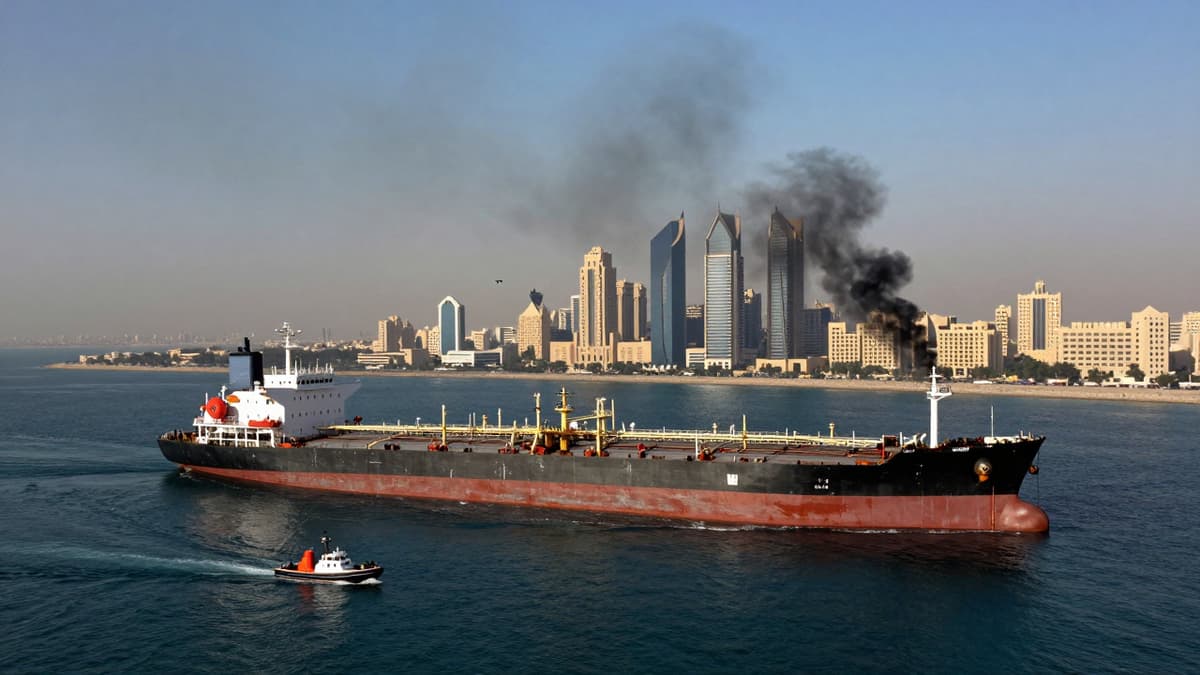
A Kuwaiti crude carrier attacked near Dubai sparks global energy fears, prompting President Trump to threaten Iran's energy infrastructure as jet fuel prices skyrocket.
A fully loaded Kuwaiti oil tanker was struck by an Iranian drone while anchored in Dubai waters on Tuesday, igniting a fire that authorities successfully extinguished. City officials reported no oil leakage and confirmed all 24 crew members are safe following the incident. This oil tanker attack marks a significant escalation in the ongoing conflict that has already killed thousands across at least nine nations since the US and Israel launched their aerial bombing campaign against Iran a month ago.
The vessel, identified as the large crude carrier "Al-Salmi," was hit 31 nautical miles northwest of Dubai by forces described by the Kuwait Petroleum Corporation as Iranian. Although the incident occurred in international waters, the strike has ignited fears of a catastrophic oil spill and a broader energy crisis. The UK maritime authority (UKMTO) confirmed the location of the strike, while Dubai authorities stated that teams are currently assessing the extent of the damage to the vessel. Despite the attack, city authorities confirmed the fire has been contained and no injuries have been sustained by the crew.
The timing of this maritime incident coincides with renewed threats from US President Donald Trump regarding Iran's energy infrastructure. Trump has threatened to blow up Iran's energy facilities if Tehran does not reopen the Strait of Hormuz, a deadline he has pushed back twice in the past two weeks. Washington claims that talks with Tehran are ongoing, though the White House press secretary admitted that Iranian officials currently at the negotiating table appear more reasonable than previous leadership, despite sending contradictory messages. Iran's parliamentary Security Commission has also approved a plan to impose tolls on ships passing through the Strait of Hormuz, a critical waterway through which about a fifth of the world's oil supply passes.
The geopolitical tension has triggered immediate volatility in global markets. Oil prices rose slightly on Tuesday, with US crude futures settling above $100 per barrel for the first time since July 2022. Brent crude, the global benchmark, edged up 0.23% to $113.04 per barrel, while West Texas Intermediate (WTI) rose 0.04% to $102.92. However, major Asian stocks struggled, with Japan's Nikkei 225 sliding 1% and South Korea's Kospi falling 3.1% as investor concerns over a protracted conflict lingered.
The aviation sector is facing the most acute financial strain. Global jet fuel prices have more than doubled since the war in the Persian Gulf began, forcing airlines to drastically adjust their operations. Data from the International Air Transport Association (IATA) shows worldwide average jet fuel prices sit 104% higher than last month, reaching an average of $4.65 per gallon. Asia and Oceania have seen the most severe surge, with prices jumping 134% to nearly $5 per gallon. Airlines, which typically allocate about 30% of their costs to fuel, are now facing a situation where fuel expenses could more than double if current prices persist.
Korean Air Vice Chairman Woo Kee-hong announced that the airline will switch to "emergency management mode" starting in April. This decision comes as fuel costs threaten to consume a significantly larger portion of operational budgets. The "crack spread"-the difference between crude and refined jet fuel-has increased 231% in the past month alone. In response to these soaring costs, airlines are increasing surcharges, reviewing flight routes, and potentially cutting services. A smaller commercial jet like an Airbus A320 burns 750 to 900 gallons of fuel per hour, while long-haul jets like the Boeing 787 burn up to 2,200 gallons, making the current price spikes devastating for carriers operating these fleets.
Beyond the economic fallout, the military situation remains volatile. Iran has fired salvos of drones and missiles at Saudi Arabia and other Gulf Cooperation Council members, including Kuwait, Bahrain, Qatar, the UAE, and Oman. Yet, so far, none of these nations have retaliated against Tehran. Meanwhile, Israel's military reported that four additional soldiers were killed in southern Lebanon, bringing the total Israeli death toll to ten during its offensive targeting Hezbollah.
The conflict has also intensified inside Iran, with the city of Isfahan reportedly under heavy bombardment and explosions reported in Tehran. State media confirmed power outages in the capital caused by shrapnel striking a substation, though power was later restored. Israel's military had issued a warning via social media to residents of Tehran about strikes in the Vard Avar area, although an internet blackout in Iran since the war began likely prevented the message from reaching the populace. As the world grapples with the potential closure of the Strait of Hormuz by Iran, roughly 15 million barrels of crude per day remain stranded in the Persian Gulf, creating a precarious situation for global supply chains.
Strategic Sanctions and Supply Chain Risks Loom
The combination of an oil tanker attack, threats to critical energy infrastructure, and military engagements across the Gulf has created a volatile environment that shows no signs of immediate de-escalation. With Iran moving to enforce tolls and regulate passage through the Strait of Hormuz, and the US maintaining a stance of threatening further destruction of energy facilities, the immediate future points toward sustained high costs and potential logistical disruptions. As airlines continue to implement emergency cost measures and global stocks react negatively to the fear of a protracted war, the world faces a continued global energy crisis. The scale of this conflict could potentially expand further, given Iran's recent attacks on multiple Gulf neighbors and the lack of retaliation from those nations, suggesting that the current volatility may only be the beginning of a deeper regional and economic confrontation.
Jun 8, 2026 02:17 UTC
Magnitude 7.8 Quake Shakes Philippines, Urging Immediate Evacuations
Jun 8, 2026 00:51 UTC
Trump Claims Iran Nuclear Deal Imminent Despite Diplomatic Fractures
Jun 8, 2026 00:47 UTC
Iran Fires Missiles at Israel After Beirut Strike
Jun 7, 2026 22:00 UTC
US, Iran Peace Hops Fade 100 Days Into War
Jun 8, 2026 04:15 UTC
Trump Urges Netanyahu to Halt Iran Strike for Peace


