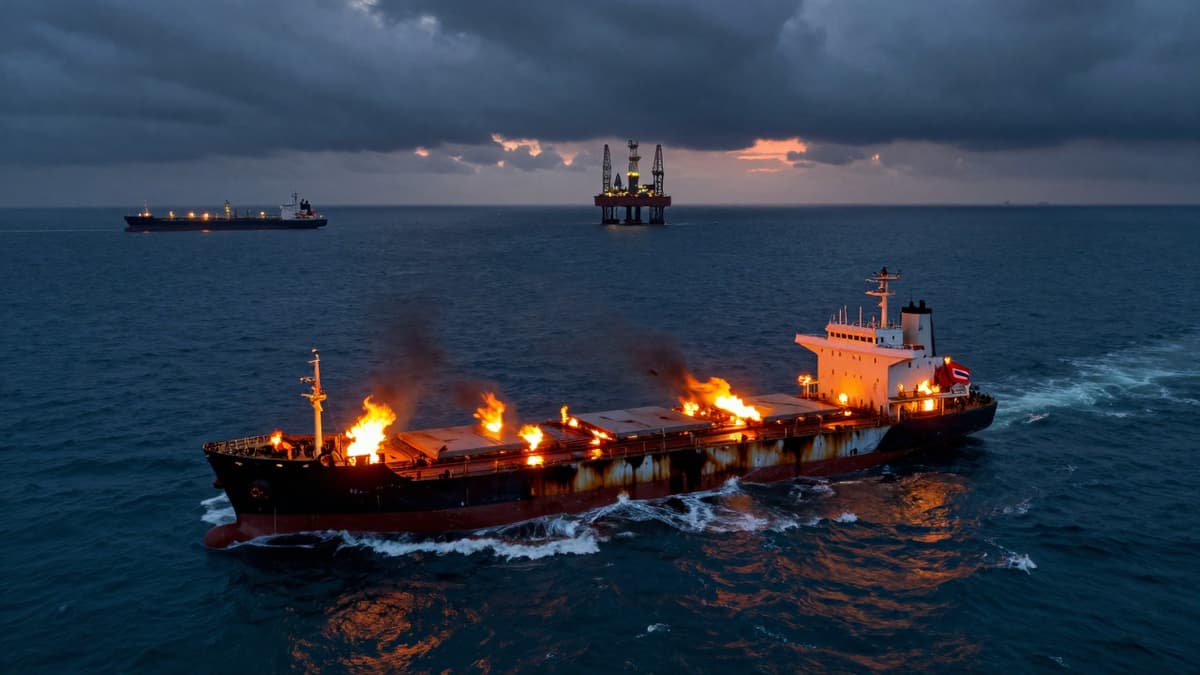
As three Thai sailors remain missing after a drone strike, the geopolitical crisis deepens. President Trump threatens to obliterate Iran's energy infrastructure if the vital waterway reopens.
The ongoing conflict in the Middle East has reached a critical tipping point, with US President Donald Trump threatening to obliterate Iran's energy infrastructure if a deal to reopen the Strait of Hormuz is not reached. This escalation coincides with a grim update from Thailand, which reported that three of its crew members remain missing following a drone attack on their vessel earlier in March. The situation has drawn sharp international condemnation regarding potential war crimes and raised alarms from global economic bodies about the IMF economic impact of a prolonged conflict.
The incident involving the Thai-flagged vessel, Mayuree Natalee, occurred on the morning of March 11 when the ship was struck by an Iranian drone while transiting the strait. According to Thai authorities, the strike caused a fire in the engine room, leaving the ship heavily damaged by fire, residual smoke, and flooding. While the Omani navy managed to rescue 20 crew members and evacuate them to Khasab, three sailors remain unaccounted for. Iran's Islamic Revolutionary Guard Corps claimed the ship was fired upon after it "disregarded warnings and insistently attempted to illegally pass through the Strait of Hormuz." Despite the vessel's owner hiring a specialized search team, Panidone Pachinsawat, a spokesperson for the Thai foreign ministry, confirmed that the team could not locate the missing sailors due to the extensive damage.
This maritime incident is just one of at least 16 attacks on vessels in the Arabian Gulf, Strait of Hormuz, and Gulf of Oman since the war began on February 28, according to the UK's maritime authority. The frequency of these strikes has triggered immediate geopolitical backlash. President Trump has explicitly warned that the US will target Iranian power facilities and potentially desalination plants if the waterway remains closed. Experts have cautioned that such moves could constitute war crimes. David Michel of the Center for Strategic and International Studies called a concerted attack on desalination plants a "provocative escalation," while Laurent Lambert of the Doha Institute noted it would be "both illegal - a war crime" given the region's limited water storage capabilities. Amnesty International added that striking energy infrastructure carries a "substantial risk of violating international humanitarian law" due to the devastating harm to civilians.
The economic fallout from these hostilities is already being felt globally. The International Monetary Fund has issued a stark warning that the Middle East war is sparking higher prices and slowing growth worldwide. In a blog post, IMF economists stated that while the war could shape the economy differently, "all roads lead to higher prices and slower growth." The fund highlighted that the selective blockade of the Strait of Hormuz is causing the loss of up to 20 million barrels of oil per day from Middle East producers, driving energy costs to soaring levels. Large energy importers in Asia and Europe are bearing the brunt of these costs, while countries in Asia and Africa struggle to access supplies even at inflated prices. The IMF further noted that rising food and fertilizer prices are already threatening food security in low-income economies. The fund has pledged to support member countries with policy advice and financial assistance, promising a fuller assessment in mid-April during meetings in Washington.
Parallel to the maritime crisis, violence in southern Lebanon has intensified, resulting in a rising death toll and the loss of UN peacekeepers. Two Indonesian UNIFIL peacekeepers were killed on Monday when an explosion destroyed their vehicle near Bani Hayyan, marking the second fatal incident involving UN personnel since the weekend. The UN mission confirmed that two others were injured, one severely. French Foreign Minister Jean-Noël Barrot has called for an emergency UN Security Council meeting, labeling the attacks "unacceptable and unjustifiable." The Lebanese army reported that a soldier was killed and five others wounded in a direct Israeli attack on a checkpoint in Ameriyeh. Israeli forces stated they fired at "suspects" identified in the area, later confirming they were Lebanese soldiers operating in a zone where launches were detected.
While the military situation deteriorates, diplomatic efforts are intensifying behind the scenes. White House press secretary Karoline Leavitt announced that talks between the US and Iran are "continuing and going well," though she noted that public statements differ from private communications. Leavitt suggested that current Iranian negotiators are more reasonable than previous leadership, describing them as "no longer on planet Earth" compared to their predecessors. US Secretary of State Marco Rubio remarked that it remains unclear how decisions are being made inside the Iranian regime. Meanwhile, Iran's Foreign Ministry spokesperson Esmaeil Baghaei dismissed the US 15-point list as containing "excessive, unrealistic, and unreasonable demands." As the conflict drags on, the world watches closely for a resolution that might avert further economic collapse and humanitarian disaster.
The United States has adopted a posture of extreme coercion, signaling that the window for a diplomatic solution is narrowing. President Trump's threat to obliterate energy sources represents a significant escalation beyond previous strategies, aiming to force the reopening of the Strait of Hormuz through direct economic and infrastructural pressure. If the current trajectory continues, the Middle East war could lock in higher global energy costs for months, exacerbating the IMF economic impact on developing nations already facing food insecurity. The potential targeting of desalination plants introduces a novel and dangerous dimension to the conflict, one that experts warn could constitute a war crime and severely deplete essential water resources for Gulf nations in a matter of weeks. As negotiations remain opaque, with the White House refusing to identify specific Iranian counterparts, the risk of miscalculation increases. Without a deal, the combination of maritime blockades, targeted infrastructure strikes, and escalating ground combat in Lebanon suggests a prolonged period of instability, with global supply chains and energy markets facing sustained disruption well into the second quarter of 2026.
Jun 8, 2026 02:17 UTC
Magnitude 7.8 Quake Shakes Philippines, Urging Immediate Evacuations
Jun 8, 2026 00:51 UTC
Trump Claims Iran Nuclear Deal Imminent Despite Diplomatic Fractures
Jun 8, 2026 00:47 UTC
Iran Fires Missiles at Israel After Beirut Strike
Jun 7, 2026 22:00 UTC
US, Iran Peace Hops Fade 100 Days Into War
Jun 8, 2026 04:15 UTC
Trump Urges Netanyahu to Halt Iran Strike for Peace


