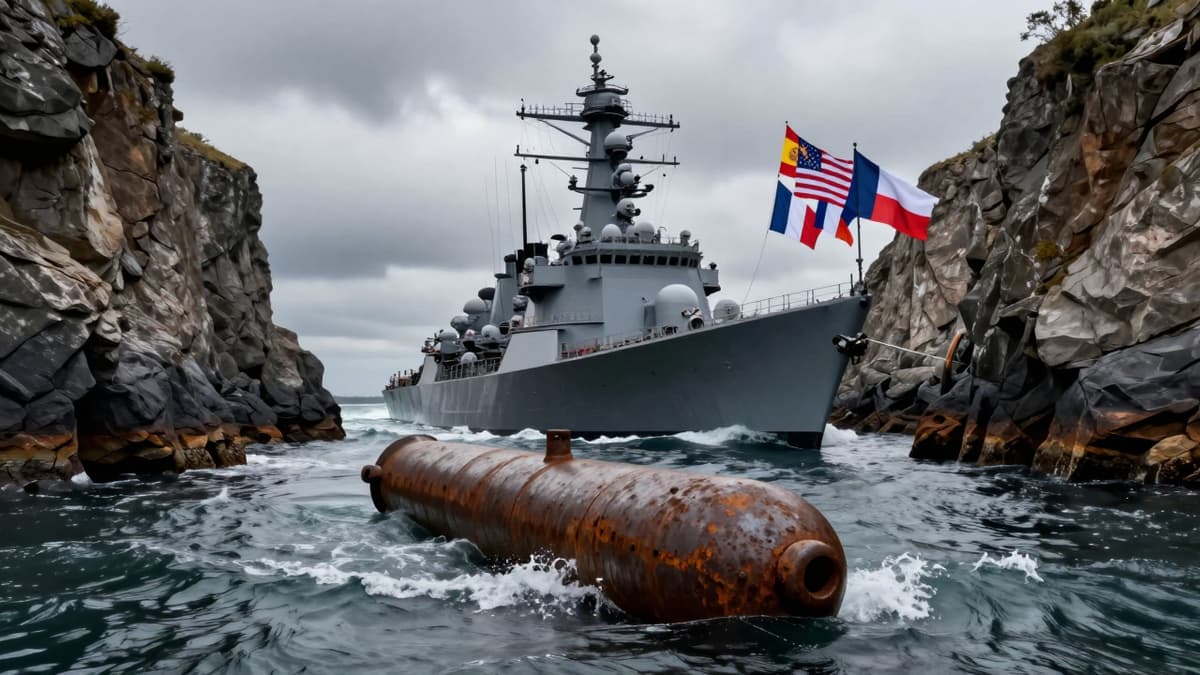
President Trump lashes out at NATO partners for denying base access and refusing to join a naval coalition, threatening to exit the alliance over their lack of support.
President Donald Trump's relationship with NATO allies is fraying as the US-Israel war on Iran enters its second month. A growing number of partners are resisting Washington's requests for support, creating a deepening transatlantic rift. From base access to naval deployments, responses remain lukewarm, prompting the Trump administration to threaten pulling out of the alliance.
This diplomatic breakdown follows a week of intense friction. Spain, the most vocal European opponent, declared its airspace closed to US military planes involved in the conflict. Defense Minister Margarita Robles stated that using jointly operated bases would be "unjustifiable" and "dangerous." Italy subsequently denied US bombers access to a Sicily base, though officials insisted there were no broader tensions with Washington. Meanwhile, the UK allowed bases only for defensive missions against attacks on British interests, with Prime Minister Keir Starmer declaring, "This is not our war."
President Trump reacted with sharp hostility. In an interview with The Telegraph, he labeled allies a "paper tiger" and said he was "strongly considering pulling out of NATO." Secretary of State Marco Rubio echoed this disdain, telling Al Jazeera that an alliance focused solely on defending Europe without reciprocal support is "not a very good arrangement" that needs re-examination. The US President specifically lashed out at France for refusing transit rights for planes carrying US weapons to Israel, calling the move "VERY UNHELPFUL." Even Poland's defense minister confirmed no plans to move Patriot systems to the Middle East, citing national security as an absolute priority.
The core of the dispute centers on the Strait of Hormuz blockade, a critical chokepoint through which a fifth of global oil exports pass. Iran has nearly halted traffic through the narrow waterway with relatively few attacks. Trump has repeatedly asked allies to join a naval coalition to open the strait, but Italy, the UK, France, Greece, and Germany have all refused. German Defense Minister Boris Pistorius explained that Germany has "not started it." When Trump questioned if allies could do what the US Navy cannot, he suggested they "TAKE IT" rather than asking for fuel they cannot get due to the blockade.
Starmer noted that London is discussing the use of mine-hunting drones with other allies, but Trump dismissed this as insufficient, demanding the strait be seized. Experts warn that this mounting anger could fuel the president's MAGA movement. Samir Puri, a visiting lecturer at King's College London, noted that such "visceral anger" towards European allies and Defense Secretary Pete Hegseth suggests the bond of NATO is weakening significantly.
The economic repercussions of the Strait of Hormuz blockade are already severe, with oil and gas prices rising by up to 60 percent in some regions. Shipping companies are avoiding the waterway due to fears of attacks, causing major disruptions to global supply chains that will persist even after the strait reopens. France is currently in talks with roughly 35 countries to plan a mission to reopen the waterway once the war concludes. If Trump follows through on his suggestion that allies must handle the blockade themselves or face US withdrawal, the world could face even greater economic instability and a potential end to the war with Iran in control of the critical waterway.
Jun 8, 2026 00:51 UTC
Trump Claims Iran Nuclear Deal Imminent Despite Diplomatic Fractures
Jun 8, 2026 00:47 UTC
Iran Fires Missiles at Israel After Beirut Strike
Jun 7, 2026 22:00 UTC
US, Iran Peace Hops Fade 100 Days Into War
Jun 7, 2026 20:57 UTC
Iran Strikes Israel: IRGC Promises Week of Continuous Offensive
Jun 8, 2026 02:28 UTC
Trump Walks Out of Meet the Press After Rejecting Evidence Demands


