
Section
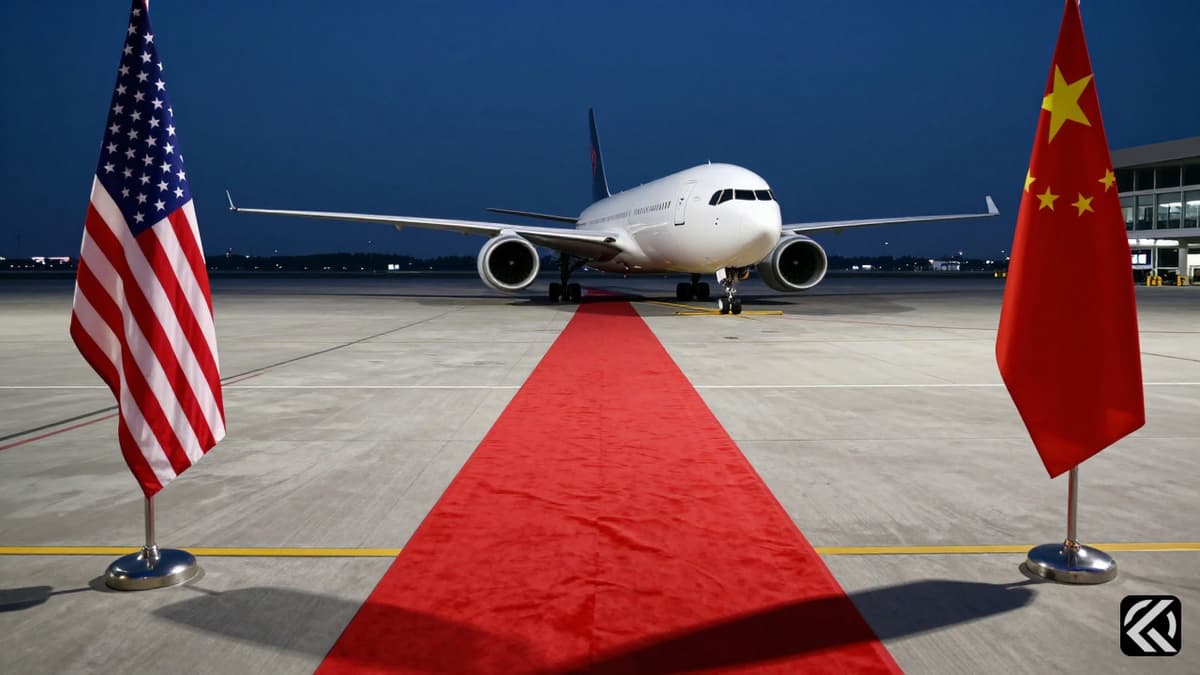
As global markets watch, President Donald Trump has landed in Beijing for urgent negotiations with Xi Jinping, focusing on trade tensions and geopolitical stability.
US President Donald Trump descended the steps of Air Force One in Beijing on Wednesday evening, marking the beginning of a highly anticipated diplomatic mission. He was greeted with significant pomp and pageantry as he prepared for a high-stakes meeting with his Chinese counterpart, Xi Jinping. This two-day visit represents a critical moment for global superpowers, who are expected to engage in serious discussions regarding tariffs, competition over technology, the ongoing war in Iran, and the United States' complex relationship with Taiwan. The arrival of the American president signals a decisive shift in geopolitical dynamics as both nations seek to stabilize their intertwined economies and security interests.
Trump returns to a more assertive China compared to the era of his last visit in 2017. At this juncture, he faces growing scrutiny regarding his military campaign in the Middle East, adding urgency to his diplomatic efforts. Originally, the president was scheduled to make this trip in March, but it was delayed due to the conflict between the United States and Israel in Iran. This war continues to roil the global economy, creating a volatile backdrop for the current negotiations. The delay allowed the situation to evolve, but it has also heightened expectations for the outcomes of this delayed visit.
When Trump exited the plane on Wednesday evening, he was met by Chinese Vice-President Han Zheng, one of China's top leaders. This high-level reception is being interpreted as a clear show of respect for the US president from Beijing. Notably, a lower-level leader received Trump on his previous visit, making this protocol change particularly significant. The presence of Han Zheng at the welcome ceremony underscores the importance China places on the current dialogue and the potential for substantial agreements.
Also spotted at the welcome, as a red carpet was unravelled across the tarmac, were Trump's son Eric Trump and a slew of US tech industry titans. Among the prominent figures present were Tesla's Elon Musk and Nvidia's Jensen Huang. Their presence highlights the commercial and technological dimensions of the visit, suggesting that economic collaboration remains a central pillar of the administration's strategy. The inclusion of these industry leaders indicates a direct effort to integrate business interests with state-level diplomacy.
"I will be asking President Xi, a Leader of extraordinary distinction, to 'open up' China so that these brilliant people can work their magic, and help bring the People's Republic to an even higher level," Trump said in a post on social media ahead of his landing. He emphasized that opening China's markets to American tech firms will be his "very first request" when he meets the Chinese leader. This statement clarifies the primary economic objective of the summit, focusing on market access and technological exchange as tools for mutual growth and influence.
The geopolitical context of the meeting is further complicated by China's economic dependencies. China relies considerably on Iran for oil exports, which have effectively been cut off as ships are unable to navigate the Strait of Hormuz due to the ongoing conflict. Consequently, the country faces growing pressure from the US to use its economic and political influence over Iran. This dynamic gives the US a significant lever in negotiations, as China's energy security is directly impacted by the war. Trump is expected to press Xi Jinping to utilize this influence to de-escalate tensions and restore stability to global energy markets.
The meeting will also be marked by tensions over Taiwan in the backdrop. The Trump administration has taken a mixed approach with Taipei, approving a massive arms deal while simultaneously downplaying its willingness to defend the island from Chinese aggression. This dual strategy creates a complex diplomatic environment where military posturing and diplomatic outreach occur simultaneously. The resolution of these tensions will require careful navigation of red lines and mutual interests by both leaders.
The discussions are expected to have far-reaching consequences for the global economy. If successful, the agreement on tariffs and market access could alleviate some of the economic strain caused by the ongoing conflicts. However, the path to agreement is fraught with challenges. Both nations have distinct strategic goals that must be reconciled. For China, maintaining energy supplies from Iran is crucial, while for the US, securing influence in the Middle East and Taiwan is paramount.
The presence of tech industry leaders like Elon Musk and Jensen Huang suggests that the outcome of these talks could reshape the global technology landscape. American companies seeking to operate in China may find new opportunities, but they must navigate a regulatory environment that is increasingly assertive. The success of this visit will depend on whether Xi Jinping is willing to make concessions that allow US firms to thrive while maintaining China's sovereignty and strategic interests.
The delay in the visit also means that public opinion and market conditions have shifted significantly. Investors and international observers are watching closely to see if the negotiations will result in a de-escalation of trade tensions or if they will lead to further confrontation. The outcome will likely set the tone for US-China relations for years to come, influencing everything from supply chains to military alignments in the Pacific and the Middle East.
In summary, the arrival of Donald Trump in Beijing for talks with Xi Jinping represents a pivotal moment in international relations. The discussions on tariffs, tech access, and regional stability will define the trajectory of US-China relations. If the leaders can bridge their differences, it could lead to significant economic recovery and geopolitical calm. However, given the deep-seated tensions and competing interests, the risk of diplomatic failure remains high, with potential consequences for the global economy and security.
Jun 11, 2026 12:59 UTC
US Strike on Settebello Kills Indian Sailors Amid Strait of Hormuz Tensions
Jun 11, 2026 12:49 UTC
Air India Flight 171 Crash Sparks Debate Over Boeing 787 Dreamliner Faults
Jun 11, 2026 08:51 UTC
US-Iran Conflict: Indian Seafarers Killed in Gulf Strike
Jun 11, 2026 18:04 UTC
Healey Quits Government Over Defence Spending Dispute


