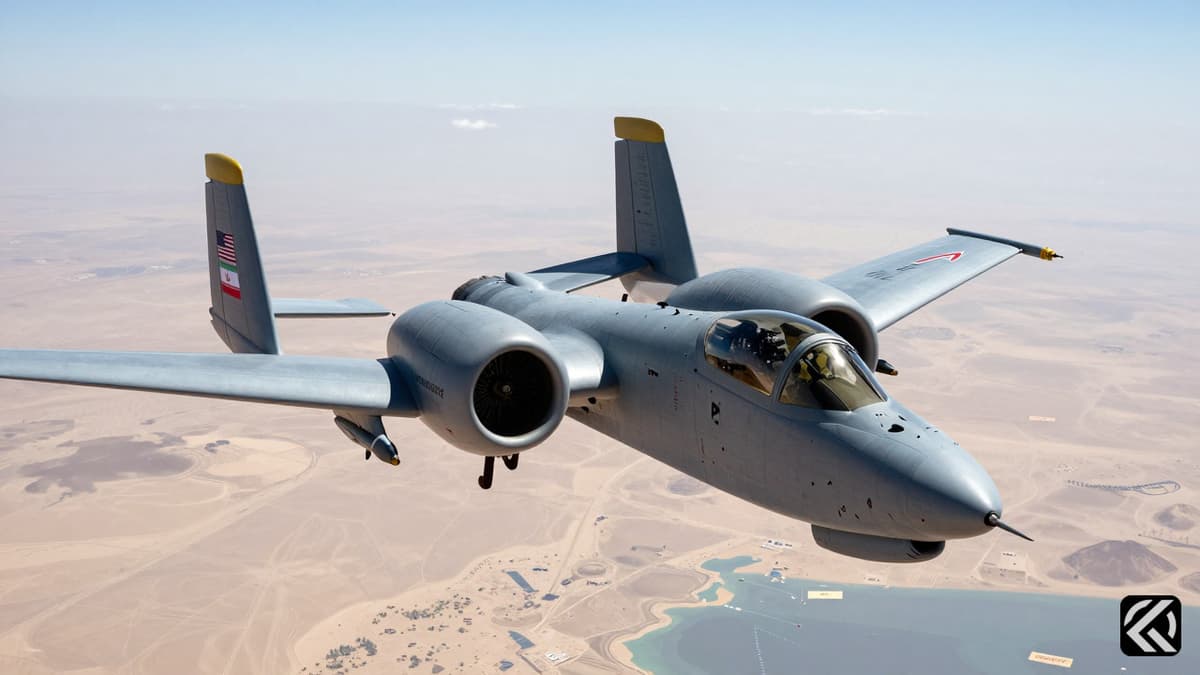
President Trump signals the US-Iran War ceasefire concludes Wednesday, while the US Air Force extends A-10 service, heightening regional tensions.
President Donald Trump announced Monday that the current ceasefire with Iran will conclude Wednesday evening, signaling a potential escalation in the US-Iran War. This development coincides with the US Air Force extending the operational life of its A-10 Thunderbolt jets to 2030, highlighting ongoing military preparedness.
The announcement followed a radio interview where Trump expressed confidence that Iran would negotiate, though he warned of severe consequences if talks fail. Meanwhile, the military landscape on the ground and at sea has shifted, with the iconic "Warthog" aircraft being retained to support rescue operations and suppress enemy forces in Iran. Top US officials are scheduled to travel to Pakistan for peace talks, yet Iranian leadership has expressed significant hesitation, citing continued US provocations as a primary barrier to renewed diplomacy.
The US Air Force officially announced the decision to keep the A-10 Thunderbolt in service until at least 2030, overturning a prior plan to retire the aircraft later this year. This extension was mandated by Congress through the National Defense Authorization Act, which required the service to maintain 103 of the twin-engine jets. The decision comes after the aircraft proved critical during recent hostilities, particularly in the rescue of two aircrew members ejected from an F-15E fighter struck by a missile over Iranian territory.
Joint Chiefs Chairman Gen. Dan Caine praised the A-10s and their pilots for spearheading the rescue mission. He noted that the jets were instrumental in suppressing Iranian forces attempting to intercept the downed crew and other US rescue teams. In a tragic but valorous event, one A-10 was hit during the operation; its pilot managed to fly the damaged aircraft back over friendly territory before ejecting safely.
The A-10, nicknamed the "Warthog," has a long history of service, having been first delivered to Davis-Monthan Air Force Base in Arizona in October 1975. Its defining feature is the 30mm gatling gun nose cannon, which produces a distinctive "BRRRPPPP" sound and can fire up to 3,900 rounds a minute to destroy tanks and decimate infantry. The aircraft's continued presence underscores the administration's commitment to aerial ground support. Notably, the final class of A-10 pilots graduated earlier this month from training at the base in Arizona, ensuring a fresh cadre of operators for the extended fleet.
President Donald Trump addressed the diplomatic crisis in a phone interview on "The John Fredericks Show," projecting certainty that Tehran would engage in negotiations ahead of anticipated talks in Pakistan. "Well, they're going to negotiate, and if they don't, they're going to see problems like they've never seen before," Trump stated, warning of dire consequences should diplomacy fail. He expressed hope for a "fair deal" that would allow Iran to rebuild without acquiring a nuclear weapon.
When pressed on the justification for the recent military action, Trump reiterated his stance that there was no alternative but to act against Iran. "I have to say we had no choice in Iran. It wasn't like we had a choice. We had to do it," he said, adding that the US had done a "great job" and expected the situation to be resolved to everyone's satisfaction.
The diplomatic landscape remains fraught with uncertainty as senior US officials prepare to travel to Pakistan. However, the Iranian Foreign Ministry has indicated that the country has no current plans to reengage with the US, citing "provocative actions" and ceasefire violations as major obstacles. Iranian Foreign Minister Abbas Araghchi told his Pakistani counterpart Ishaq Dar that Tehran is considering all aspects of the situation before deciding on the next steps.
The rhetoric from Tehran has been sharp. Parliament Speaker and negotiator Mohammad Ghalibaf criticized Trump, stating in a post on X that the President seeks to turn the negotiating table into a "table of surrender" or to justify renewed warmongering. Ghalibaf emphasized that Iran does not accept negotiations under the shadow of threats and has prepared to reveal new strategies on the battlefield.
The situation has already impacted global commerce, with shipping through the Strait of Hormuz remaining cautious. Data from MarineTraffic.com shows that only 16 ships traversed the strait on Monday, including two Iranian-flagged vessels entering and one cargo ship exiting. US Central Command previously claimed to have directed 27 vessels to turn around or return to Iranian ports following the blockade.
President Trump has also used the opportunity to contrast his proposed agreement with the previous nuclear deal. In a Truth Social post, he labeled the Obama-era JCPOA as one of the "Worst Deals ever made," arguing his approach would prevent nuclear weapons acquisition and ensure broader security. He claimed the old deal was a "guaranteed Road to a Nuclear Weapon," whereas his administration's efforts would differ significantly in structure and outcome, potentially involving the unfreezing of $20 billion in Iranian assets.
The convergence of a military extension for the A-10 Thunderbolt and a diplomatic ultimatum from President Trump suggests the US-Iran War is entering a critical phase where military leverage is being used to force a new diplomatic outcome. With the ceasefire set to expire Wednesday evening and no likely extension, the window for a negotiated settlement is narrowing rapidly. If Iran refuses to engage or if US-Iran diplomatic channels remain blocked by accusations of violations, the region faces a high probability of renewed direct conflict. The low volume of shipping in the Strait of Hormuz indicates that economic consequences are already materializing, while the retention of combat aircraft signals a readiness for prolonged engagement. Future stability will depend heavily on whether the "problems" threatened by Trump materialize into action or if a last-minute diplomatic breakthrough occurs in Pakistan before the deadline.
Jun 8, 2026 02:17 UTC
Magnitude 7.8 Quake Shakes Philippines, Urging Immediate Evacuations
Join 50,000+ readers getting the global briefing every morning.
No spam. Unsubscribe anytime.
Jun 8, 2026 02:17 UTC
Magnitude 7.8 Quake Shakes Philippines, Urging Immediate Evacuations
Jun 8, 2026 00:51 UTC
Trump Claims Iran Nuclear Deal Imminent Despite Diplomatic Fractures
Jun 8, 2026 00:47 UTC
Iran Fires Missiles at Israel After Beirut Strike
Jun 7, 2026 22:38 UTC
Congress Party Claims Unity for INDIA Bloc Delhi Meeting


