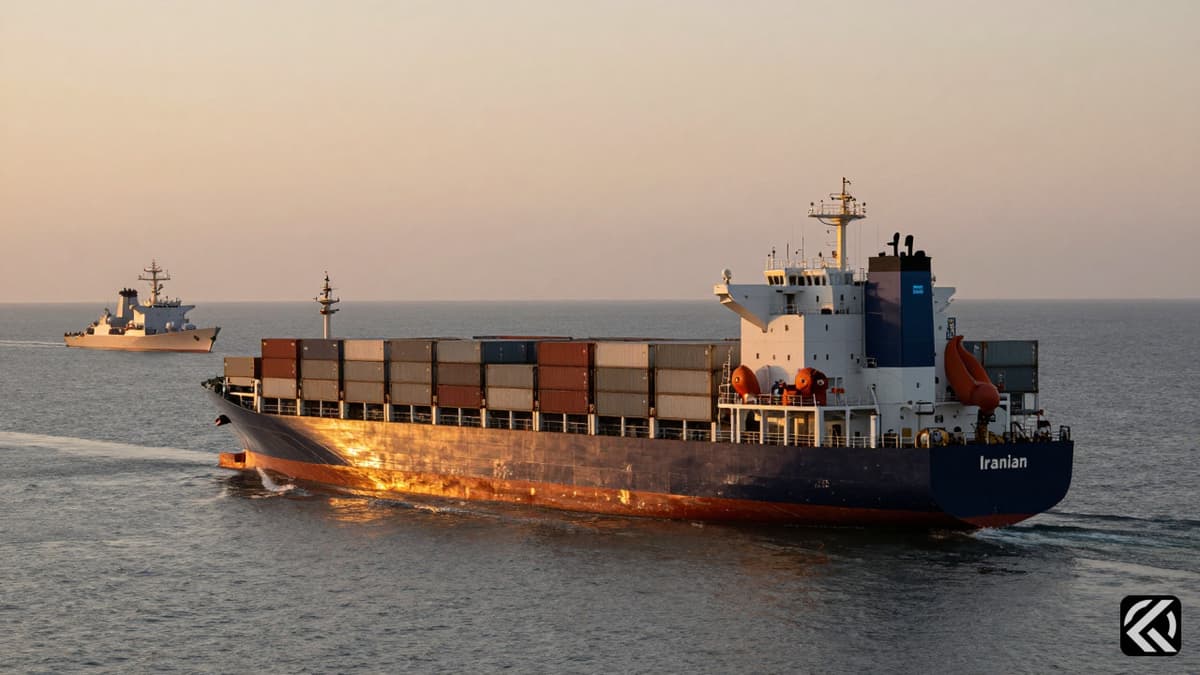
Amidst a fragile diplomatic window, US forces seized the Iranian vessel Touska following a refusal to heed blockade orders, instantly derailing negotiations and raising tensions.
The United States military seized the Iranian container ship Touska near the Gulf in the early hours of Monday, escalating tensions hours before Washington planned to send negotiators to Pakistan for talks aimed at ending their war. US Central Command (CENTCOM) and President Donald Trump stated the vessel was hit after refusing to withdraw from its planned passage through the Strait of Hormuz, where a naval blockade has been in effect since last Monday.
Iran immediately responded to the capture by labeling the attack an act of "piracy" and threatening retribution. In a significant shift, the Iranian Foreign Ministry announced on Monday that it has no plans to send its negotiators to Islamabad, derailing the talks Pakistan was attempting to host as early as Tuesday. This incident marks the first time US forces have targeted a non-military Iranian ship or captured a cargo vessel during the current conflict, which has been characterized by a week-long naval blockade enforced by American forces.
A little after midnight in Iran, CENTCOM announced that the guided-missile destroyer USS Spruance had fired its 5-inch (127 mm) MK 45 gun at the Touska's engine room, effectively disabling the vessel. According to the US military, the Touska was attempting to cross from the Arabian Sea through the Strait of Hormuz, heading toward the Iranian port of Bandar Abbas. The US had been enforcing a strict naval blockade since April 13, a response to Iran blocking the passage of most vessels through the narrow waterway.
Under the rules of the blockade, the US military is barring any ships belonging to Iran, or those traveling to or from Iranian ports, from passing through the strait. This measure effectively blocks Iran's own ships from exporting the country's oil to other nations. According to Al Jazeera's calculations, Iran earned nearly $5 billion in revenue from the export of oil in the month leading up to the US blockade. The CENTCOM confirmed that American forces issued multiple warnings to the Iranian-flagged vessel, informing it that it was in violation of the US Strait of Hormuz blockade.
After the Touska's crew failed to comply with repeated warnings over a six-hour period, the USS Spruance directed the vessel to evacuate its engine room. Following the command, the American destroyer fired at the Iranian ship. Subsequently, US Marines from the 31st Marine Expeditionary Unit clambered onto the Touska to capture the vessel. In a grainy video released by CENTCOM, US troops can be seen flying from the USS Tripoli on helicopters and using ropes to climb down to the Touska.
The container ship flies under the Iranian flag and measures 294 meters (965 feet) in length, making it only a little shorter than the US aircraft carrier USS Abraham Lincoln, which stands at 332.8 meters (1,092 feet) long. The Touska is 32.25 meters (105.8 feet) wide. The vessel and its owners have been under sanctions issued by the US Treasury Department and the US Office of Foreign Assets Control, with accusations that they helped Iran break sanctions. It remains unclear exactly what the Touska was carrying at the time of the seizure. Donald Trump posted on Truth Social that American troops are currently "seeing what's on board."
Early on Monday morning, Iran called the capture of the Touska an act of "piracy." Hours later, Iranian Foreign Ministry Spokesperson Esmaeil Baghaei told reporters that Tehran had no plans to send its negotiators to Islamabad for a round of talks that Pakistan is trying to host. The US has stated that its negotiators, Steve Witkoff and Jared Kushner, were scheduled to go to Islamabad on Monday for these talks. Baghaei accused the US of "violating the ceasefire" that has largely held between the US and Iran since April 9.
"Iran does not trust Washington," Baghaei stated. When asked about the US negotiators expected to travel to Islamabad, the Iranian foreign ministry spokesperson added, "There are indications from the American side that there is no seriousness on the side of the US to walk down the path of diplomacy." Separately, the Iranian military has vowed retaliation for the ship's seizure. A spokesperson for Khatam al-Anbiya, Iran's joint military command, stated, "We warn that the armed forces of the Islamic Republic of Iran will soon respond and retaliate against this armed piracy by the US military." This escalation has solidified the current Iran-US naval confrontation, turning a diplomatic opportunity into a military crisis.
The seizure of the Touska represents a critical turning point in the ongoing conflict, shifting the dynamic from a tense standoff to direct kinetic engagement. With the US having disabled and captured a civilian vessel under sanction, and Iran immediately canceling its participation in peace talks, the diplomatic path to de-escalation appears closed. The Iranian threat of retaliation suggests a high probability of further military actions in the immediate future, potentially targeting US naval assets or disrupting the blockade itself. As the US holds the captured ship, the window for the planned negotiations in Islamabad has effectively slammed shut, leaving the region on the brink of a wider escalation in the Persian Gulf.
Jun 8, 2026 00:51 UTC
Trump Claims Iran Nuclear Deal Imminent Despite Diplomatic Fractures
Jun 8, 2026 00:47 UTC
Iran Fires Missiles at Israel After Beirut Strike
Jun 7, 2026 22:00 UTC
US, Iran Peace Hops Fade 100 Days Into War
Jun 7, 2026 20:57 UTC
Iran Strikes Israel: IRGC Promises Week of Continuous Offensive
Jun 8, 2026 02:28 UTC
Trump Walks Out of Meet the Press After Rejecting Evidence Demands


