
Section
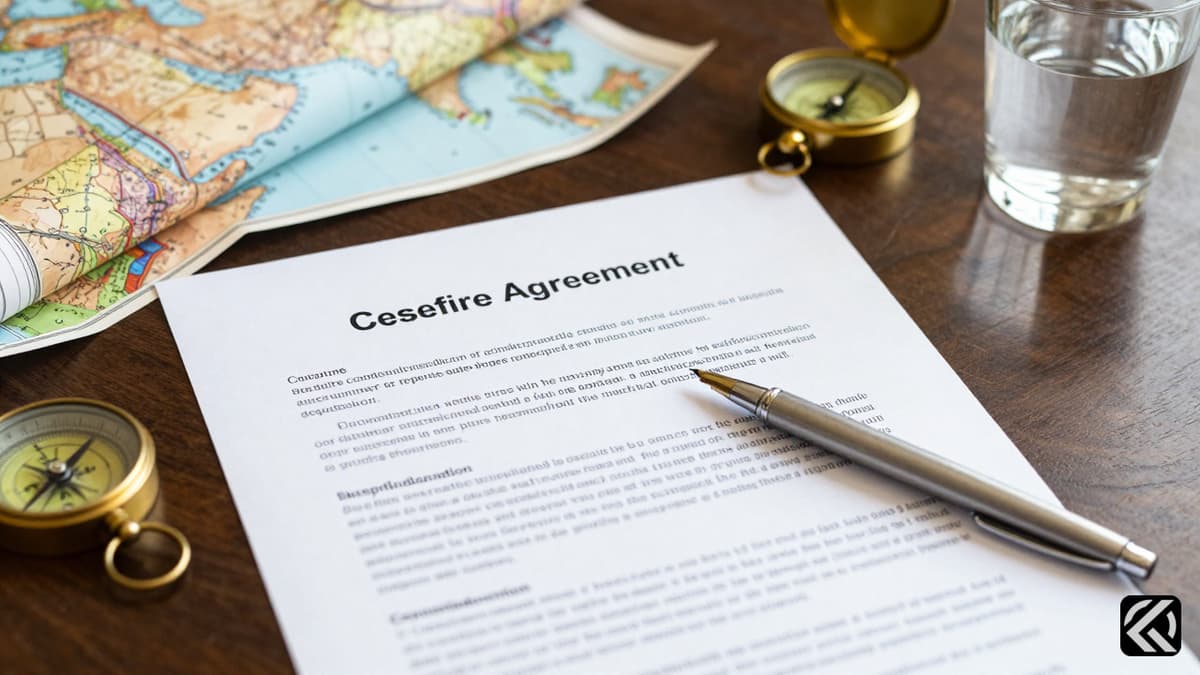
President Trump confirms the Trump ceasefire deal with Iran is largely negotiated, outlining key terms including the reopening of the Strait of Hormuz for global trade.
United States President Donald Trump has declared that a significant Trump ceasefire deal with Iran has been largely negotiated, marking a pivotal shift in the ongoing conflict. Speaking on Saturday, the US president confirmed that the Memorandum of Understanding intended to end the US-Israel war with Iran is in its final stages. He emphasized that the agreement is still "subject to finalization" by US and Iranian negotiators, as well as "various other countries" involved in the diplomatic process. This announcement signals a critical juncture in a week characterized by fluctuating threats and diplomatic maneuvering.
The President made his statement following a series of high-level diplomatic calls with leaders and officials from Qatar, Saudi Arabia, the United Arab Emirates, Pakistan, Jordan, Egypt, Turkiye, and Bahrain. Additionally, he held a separate conversation with Israeli Prime Minister Benjamin Netanyahu. On his Truth Social platform, Trump wrote, "Final aspects and details of the Deal are currently being discussed, and will be announced shortly." This declaration follows a period of intense uncertainty, during which Trump had previously warned Iran that time was running out for a lasting ceasefire. He had later revealed to reporters that he was moments away from resuming military attacks before deciding to put them "on hold" at the request of Gulf nations.
A central component of the emerging agreement is the reopening of the Strait of Hormuz. Trump noted on Saturday that the deal will explicitly include provisions to reopen this vital maritime chokepoint. This detail is crucial given the current status of regional trade and military logistics. While Trump did not provide specific operational details on how the reopening will be enforced, the inclusion of this term suggests a move toward normalizing maritime traffic. Turkiye’s President Recep Tayyip Erdogan commented on the progress after the call, stating that Ankara was pleased with the developments. He highlighted that any resulting agreement would facilitate free passage through the Strait of Hormuz, although he declined to elaborate further on the mechanics of this facilitation.
The diplomatic efforts have been bolstered by recent activities from regional mediators. Pakistan’s army chief, Asim Munir, concluded a short but "highly productive" visit to Iran on Saturday, according to a statement from Pakistan’s military. The statement noted that "encouraging progress" had been made toward reaching a final understanding. Following this, Pakistani Prime Minister Shehbaz Sharif stated that his country would continue to facilitate dialogue between the warring parties. Sharif expressed hope that Islamabad could host future US-Iran talks "very soon," positioning Pakistan as a key hub for subsequent negotiations.
Egypt’s presidency also issued a separate statement urging all parties to seize the diplomatic initiative and reach an agreement swiftly. This collective pressure from regional powers underscores the urgency and importance of finalizing the terms. The context for these talks is a conflict that began on February 28, when the US and Israel launched the latest war. However, fighting has largely remained paused as of April 8, barring a handful of flare-ups. Despite the pause in direct combat, tensions remain high. The US has continued to blockade Iran’s ports, and Iran has effectively closed the Strait of Hormuz, creating a stalemate that diplomats are now working to break.
The current negotiations are taking place against a backdrop of deep-seated mistrust. Tehran officials have repeatedly voiced wariness over negotiating with the US, citing past hostilities. Specifically, the US had twice launched military attacks on Iran during previous talks about its nuclear programme. This history adds a layer of complexity to the current Trump ceasefire deal, requiring careful navigation of historical grievances.
Trump’s approach has been characterized by a mix of escalation and de-escalation rhetoric. In the days leading up to the announcement, he alternated between renewing threats of escalation and suggesting that a deal was close. On Saturday, he posted a picture on his platform showing the map of Iran covered in a US flag, a move that drew significant attention. This visual gesture served as a stark reminder of the power dynamics at play, even as diplomatic channels remained open.
The role of international mediators has been crucial in bridging the gap between the conflicting parties. The involvement of Gulf states, Pakistan, and other regional powers highlights the global interest in stabilizing the region. The participation of multiple countries in the ceasefire talks indicates that any agreement will have broader geopolitical implications, extending beyond the immediate belligerents.
The potential reopening of the Strait of Hormuz represents a significant economic and strategic turning point for the region. If the Trump ceasefire deal is finalized as indicated, the removal of blockades and the restoration of free passage will likely lead to a surge in global energy shipments from the Middle East. This normalization would alleviate global fuel price pressures and restore supply chains that have been disrupted by the ongoing conflict. However, the success of this reopening depends entirely on the strict adherence to the agreement by both US and Iranian forces. Given the history of mistrust and the recent pause in fighting, the implementation phase will be critical. Future stability will rely on sustained diplomatic engagement, particularly from mediators like Pakistan and Gulf nations, to ensure that the ceasefire holds and that maritime routes remain open for international commerce.
Jun 11, 2026 17:21 UTC
Bangladesh Opposition Mobilizes Against India-Bangladesh Border Push-Ins and BSF Killings
Join 50,000+ readers getting the global briefing every morning.
No spam. Unsubscribe anytime.
Jun 11, 2026 17:40 UTC
Boelter Pleads Guilty in Minnesota Political Assassinations
Jun 11, 2026 17:21 UTC
Bangladesh Opposition Mobilizes Against India-Bangladesh Border Push-Ins and BSF Killings
Jun 11, 2026 17:21 UTC
John Healey Quits as UK Defence Secretary Over Funding Dispute
Jun 11, 2026 16:19 UTC
UK Defence Secretary John Healey Quits Over Funding Dispute


