Conflicting reports emerge as the White House claims productive US-Iran negotiations, contrasting sharply with Tehran's rejection of dialogue and rising fears over global fuel markets.
A stark divergence of reality has emerged from the White House and Tehran regarding the ongoing war. White House Press Secretary Karoline Leavitt stated on Wednesday evening that President Trump is engaged in "productive conversations" with Iranian leaders. This assertion stands in direct contradiction to official statements from Tehran, which firmly rejects the existence of any dialogue or negotiations. The conflicting accounts create a complex diplomatic landscape where Washington claims progress while the Islamic Republic denies any engagement, leaving the status of potential US-Iran negotiations in a state of intense uncertainty.
The administration's stance is further characterized by bold declarations from President Trump himself. Leavitt reiterated Trump's position that a regime change in Iran has already been achieved, citing reports that Iranian leaders have been killed and that no one has legitimately heard from Mojtaba Khamenei. The President insists that the Iranian leadership is currently negotiating but is too afraid to admit it, fearing retribution from their own population or the United States. Leavitt also noted that the US operation is "ahead of schedule," suggesting an imminent resolution. When questioned about the specifics of the talks, she described a circulating 15-point plan as having "elements of truth" despite being largely speculative, while refusing to disclose further "nitty gritty" details of the unfolding diplomatic strategy.
Conversely, the tone from Iranian officials is one of absolute refusal. Iranian Foreign Minister Abbas Araghchi explicitly stated later on Wednesday that the country has "no intention of negotiating for now." He clarified that while messages have been conveyed through friendly nations, these exchanges do not constitute dialogue or negotiation. Araghchi's comments were reinforced by a senior political-security official quoted by state broadcaster Press TV, who outlined five non-negotiable conditions for ending the war. These demands include a complete halt to aggression and assassinations, concrete mechanisms to prevent the reimposition of war, guaranteed payment for war damages and reparations, a conclusion to fighting across all regional fronts, and international recognition of Iran's sovereign right over the Strait of Hormuz. The official emphasized that Iran seeks a full end to the war rather than a mere ceasefire, rejecting the US proposal aimed at ending the current hostilities.
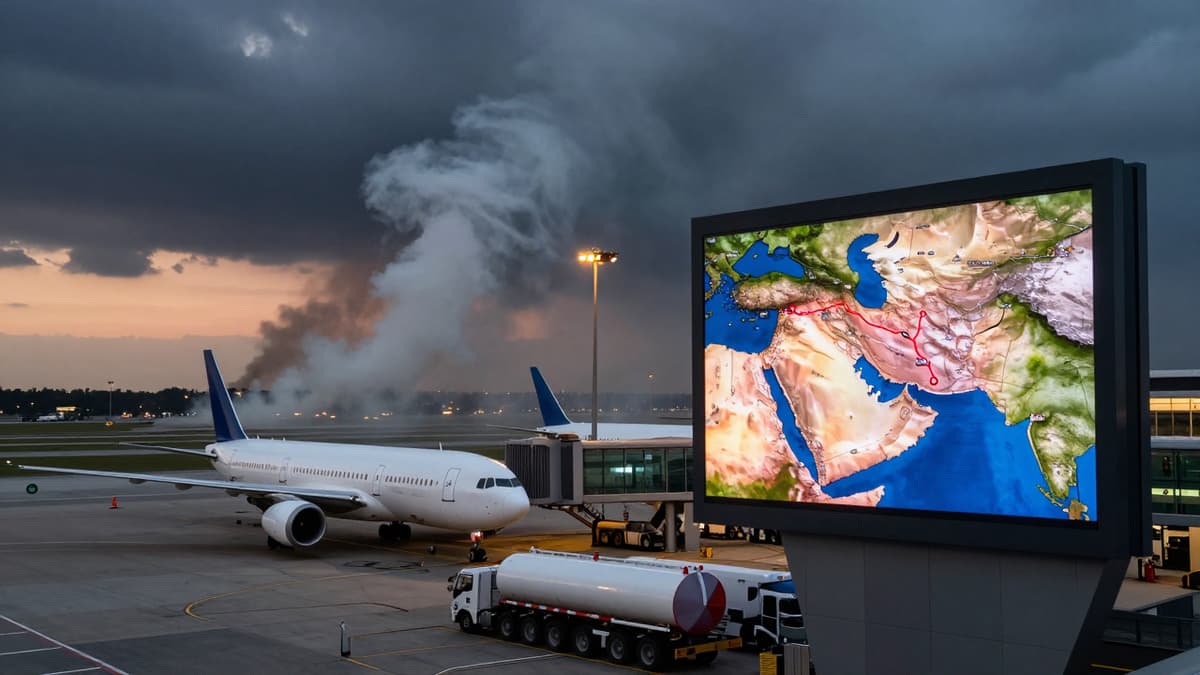
While diplomats argue over the existence of talks, the human and economic toll of the Middle East conflict continues to mount. The disruption extends far beyond the battlefield, severely impacting global aviation infrastructure centered in the Gulf. Dubai International Airport, the world's busiest for international travelers, saw more than 92 million passengers in 2024 under normal conditions. Similarly, the trio of Gulf hubs-Dubai, Abu Dhabi, and Doha-typically handles over 3,000 flights daily. However, the ongoing bombardments and strategic blockades have grounded aircraft, leaving hundreds of thousands of passengers stranded and air traffic in the region heavily disputed.
The economic shockwave is most acutely felt in the fuel supply chain. With Iran effectively blocking the Strait of Hormuz, supplies from oil refineries in the Gulf have been choked off. Since the region accounts for approximately half of Europe's jet fuel imports, the scarcity has caused prices to double since the conflict began. Analysts at Cirium report that more than 30,000 services to the Middle East have been cancelled, forcing carriers to cut flights in response. Experts warn that if the conflict drags on, the damage to the successful "Gulf model" of aviation could be significant. Passengers are likely to seek alternative routes, a shift that experts predict will inevitably drive prices up permanently, reshaping the economics of long-distance travel.
Behind the geopolitical maneuvering and economic statistics lies a profound human tragedy. The BBC spoke with several residents in Tehran, whose names were changed to protect them from retaliation. Zahra, a grandmother whose children are described as "restless" due to internet blackouts, expressed the psychological toll of the situation. She described the inability to hear her children's voices as driving her "insane," labeling the government's actions as the "height of cruelty and oppression." The physical reality of the war is visible in the residue of "black rain" covering the ground outside homes, a result of US and Israeli strikes on oil depots.
Zahra's sentiment reflects a deeper sentiment among those interviewed. When asked about the prospect of a ceasefire, she expressed scorn, noting that the regime has inflicted more pain on mothers over the past 47 years than the war itself. Her stance is clear: she prefers no ceasefire until the entire regime is gone. This sentiment underscores the deep-seated desire for regime change among certain sectors of the population, aligning with the White House's narrative that the regime is already in collapse. Amidst the fighting, smoke was seen billowing from an Israeli power station following a reported Iranian missile attack, while air defense systems were active in Tehran, signaling that the conflict remains active and volatile.
The convergence of military blockades and conflicting diplomatic narratives suggests a prolonged period of instability that will redefine regional and global dynamics. The immediate future for air travel in the Middle East looks bleak, with experts predicting that the "Gulf model" of affordable long-distance travel will suffer irreversible damage if the blockade of the Strait of Hormuz persists. As fuel prices continue to soar and flight cancellations mount, the shift toward alternative routes is not merely a temporary adjustment but a structural change that will likely keep costs high for years to come.
Diplomatically, the disconnect between Washington's claim of "productive conversations" and Tehran's outright denial of negotiations indicates that any path to peace remains elusive. The White House's insistence that the regime is effectively dead and negotiating in secret stands in sharp contrast to the Five Conditions demanded by Iranian officials, which require significant territorial and financial concessions. Until a unified narrative emerges or one side achieves a definitive military advantage, the status quo of grounded flights, soaring fuel prices, and unverified diplomatic talks will likely persist, leaving the region in a fragile and dangerous equilibrium.
May 9, 2026 19:32 UTC
Hardliners Sabotage Iran-US Negotiations Amidst Fractured Regime
May 9, 2026 17:43 UTC
Moscow's Stripped-Down Victory Day: A Shift in Military Display
May 8, 2026 19:28 UTC
Iran Transforms Destroyed B1 Bridge Into Symbol of Resistance
May 8, 2026 15:53 UTC
China Confirms Technical Aid for J-10CE Fighter Jets in Regional Conflict
May 10, 2026 07:57 UTC
Celebrate 2026 Mom with Heartfelt Tributes and Humor


