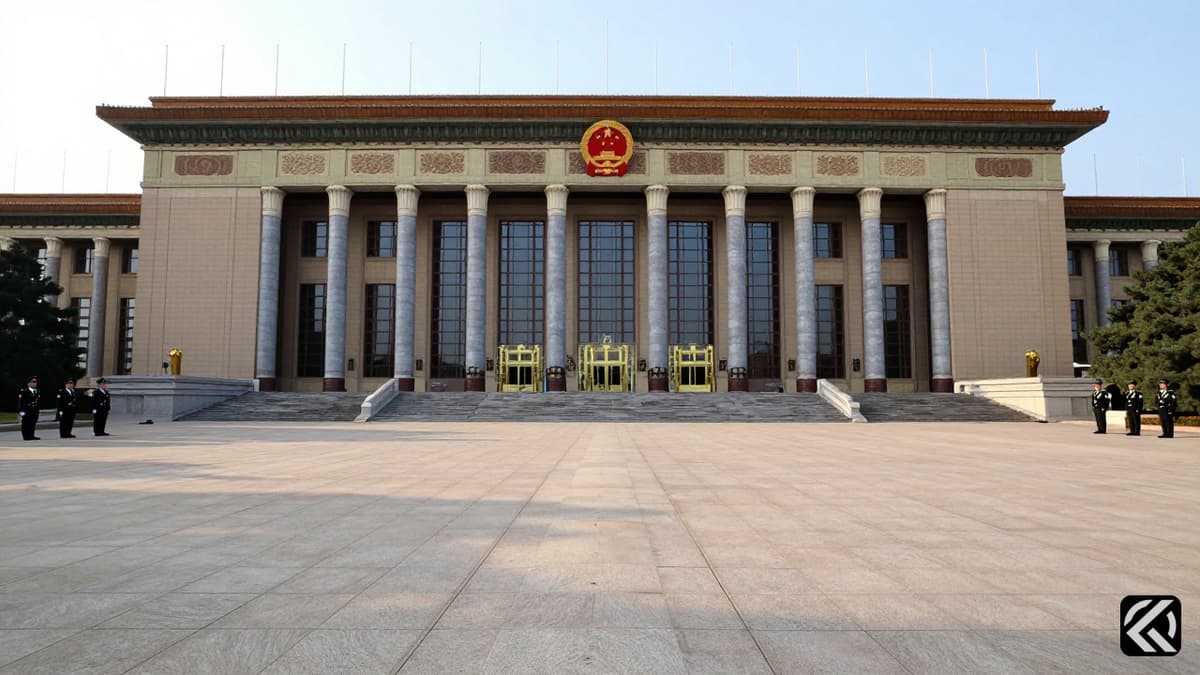
In a historic meeting in Beijing, Taiwan's opposition leader and Chinese President Xi discussed reconciliation, urging an end to political hostility and foreign interference in cross-strait affairs.
In a landmark diplomatic event, Taiwan opposition leader Cheng Li-wun and Chinese President Xi Jinping convened in Beijing, marking the first meeting of its kind by a Taiwanese leader of her rank. Both parties explicitly opposed Taiwanese independence and expressed a shared commitment to resolving the long-standing dispute over the island's future through peaceful means.
This gathering, held at the Great Hall of the People, marked the first time since 2015 that a leader of such stature has met the Chinese president, with Cheng being the highest-ranking official to visit since Ma Ying-jeou's 2015 encounter. The leaders engaged in both closed-door discussions and public exchanges, posing for photos and issuing joint statements emphasizing a desire for de-escalation and stability.
Cheng Li-wun, representing the Kuomintang (KMT), stressed the need to transcend political confrontation and mutual hostility between the two sides. She emphasized that the Taiwan Strait should not serve as a flashpoint for conflict or a chessboard for external powers, but rather a channel connecting family ties and shared civilization. Her remarks echoed key Chinese Communist Party narratives, praising China's eradication of poverty and its goal of national rejuvenation. Xi Jinping reinforced this narrative, stating that all sons and daughters of China share the same roots and spirit, which cannot be erased by time or politics.
Cheng's proposal to slow Taiwan's military buildup and avoid a defense-oriented approach was highlighted by Wen-ti Sung of the Atlantic Council. Sung noted that Cheng's call for an "institutional arrangement for war prevention" effectively signals a shift away from the current strategy of acquiring US weapons, suggesting a desire to reduce regional tension through diplomatic means rather than military deterrence.
While the meeting offered a path toward reconciliation, significant political divides remain between the KMT and the ruling Democratic Progressive Party (DPP). KMT leader Cheng faced skepticism from the DPP, particularly regarding her potential to prioritize peace over defense. President Lai Ching-te, speaking on Facebook, criticized the KMT for delaying a $40 billion special defense budget, calling for "unrealistic fantasies" to be discarded in favor of concrete security measures.
The historical backdrop of this meeting is steeped in conflict. The KMT and the Chinese Communist Party fought a bloody civil war from the 1920s to the 1940s, with the KMT eventually retreating to Taiwan in the late 1940s. Despite the passage of time and Taiwan's democratization, the conflict remains unresolved in the eyes of Beijing, which continues to claim Taiwan as a province and maintains the goal of unification, whether peaceful or otherwise.
Recent data underscores a shifting national identity in Taiwan. A 2025 survey by National Chengchi University revealed that 62% of respondents identify as "Taiwanese," a significant increase from 17.6% in 1992. Conversely, those identifying as "Chinese" dropped from 25.5% to just 2.5% over the same period. This rising Taiwanese nationalism complicates the "one family" narrative promoted by the KMT and CCP, as the Taiwan's Mainland Affairs Council has stated that framing the sovereignty dispute as an internal matter mischaracterizes the situation between two distinct governments.
The DPP advocates for a distinct Taiwanese identity and has sought to elevate Taiwan's global profile, actions that Beijing views as a "separatist" agenda. Consequently, formal contact between the two governments was cut off in 2016, though Beijing continues to engage through groups like the KMT. Despite promises of peace from Xi Jinping, China has maintained a steady military presence around Taiwan, conducting six rounds of live-fire drills in the Taiwan Strait since 2022.
President Lai Ching-te argued that compromising with authoritarian regimes sacrifices sovereignty and democracy, asserting that true peace cannot be achieved without addressing the underlying power dynamics. The KMT, however, continues to block the larger defense budget, proposing a smaller $12 billion alternative, a move that has intensified the debate within Taiwan's legislature over the island's security posture.
The recent meeting underscores a complex dynamic where diplomatic overtures for peace coexist with deep-seated political and historical contradictions. While Cheng Li-wun successfully facilitated a dialogue that emphasizes shared history and cultural ties, the lack of a unified national identity in Taiwan and the continued military buildup by China suggest that the path to reconciliation is fraught with challenges. The divergent views on defense spending and sovereignty indicate that future interactions will likely remain contentious, with the international community watching closely as the balance between diplomatic engagement and military deterrence continues to shift in the region. The outcome of these negotiations will likely depend on how Taiwan's political landscape evolves and whether the KMT can translate its "peace" rhetoric into a tangible shift in security policy without alienating the growing nationalist sentiment within Taiwan.
Jun 8, 2026 00:51 UTC
Trump Claims Iran Nuclear Deal Imminent Despite Diplomatic Fractures
Jun 8, 2026 00:47 UTC
Iran Fires Missiles at Israel After Beirut Strike
Jun 7, 2026 22:00 UTC
US, Iran Peace Hops Fade 100 Days Into War
Jun 7, 2026 20:57 UTC
Iran Strikes Israel: IRGC Promises Week of Continuous Offensive
Jun 8, 2026 02:28 UTC
Trump Walks Out of Meet the Press After Rejecting Evidence Demands


