Section
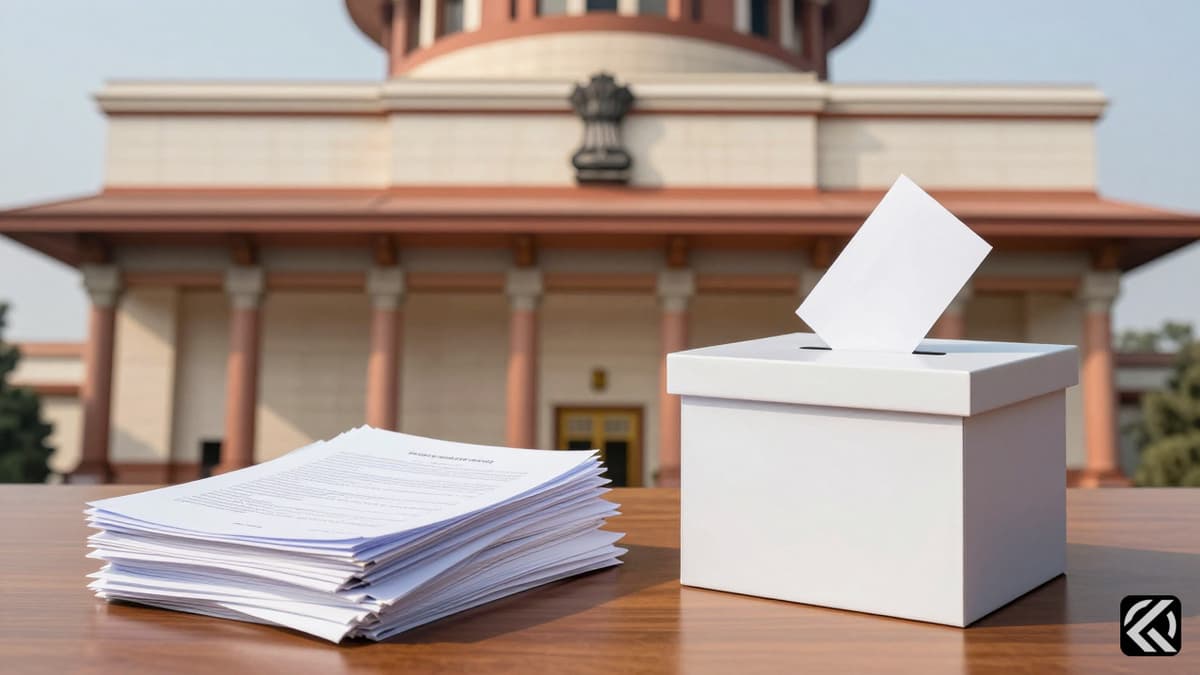
In a landmark decision, the Supreme Court validates the Election Commission's electoral roll revision, ensuring free elections while upholding procedural safeguards against citizenship disputes.
The Supreme Court on Wednesday, May 27, 2026, ruled that the Special Intensive Revision (SIR) of electoral rolls is a valid exercise undertaken by the Election Commission of India (ECI) to uphold the Constitutional principle of free and fair elections. A Bench headed by Chief Justice of India Surya Kant dismissed the petitioners' allegations that the revision was a clandestine effort to screen citizens under the guise of removing "aliens" from the rolls.
The legal challenge, primarily stemming from Bihar, argued that the ECI had arbitrarily assumed powers to determine citizenship, bypassing limitations set by parliamentary laws and its own manual without sufficient justification. The petitioners, including the Association for Democratic Reforms represented by advocates Prashant Bhushan and Neha Rathi, contended that the SIR effectively reversed the burden of proof regarding citizenship, placing an undue onus on voters. However, the apex court rejected these arguments, establishing that the revision process, while expansive, remains within constitutional bounds.
The court clarified that the Supreme Court judgment explicitly empowers the ECI under Article 324 of the Constitution to examine citizenship status as part of verifying inclusion in the electoral roll. This verification step is not a final determination of a person’s citizenship. Instead, if the ECI finds that an individual lacks necessary documents or fails the enquiry, it can forward the case to competent authorities in the Central government for adjudication under the Citizenship Act. This distinction ensures that the electoral body acts as a verifier rather than a judge of final citizenship status.
The ruling carries significant implications for the ongoing second phase of the SIR, which covers 51 crore voters across 12 States and Union Territories, including West Bengal, Tamil Nadu, and Assam. This phase had commenced while the Bihar challenge was pending in the Supreme Court, raising questions about the legitimacy of the ongoing exercise. By upholding the constitutionality of the Bihar SIR, the court has effectively validated the methodology used in subsequent phases, allowing the "juggernaut" of revision to proceed without legal impediment.
The court acknowledged that the SIR stretched the modalities of electoral roll revision under the Representation of the People Act and the Registration of Electors Rules. However, it determined that the exercise was done in an exigency and was not "manifestly excessive." The bench emphasized that procedural safeguards of revision were complied with, maintaining a calibrated balance in the choice of indicative documents required from voters.
The Bihar SIR hearings were marked by effective judicial interventions aimed at making the massive exercise more inclusive. One notable intervention by the court was the inclusion of Aadhaar as the 12th document in the list of 11 ‘indicative’ documents that voters could file as proof of their identity or residence. The court stated that such documents constitute a reasonable demand and are part of a structured regime devised for verifying voters, rejecting the claim that requiring such proof was arbitrary or overly burdensome.
Transparency was a central theme of the court's engagement with the Election Commission. The apex court reminded the ECI that "the degree of transparency and access to information form the hallmarks of an open democracy." Consequently, the court directed the poll body to publish the names and details of voters added to the final electoral roll in the Bihar SIR. The final list for Bihar recorded a total of 7.42 crore eligible voters.
Furthermore, the court mandated the publication of a district-wise, booth-level searchable list of the nearly 65 lakh voters who were purged from the draft roll, along with the exact reasons for their deletion. This directive ensures that any decision taken during the SIR remains subject to judicial review and public scrutiny, balancing the state's interest in clean rolls with the individual's right to participation.
The judgment underscores the ECI's role in maintaining the integrity of the democratic process. By affirming that the SIR electoral rolls exercise is a constitutional mandate rather than a political maneuver, the court has provided a legal framework that supports future electoral reforms. The decision highlights the delicate balance between administrative efficiency in updating voter lists and the protection of individual rights, ensuring that the Election Commission of India operates within a transparent and legally sound environment.
The validation of the Special Intensive Revision marks a pivotal moment in India's electoral landscape, setting a precedent for how voter rolls are managed in future cycles. With the court upholding the ECI's authority to verify citizenship through indicative documents, the framework for subsequent revisions is now firmly established. This legal backing is expected to facilitate smoother execution of upcoming SIR phases across diverse states, reducing the likelihood of successful legal challenges that could delay electoral preparations.
The emphasis on transparency and judicial review suggests that future revisions will likely see continued oversight to prevent arbitrary deletions. The requirement for searchable, detailed lists of purged voters will likely become a standard practice, enhancing public trust in the electoral process. As the SIR progresses through its remaining phases, the focus will likely shift to addressing specific grievances through the established judicial review mechanisms, ensuring that the pursuit of free and fair elections remains grounded in legal integrity and procedural fairness.
Jun 11, 2026 17:21 UTC
Bangladesh Opposition Mobilizes Against India-Bangladesh Border Push-Ins and BSF Killings
Join 50,000+ readers getting the global briefing every morning.
No spam. Unsubscribe anytime.
Jun 11, 2026 17:40 UTC
Boelter Pleads Guilty in Minnesota Political Assassinations
Jun 11, 2026 17:21 UTC
Bangladesh Opposition Mobilizes Against India-Bangladesh Border Push-Ins and BSF Killings
Jun 11, 2026 17:21 UTC
John Healey Quits as UK Defence Secretary Over Funding Dispute
Jun 11, 2026 16:19 UTC
UK Defence Secretary John Healey Quits Over Funding Dispute