Nepal witnesses a seismic political shift as a young rapper secures an absolute majority, ending decades of stagnation and dismantling the old guard.
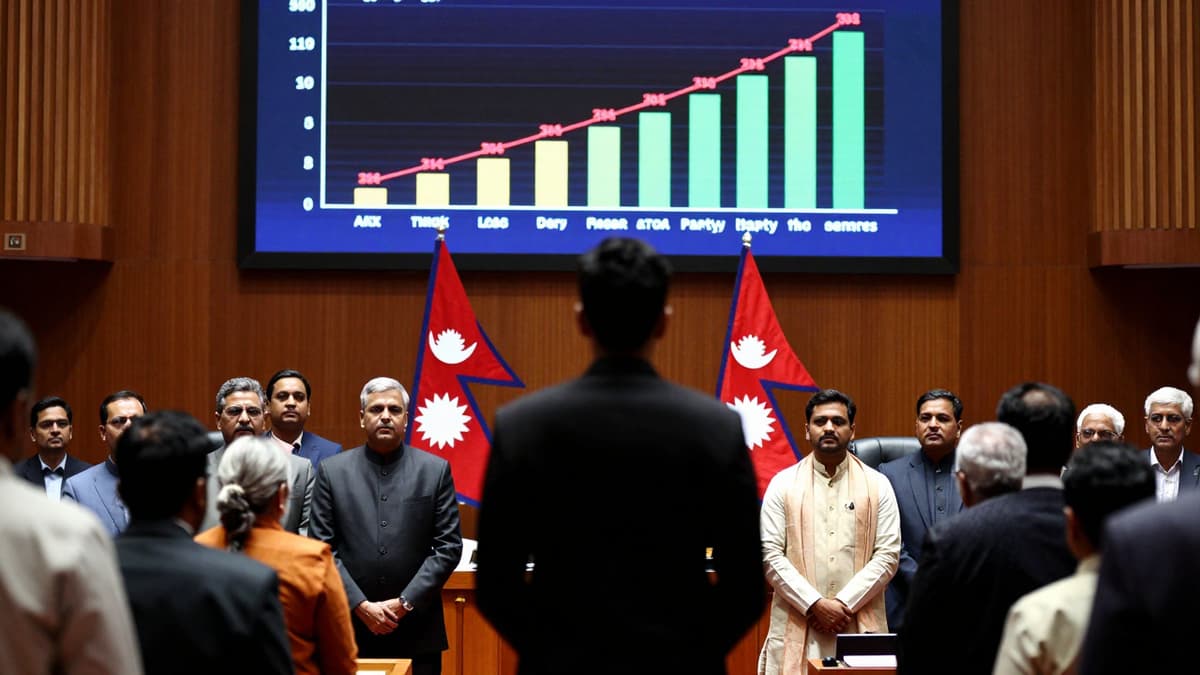
Nepal's political landscape underwent a radical transformation in March 2026 as the Rastriya Swatantra Party secured an absolute majority in the House of Representatives. This stunning sweep marks the first time a single party has achieved such dominance in the country's parliamentary history in 27 years. Rapper-turned-politician Balendra Shah emerged as the central figure, defeating former Prime Minister K.P. Sharma Oli in his own Jhapa-5 constituency. This specific defeat symbolizes a broader rejection of the political old guard by the electorate.
The path to this electoral victory was paved by the September 2025 uprising, a violent popular upheaval that began with a protest against a government ban on 26 social media platforms. What started as a youth-led movement against digital censorship quickly metamorphosed into a nationwide rage against corruption, instability, and economic mismanagement. The security forces' killing of at least 19 demonstrators on the first day transformed local dissent into a national crisis that destroyed government buildings and toppled the Oli administration.
Following the collapse of the existing government and a subsequent three-day power vacuum, former Chief Justice Sushila Karki was appointed interim Prime Minister on September 12. She moved swiftly to dissolve Parliament and announced new elections for March 5, 2026. Despite condemnations from major established parties regarding the constitutionality of these actions, the momentum of the uprising rendered their protests powerless. The thorough discrediting of the established political class paved the way for the Rastriya Swatantra Party's rise.
In the March 2026 elections, the Rastriya Swatantra Party, founded only in 2022 by television personality Rabi Lamichhane, capitalized on the deep anti-establishment sentiment. The party secured a majority of votes in the proportional representation system alongside their direct mandate. The consequences for Nepal's traditional political giants were severe. The Nepali Congress, CPN-UML, and CPN (Maoist Centre) collectively suffered their worst performance, securing only 38, 25, and 17 seats respectively. This outcome shattered the dominance of the three parties that had controlled Nepali politics since the 1990s.
The scale of this victory reflects the depth of the anger that fueled it. Before the election, the nation had witnessed its most violent popular upheaval since the civil war era. The government's initial justification for the social media ban, citing non-compliance with Supreme Court content monitoring rulings, failed to resonate with a generation that viewed it as a suppression of dissent. Unemployment among young people, which reached 22.7% in 2022-23, and a heavy reliance on remittances accounting for over 33% of GDP, highlighted the economic desperation driving the revolt.
Balendra Shah, at just 35 years old, is poised to become Nepal's youngest Prime Minister. He resigned from his role as Kathmandu's mayor in January 2026 to lead the RSP's campaign. The result leaves him set to govern a country that remains among the world's least developed, facing the task of translating electoral enthusiasm into tangible governance. The election results suggest a potential rupture in the long history of Nepali politics, moving from a system defined by instability to one led by a new political force.
To understand the magnitude of the March 2026 election, one must look at Nepal's modern political history. The September 2025 uprising is the latest in a series of decisive moments that have reshaped the country's political order. Three earlier pivotal periods-1950, 1990, and 2005-07-each brought fundamental breaks from the preceding governing order. The current situation raises the question of whether this is a structural transformation or merely a generational change within an unreformed system.
The cycle of change began in 1950-51 with the end of Ranacracy. The Rana oligarchy, a long-lasting feudal regime, had reduced the monarchy to a titular role. The system was a military despotism where the government functioned to enrich the prime minister's family. While cultivable land expanded, there was virtually no investment in agricultural productivity or industrial development. The Muluki Ain civil code of 1854 codified a caste hierarchy that privileged hill castes, creating an extractive oligarchic regime supported by religious legitimacy. Although the Rana regime fell, the Brahmin-Chhetri elite remained dominant, and the political economy saw little substantive change.
Nepal then moved from Ranacracy back to absolute monarchy, a period known as the Panchayat Era, which lasted from 1960 until the 1990 Jan Andolan. The king sought legitimacy through abstract nationalism, counterbalancing influence with China and diversifying foreign aid. Political parties were banned, and the Rashtriya Panchayat was a quasi-legislative body with no real power. The current political moment, following the fall of the Oli government, mirrors these historical breaks, suggesting a potential return to fundamental change after decades of stagnation.
Nepal's current political moment stands at a critical juncture, defined by the decisive shift from the old guard to the Rastriya Swatantra Party. The September 2025 uprising demonstrated that the public has exhausted patience with the 30 changes of government since 1990 and the inability of any Prime Minister to complete a full term. With the major established parties reduced to their lowest seat counts and Balendra Shah leading a new administration, the trajectory of Nepal's governance is poised for a significant pivot. If the new leadership can address the underlying issues of unemployment, remittance dependency, and feudal structures, the 2025-26 period may be remembered as the definitive end of the era of instability. However, if the changes are merely superficial, the deep-seated resentments that fueled the uprising could resurface, threatening the longevity of the new democratic experiment in this young republic.
Jun 8, 2026 02:17 UTC
Magnitude 7.8 Quake Shakes Philippines, Urging Immediate Evacuations
Jun 8, 2026 00:51 UTC
Trump Claims Iran Nuclear Deal Imminent Despite Diplomatic Fractures
Jun 8, 2026 00:47 UTC
Iran Fires Missiles at Israel After Beirut Strike
Jun 7, 2026 22:00 UTC
US, Iran Peace Hops Fade 100 Days Into War
Jun 8, 2026 04:15 UTC
Trump Urges Netanyahu to Halt Iran Strike for Peace