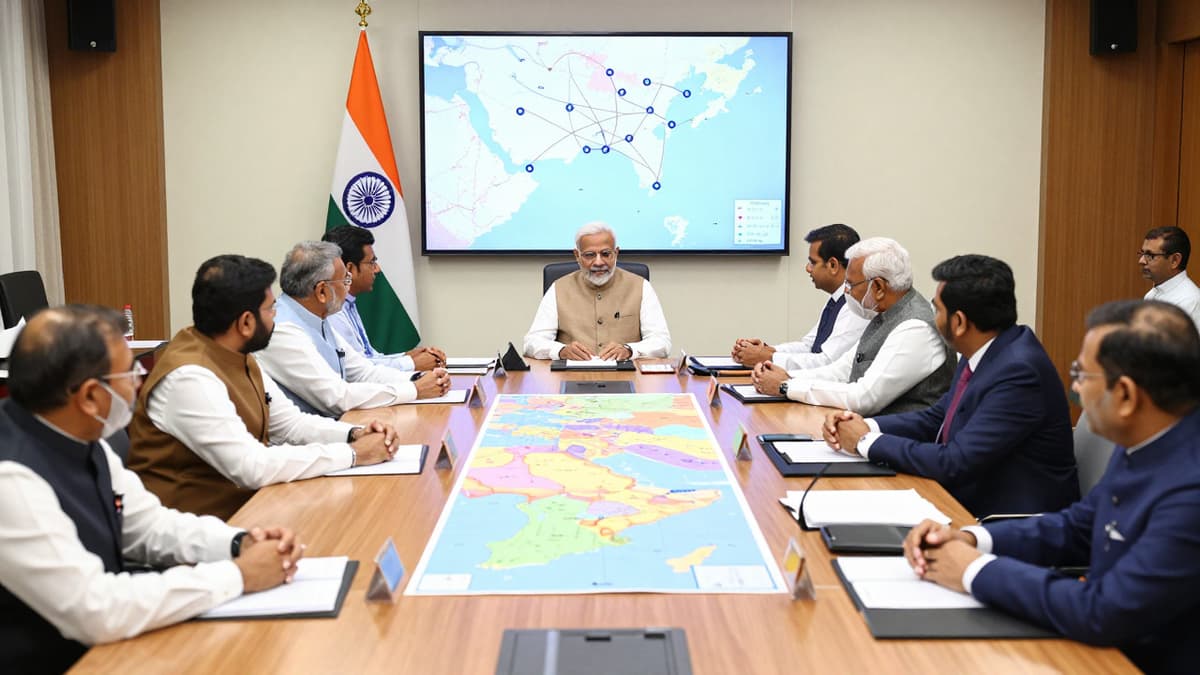
Prime Minister Narendra Modi has convened Chief Ministers to launch a unified national effort, ensuring fuel and fertilizer security while curbing panic during the ongoing West Asia conflict.
Prime Minister Narendra Modi convened a critical meeting on Friday, March 27, 2026, with Chief Ministers and Lieutenant-Governors to address the supply chain crisis triggered by the ongoing war in West Asia. The Prime Minister emphasized a "Team India" approach, demanding tight coordination between the Centre and States to secure the flow of fuel and fertilizers while cracking down on hoarders and rumour-mongers.
This was the first such gathering held by Mr. Modi with political leaders of non-poll-bound States and Union Territories since the conflict began on February 28, 2026. Key figures present included Chief Ministers like Chandrababu Naidu, Yogi Adityanath, and Revanth Reddy, alongside Union Home Minister Amit Shah and Defence Minister Rajnath Singh. The meeting occurred against a backdrop of significant global instability, prompting an immediate review of India's logistical resilience.
Mr. Modi highlighted India's historical capacity to handle global disruptions, drawing a direct parallel to the collective "Team India" response during the COVID-19 pandemic. He noted that the spirit of cooperation that successfully mitigated supply chain and trade impacts during the health crisis remains the nation's greatest strength in navigating the current geopolitical challenges. This historical context was used to underscore the urgency and necessity of a unified front to manage the India fuel shortage and ensure the availability of essential commodities.
The Prime Minister placed a specific focus on the agriculture sector, calling for advanced planning to monitor fertilizer storage and distribution. The objective is to prevent any difficulties for farmers during the upcoming Kharif season, ensuring that food production remains stable despite external pressures. Additionally, special attention was directed toward border and coastal States to address emerging challenges related to shipping, maritime operations, and the movement of essential supplies.
To maintain public confidence, Mr. Modi stressed the importance of reassuring citizens about the availability of essential goods to prevent unnecessary panic. He instructed States with significant populations in West Asia to activate helplines, appoint nodal officers, and establish district-level support systems. These measures are designed to assist affected families and ensure a timely flow of information, thereby stabilizing local markets and public sentiment during the crisis.
The discussion placed significant emphasis on long-term energy security to mitigate future vulnerabilities. Mr. Modi urged States to lead efforts in accelerating alternative energy sources, including biofuels, solar energy, and the GOBARdhan initiative. He also called for expanded piped natural gas connections and electric mobility to reduce reliance on traditional fuel sources. Furthermore, the Prime Minister directed states to coordinate with the Centre on exploring domestic production of oil and gas to strengthen national resilience against global shocks.
During the meeting, Defence Minister Rajnath Singh highlighted the government's decision to cut excise duty on petrol and diesel as a vital positive step to address the India fuel shortage. The presentation by Cabinet Secretary T.V. Somanathan outlined a robust monitoring framework, including a Centre-States and district-level system, to oversee the situation and ensure effective distribution. The leadership praised the immediate relief measures, specifically the decision to increase commercial LPG allocation to States and Union Territories to 70% of pre-crisis levels, a significant jump from the previous 50%.
To institutionalize the response, the Union government has formed a Group of Ministers to ensure regular coordination during the crisis, particularly concerning inter-ministerial domains. Meanwhile, a separate meeting involving Chief Secretaries from poll-bound States of Tamil Nadu, West Bengal, Assam, and Kerala, along with Puducherry, is scheduled to be held by Mr. Somanathan to ensure comprehensive coverage of the national response.
The formation of the Group of Ministers and the immediate allocation of resources signal a shift towards a more agile, coordinated national response to external geopolitical shocks. Based on the established frameworks for monitoring and the push for domestic energy exploration, it is likely that India will see a rapid expansion of alternative energy infrastructure in the coming months. The immediate cut in excise duties and increased LPG allocations are expected to stabilize consumer markets, potentially reducing inflationary pressures associated with the West Asia conflict. However, the long-term success of the "Team India" effort will depend heavily on the sustained cooperation of state governments in implementing the new helpline and district-level support systems. If the current trajectory of accelerating biofuel and solar initiatives continues, India could significantly reduce its dependence on imported fuels, fundamentally altering its vulnerability profile in future global supply chain disruptions.
Jun 8, 2026 02:17 UTC
Magnitude 7.8 Quake Shakes Philippines, Urging Immediate Evacuations
Jun 8, 2026 00:51 UTC
Trump Claims Iran Nuclear Deal Imminent Despite Diplomatic Fractures
Jun 8, 2026 00:47 UTC
Iran Fires Missiles at Israel After Beirut Strike
Jun 7, 2026 22:00 UTC
US, Iran Peace Hops Fade 100 Days Into War
Jun 8, 2026 04:15 UTC
Trump Urges Netanyahu to Halt Iran Strike for Peace


