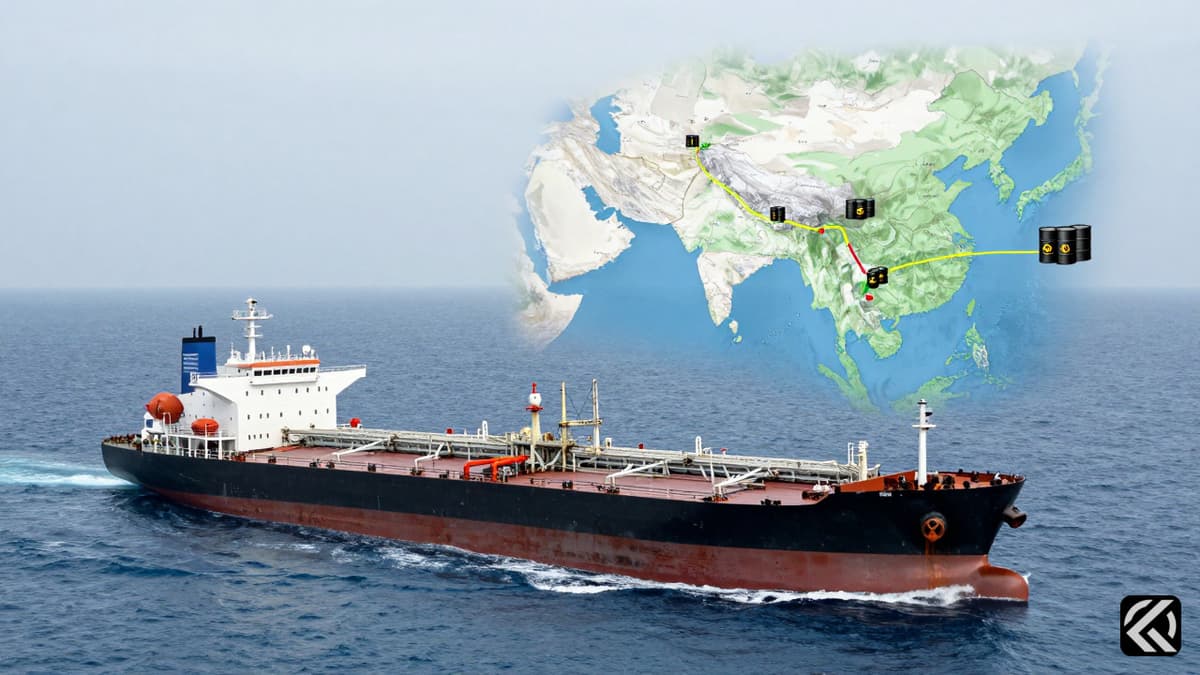
A U.S.-sanctioned vessel originally bound for India has unexpectedly diverted to China, disrupting hopes of resuming direct oil purchases and signaling deepening financial hurdles.
A U.S.-sanctioned vessel originally destined for India has unexpectedly rerouted mid-voyage to China, effectively ending speculation of a major resumption in fuel trade. The shift comes as the country seeks to leverage a recent waiver to restart India oil imports, yet the logistical change underscores deepening financial complexities. The Ping Shun tanker, carrying Iranian crude, has abandoned its planned arrival at Gujarat's Vadinar port, signaling that commercial terms now override strategic intentions for this cargo.
The rerouting was confirmed by ship-tracking firm Kpler, which noted that the vessel, built in 2002 and sanctioned by the U.S. in 2025, has updated its Automatic Identification System (AIS) transponder to indicate Dongying, China, instead of Vadinar, India. Sumit Ritolia, a lead research analyst at Kpler, stated that the vessel had been en route to Vadinar for three days but dropped the Indian destination near its arrival time. This development is particularly significant because the cargo would have represented the first purchase of Iranian crude oil by Indian refiners since 2019.
According to Ritolia, the sudden change in destination appears to be driven by payment-related issues rather than logistical constraints. Sellers are reportedly tightening their terms, moving away from the previously established 30-to-60-day credit window toward requirements for upfront or near-term settlement. This shift highlights the increasing sensitivity of trade flows to financial conditions and counterparty risk. While the vessel's AIS indication is not a confirmed final destination, the move has already cast a shadow over the feasibility of the shipment reaching an Indian refinery.
The potential purchase was poised to be a landmark event for the Indian refining sector. The cargo was destined for the Nayara Energy refinery in Vadinar, a facility backed by the Russian oil giant Rosneft with an annual capacity of 20 million tonnes. Indian refiners had been actively seeking opportunities to purchase cargoes of Iranian oil following Washington's recent decision to issue a 30-day sanctions waiver. This waiver was an attempt to ease oil prices, which have been driven upward by the ongoing conflict involving Israel and Iran.
However, the waiver expires on April 19, and the uncertainty surrounding payment mechanisms has created a bottleneck. Iran remains disconnected from the SWIFT banking system, a global messaging network essential for secure international financial transactions. Following EU sanctions in 2012 and U.S. reimposition of sanctions in 2018, Iranian banks were severed from the network, severely restricting Tehran's ability to receive oil payments and access foreign currency reserves. Last purchases were facilitated through a Turkish bank using Euros, but that option is reportedly no longer viable, forcing sellers to demand more immediate payment solutions.
The vessel in question, the Ping Shun, is estimated to be carrying approximately 600,000 barrels of crude loaded from Kharg Island around March 4. It was initially scheduled to arrive in Vadinar by April 4. Experts suggest that while the cargo could still reach India if payment issues are resolved, the episode serves as a stark reminder of how commercial terms have become as critical as logistics in determining the flow of Iranian crude to countries other than China.
Historically, India was a major buyer of Iranian crude, importing significant volumes of Iran light and Iran heavy grades which offered strong refinery compatibility. At its peak, Iranian crude oil accounted for 11.5% of India's total imports, with consumption reaching 518,000 barrels per day in 2018. However, imports ceased in May 2019 following sanctions tightening, with volumes subsequently replaced by grades from West Asia and the U.S. Between January and May 2019, imports slowed to 268,000 barrels per day due to U.S. waivers granted to a few buyers, but no imports have occurred since then.
The current situation involves an estimated 95 million barrels of Iranian oil currently on vessels at sea. Analysts believe around 51 million barrels of this volume could be suitable for Indian buyers, while the remainder is better suited for markets in China and Southeast Asia. Despite the U.S. waiver allowing countries to purchase these barrels, the unresolved payment mechanisms and the specific demands of sellers have created a volatile environment where commercial terms dictate trade outcomes.
The mid-voyage diversion of the Ping Shun tanker illustrates a critical juncture in global energy markets where financial infrastructure struggles to keep pace with political waivers. As long as Iran remains cut off from the SWIFT network and alternative payment channels remain unproven or unavailable, the flow of sanctioned crude will likely remain erratic. If the payment terms cannot be bridged, future attempts to resume India oil imports may face similar disruptions, potentially forcing the market to rely even more heavily on China and Southeast Asian buyers who can navigate the financial constraints more effectively. The sensitivity of these trade flows suggests that commercial feasibility, rather than just legal waivers, will be the primary driver of future Iranian oil exports to the subcontinent.
Jun 8, 2026 02:17 UTC
Magnitude 7.8 Quake Shakes Philippines, Urging Immediate Evacuations
Jun 8, 2026 00:51 UTC
Trump Claims Iran Nuclear Deal Imminent Despite Diplomatic Fractures
Jun 8, 2026 00:47 UTC
Iran Fires Missiles at Israel After Beirut Strike
Jun 7, 2026 22:00 UTC
US, Iran Peace Hops Fade 100 Days Into War
Jun 8, 2026 04:15 UTC
Trump Urges Netanyahu to Halt Iran Strike for Peace


