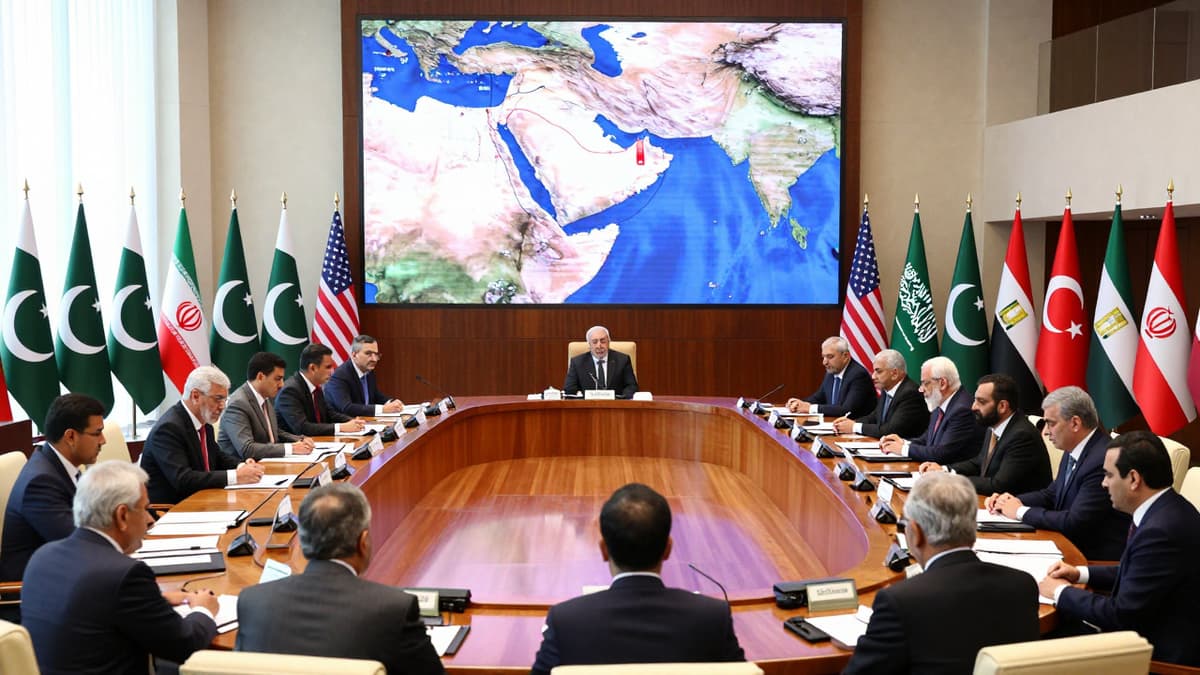
In a tense geopolitical landscape, Pakistan hosts crucial diplomatic talks involving Saudi Arabia, Turkey, and Egypt, even as President Trump weighs a deal while threatening Iran's oil exports.
In Islamabad, the foreign ministers of Saudi Arabia, Turkiye, and Egypt arrived over the weekend for the second diplomatic gathering in less than two weeks, aimed at containing the fallout from the US-Israel war on Iran. Pakistani Deputy Prime Minister Ishaq Dar confirmed that both Washington and Tehran have expressed confidence in Pakistan to facilitate direct talks, with the summit focusing on a comprehensive settlement of the ongoing conflict. These high-level consultations, attended by counterparts from Turkey, Egypt, and Saudi Arabia, marked a significant push to establish a multilateral framework for peace.
The quadrilateral group, initially formed during a broader Arab and Islamic meeting in Riyadh, has hardened into a focused peace initiative with Pakistan acting as the primary channel between Washington and Tehran. While the ministers agreed to form a Committee of Four to structure the negotiation process, the diplomatic efforts face a stark contrast in US President Donald Trump's public stance. In an interview with the Financial Times, Trump stated his desire to seize oil, specifically mentioning Kharg Island, which handles roughly 90 percent of Iran's crude exports, without ruling out a military seizure of the hub.
Despite these threats, Trump described negotiations as going "extremely well" while on Air Force One, expressing certainty that a deal could be reached soon. This mixed messaging underscores the tension Pakistan faces, attempting to build a diplomatic bridge while the war scenario escalates with continued Israeli strikes and an expanding US military presence. Mushahid Hussain Sayed, a former Pakistani information minister, noted that while the initiative is a historic institutional effort from the Muslim world to open a dialogue, the diplomatic steps remain small against a backdrop of increasing complexity.
Former ambassador Masood Khan outlined the structured approach being taken, which includes a Committee of Four to manage a step-by-step process involving trust-building, ceasefire negotiations, and discussions on complex issues like the nuclear program. However, Khan cautioned that deep obstacles remain, particularly Tehran's demands for war reparations and its sovereignty over the critical waterway. The Strait of Hormuz crisis remains a focal point, with Iranian officials insisting on formal recognition of their control over the passage as a non-negotiable condition for any agreement.
Before the ministers' meeting, Pakistani Prime Minister Shehbaz Sharif held a 90-minute call with Iranian President Masoud Pezeshkian to brief him on the outreach to the US and other Islamic nations. China's Foreign Minister Wang Yi also conveyed Beijing's full backing, with Dar scheduled to visit China to discuss regional developments despite suffering a minor shoulder fracture earlier in the day. This international support highlights the gravity of the situation as diplomats strive to create a conducive environment for peace talks amidst a deadlock.
The core impasse lies in the structurally incompatible positions formally put forward by both sides. Washington's 15-point plan, transmitted via Pakistan, demands a one-month ceasefire, the handover of highly enriched uranium, a halt to enrichment, and curbs on ballistic missile programs. In contrast, Iran's counterproposal calls for a halt to aggression, reparations, and formal recognition of Iranian sovereignty over the Strait of Hormuz.
While Trump claimed Iran had agreed to "most of" the 15 points, Iranian spokesperson Esmaeil Baghaei dismissed the US proposals as "unrealistic, illogical and excessive." He emphasized that Tehran did not participate in the meeting frameworks established by Pakistan, suggesting that the dialogue is a US-led initiative. Analyst Javad Heiran-Nia noted that any negotiation must ensure neither side feels it has surrendered, suggesting a US commitment to postpone threats against power plants as a realistic first step.
Reza Khanzadeh of George Mason University argued that the burden of compromise lies with Washington, as Tehran views regime survival as non-negotiable. With Iran's approval ratings fluctuating and domestic pressure mounting in the US, the path forward remains fraught. President Trump's Trump Kharg Island threat continues to loom, with a deadline of April 6 set for Iran to accept a deal or face US strikes on its energy sector. The Pakistan-US-Iran talks are now attempting to bridge these gaps, but experts warn that a trust deficit regarding potential ground assaults cannot be erased overnight.
The coming weeks will test the viability of the Committee of Four as the primary mechanism for de-escalation. If the US continues to push military options while offering conditional diplomatic engagement, the risk of miscalculation remains high. The upcoming visit of Ishaq Dar to China signals a continued push for global consensus, yet the fundamental disagreement over sovereignty and war reparations suggests that a breakthrough is not imminent. As the deadline approaches, the region watches to see if the diplomatic corridor established in Islamabad can withstand the pressures of a war scenario where military escalation appears to be the counter-trend to peace.
Jun 8, 2026 02:17 UTC
Magnitude 7.8 Quake Shakes Philippines, Urging Immediate Evacuations
Jun 8, 2026 00:51 UTC
Trump Claims Iran Nuclear Deal Imminent Despite Diplomatic Fractures
Jun 8, 2026 00:47 UTC
Iran Fires Missiles at Israel After Beirut Strike
Jun 7, 2026 22:00 UTC
US, Iran Peace Hops Fade 100 Days Into War
Jun 8, 2026 04:15 UTC
Trump Urges Netanyahu to Halt Iran Strike for Peace


