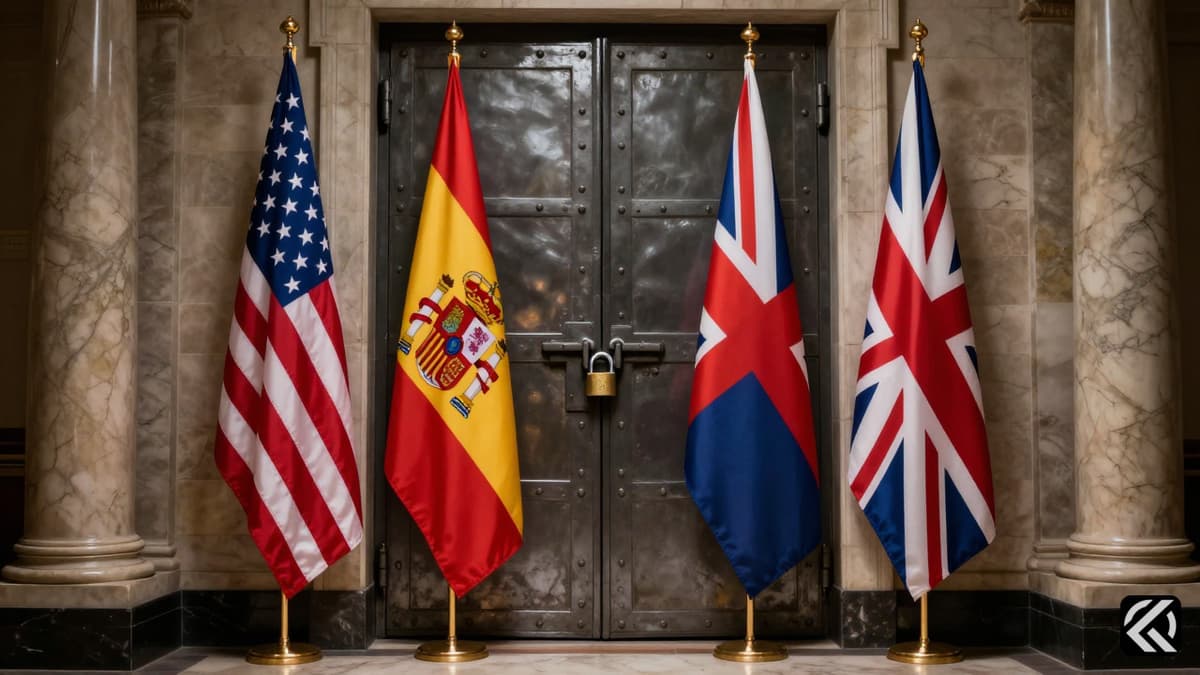
With reports of US threats to suspend Spain and challenge UK sovereignty over the Falkland Islands, Nato firmly denies any mechanism for member expulsion amid rising geopolitical friction.
Nato has firmly stated there is no mechanism to suspend or expel member states, following reports that the United States might seek to penalize Spain due to its stance on the ongoing conflict in Iran. The clarification came after a Reuters report quoted a US official discussing internal Pentagon communications that outlined potential punitive measures against allies perceived as lacking support for the US campaign against Iran. These measures reportedly included reviewing the US position on the United Kingdom’s sovereignty over the Falkland Islands, a move that could destabilize long-standing diplomatic relations in the South Atlantic.
A Nato official confirmed to the BBC that the organization’s founding treaty explicitly does not foresee any provision for the suspension or expulsion of its members. This statement serves as a direct rebuttal to the implications of the internal memo, which suggested leveraging diplomatic support for "imperial possessions" as a form of retaliation. The memo, which cited access, basing, and overflight rights as the "absolute baseline" for alliance cooperation, indicated that the US might reassess its support for countries like the UK if they failed to align with US military objectives.
The controversy stems from the geopolitical tensions arising after the US and Israel launched attacks on Iran in late February. In response, Iran restricted shipping through the critical Strait of Hormuz, prompting US officials to criticize allies for their reluctance to play a greater role in the conflict. Donald Trump has repeatedly voiced frustration with Spain and other allies, describing Nato as a "one-way street" where the US protects others without receiving equivalent support. This sentiment was echoed in the internal Pentagon email, which suggested that access to US military bases in allied territories is conditional on full cooperation with US strategic goals.
Spain has been at the center of this diplomatic friction after refusing to allow the use of its air bases for attacks on Iran. The US currently operates two significant military installations on Spanish soil: Naval Station Rota and Morón Air Base. Despite the US pressure, Spanish Prime Minister Pedro Sanchez dismissed the report of potential punishment. He told reporters, "We do not work based on emails. We work with official documents and official positions taken, in this case, by the government of the United States." Sanchez emphasized that Spain supports full cooperation with its allies but insists this must always occur within the framework of international law.
The US report also targeted the United Kingdom, suggesting a review of American diplomatic support for the Falklands. The islands, located about 8,000 miles from the UK and 300 miles from Argentina, have been a point of contention since Argentina invaded them in 1982. Argentina continues to claim sovereignty over the territory, known as the Malvinas. By suggesting a reassessment of US support for the UK’s claim, the Pentagon memo implied that diplomatic leverage could be used to pressure European allies into greater military involvement.
UK Prime Minister Keir Starmer has also pushed back against the expectation of greater involvement. He stated that increased participation in the war or the current US blockade of Iran’s ports is not in the UK’s interest. However, the UK has allowed the US to use its bases to launch strikes on Iranian sites targeting the Strait of Hormuz, and Royal Air Force planes have participated in missions to shoot down Iranian drones. Starmer’s position highlights a divergence in how European allies interpret their obligations compared to the US administration’s expectations.
Other European leaders have responded to the memo with calls for unity. Italian Prime Minister Giorgia Meloni urged Nato allies to stick together, describing the alliance as a "source of strength." Speaking at an EU summit in Cyprus, Meloni emphasized the need to strengthen Nato’s European pillar, which should complement the American one. Similarly, a German government spokesperson stated that Spain’s membership in the alliance is not in question, adding, "I see no reason why that should change."
The Pentagon has not denied the existence of the email but has reframed its narrative. Pentagon Press Secretary Kingsley Wilson responded to the Reuters story by acknowledging that despite everything the US has done for its Nato allies, "they were not there for us." This comment underscores the deepening rift between the US and its traditional partners, who are navigating a complex landscape of conflicting national interests and alliance obligations.
The memo also outlined another potential sanction: suspending "difficult" countries from important positions within the alliance. However, the US official clarified to Reuters that the memo does not suggest the US could withdraw from the alliance nor does it propose closing bases in Europe. This distinction is crucial, as it limits the scope of the reported threats to diplomatic and positional leverage rather than a full break in military ties.
The incident has reignited debates about the nature of international alliances in an era of rising geopolitical instability. While the US seeks unified military action against Iran, European allies are balancing their support with domestic political pressures and international law. The refusal of Spain to provide air bases and the UK’s limited engagement illustrate the challenges of maintaining cohesion in a multi-national military framework.
As diplomatic tensions persist, the reported US threats to suspend Spanish privileges and challenge UK sovereignty over the Falkland Islands could test the resilience of the transatlantic alliance. If such measures are pursued, they may lead to a fragmented alliance where military cooperation becomes conditional rather than collective. This shift could weaken Nato’s strategic unity in future conflicts, forcing allies to prioritize national sovereignty over collective defense commitments. The long-term impact may be a redefinition of the alliance’s purpose, moving away from shared military goals toward a more transactional relationship between the US and its European partners.
Jun 8, 2026 14:20 UTC
Xi Jinping Returns to North Korea for Strategic Leverage
Join 50,000+ readers getting the global briefing every morning.
No spam. Unsubscribe anytime.
Jun 8, 2026 18:27 UTC
INDIA Bloc Unanimously Demands Education Minister’s Resignation
Jun 8, 2026 16:44 UTC
Trinamool Congress Rebellion: Rebel MPs Form Bloc to Back NDA
Jun 8, 2026 14:58 UTC
INDIA Bloc Unanimously Demands Pradhan's Resignation
Jun 8, 2026 14:20 UTC
Xi Jinping Returns to North Korea for Strategic Leverage


