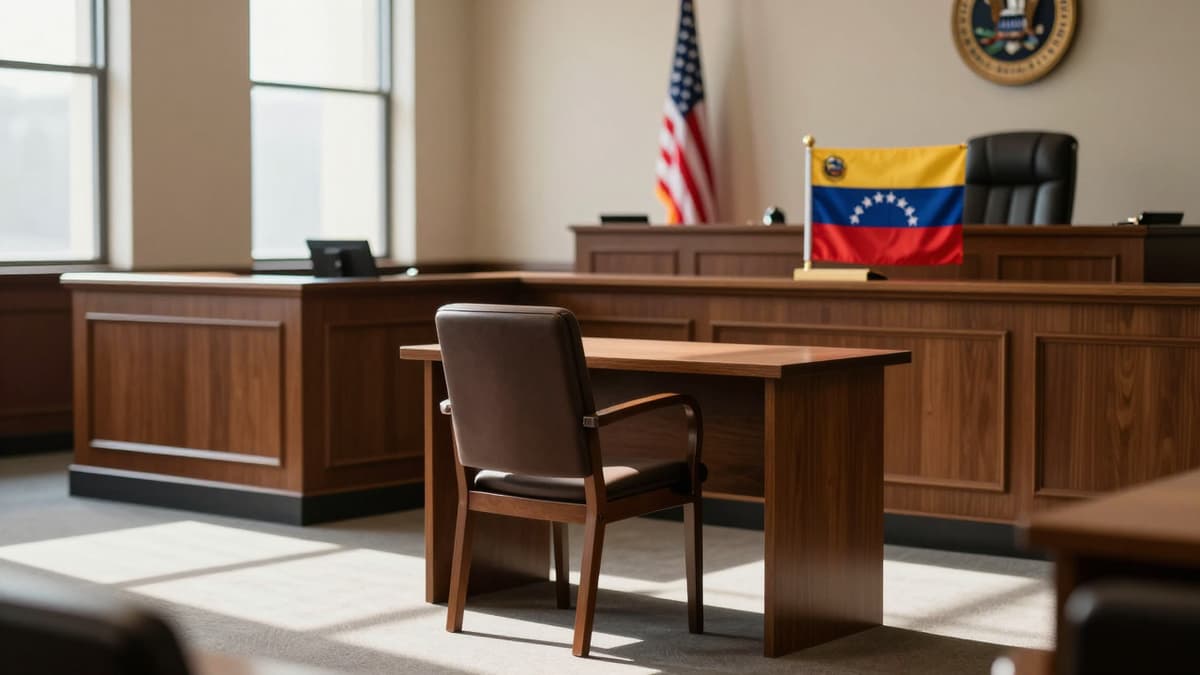
In a tense New York courtroom, judges weigh whether a former dictator can use seized state funds for his legal defense amid high-stakes narco-terrorism charges.
A New York judge on Thursday appeared sympathetic to arguments allowing ex-Venezuelan leader Nicolás Maduro and his wife to access state funds for their legal defense. This court session focused on whether the couple can utilize Venezuelan government money to pay for attorneys despite active US Venezuela sanctions blocking such transfers. Prosecutors fiercely argued against the request, asserting the pair should not be permitted to spend the country's wealth on their own defense.
The dispute arose after the US Office of Foreign Assets Control (OFAC) initially granted a license for the funds to be used, only to revoke it shortly thereafter. US prosecutors contended that Maduro and his wife, Cilia Flores, should be barred from accessing these government funds due to national security concerns and their alleged theft of national resources. The couple, who have been denied access to these funds, deny having personal finances sufficient to cover their legal fees.
The 92-year-old Judge Alvin Hellerstein did not dismiss the case over this dispute, noting that the right to defense is paramount. However, he acknowledged the complexity of the situation, as Maduro's legal team had requested a dismissal of the entire case due to their inability to secure funding. The judge indicated he would issue a formal ruling on the matter at a later date, alongside a scheduling order for the next court hearing.
During the Thursday hearing, Maduro and Flores sat quietly in green khaki prison jumpsuits, flanked by several lawyers. They listened to the translation of arguments through headphones, a stark contrast to their initial court appearance where Maduro delivered a multi-minute speech claiming he was kidnapped. The mood in the courtroom was tense, with Maduro and his wife facing serious allegations of narco-terrorism, drug trafficking, and weapon possession.
US forces executed a dramatic night-time raid on their compound in Caracas on January 3, seizing the couple and transporting them to New York. They now face multiple charges including conspiracy to import cocaine, possession of machine guns, and conspiracy to possess destructive devices. Despite these grave accusations, which they deny, they have not yet applied for bail and remain held at Brooklyn's federal Metropolitan Detention Center.
The core of the legal battle centers on the revocation of the OFAC license. Prosecutors argued that the couple has personal funds available to pay for attorneys, a claim the Maduros deny. They further asserted that because of longstanding sanctions and the couple's alleged plundering of Venezuelan wealth, allowing the use of state funds would be inappropriate. Judge Hellerstein questioned this logic, suggesting that the capture of the former leader had altered the foreign policy landscape.
"We are doing business with Venezuela," Judge Hellerstein remarked during the proceedings. He noted that since Maduro's arrest, former Vice-President Delcy Rodríguez has assumed power, and diplomatic ties with the US have resumed. The judge pointed out that the Venezuelan government is willing to pay for the defense, challenging the prosecutors' stance on the continued applicability of strict sanctions in this specific legal context.
Maduro's attorney, Barry Pollack, argued that the narco-terrorism trial presents unique challenges that would be overwhelming for a court-appointed public defender. Pollack contended that the unusual nature of the case, occurring in a foreign country against a former head of state, necessitates a specialized private legal team to ensure effective counsel. Judge Hellerstein appeared to side with this perspective, expressing concern that a public defender might be unable to adequately handle the complex international and legal nuances involved.
When the judge inquired about the relief sought by the defense team, he asked both sides several times, "What is the relief?" The legal team was seeking the dismissal of the entire case, a move the judge ultimately refused to grant based solely on the funding dispute. He emphasized that while the right to defense is paramount, the case would not be dismissed over the financing controversy alone.
In a cabinet meeting on Thursday in Washington, President Donald Trump stated that the US is considering bringing additional cases against Maduro. Despite the ongoing legal battle, Trump also affirmed that Maduro would be granted a fair trial. Meanwhile, residents of Caracas continue to watch the proceedings closely, with many noting that while local media is censored, the international press provides a window into the unfolding events.
One Caracas resident, a retired lawyer named Ana Patricia, expressed a complex mix of sympathy and condemnation. She acknowledged that while the government controls local media, international reporting allows the public to follow the process. Patricia stated she felt sorry for Maduro as a human being who lost everything through greed, yet she hoped he received a life sentence for his crimes, including drug trafficking and weapons possession.
The legal team's insistence on dismissing the case due to lack of funds highlights a significant procedural bottleneck. However, the judge's refusal to dismiss the case suggests a path forward where the court will address the funding issue through rulings rather than termination of proceedings. With no trial date set and the couple still detained, the resolution of the Venezuela sanctions dispute remains critical to the defense strategy.
Judicial Outlook and Sanctions Impact Judge Hellerstein's indication that the foreign policy situation has shifted due to Maduro's arrest and the resumption of diplomatic ties suggests a potential pivot in how the narco-terrorism trial handles state funding. As the US considers additional cases, the immediate future will likely see the court grappling with how to balance national security interests with the constitutional right to a robust defense. The outcome of this specific funding dispute could set a precedent for how similar cases involving sanctioned foreign leaders are handled in US federal courts.
Jun 8, 2026 04:15 UTC
Trump Urges Netanyahu to Halt Iran Strike for Peace
Join 50,000+ readers getting the global briefing every morning.
No spam. Unsubscribe anytime.
Jun 8, 2026 02:28 UTC
Trump Walks Out of Meet the Press After Rejecting Evidence Demands
Jun 8, 2026 02:17 UTC
Magnitude 7.8 Quake Shakes Philippines, Urging Immediate Evacuations
Jun 8, 2026 00:51 UTC
Trump Claims Iran Nuclear Deal Imminent Despite Diplomatic Fractures
Jun 8, 2026 00:47 UTC
Iran Fires Missiles at Israel After Beirut Strike


