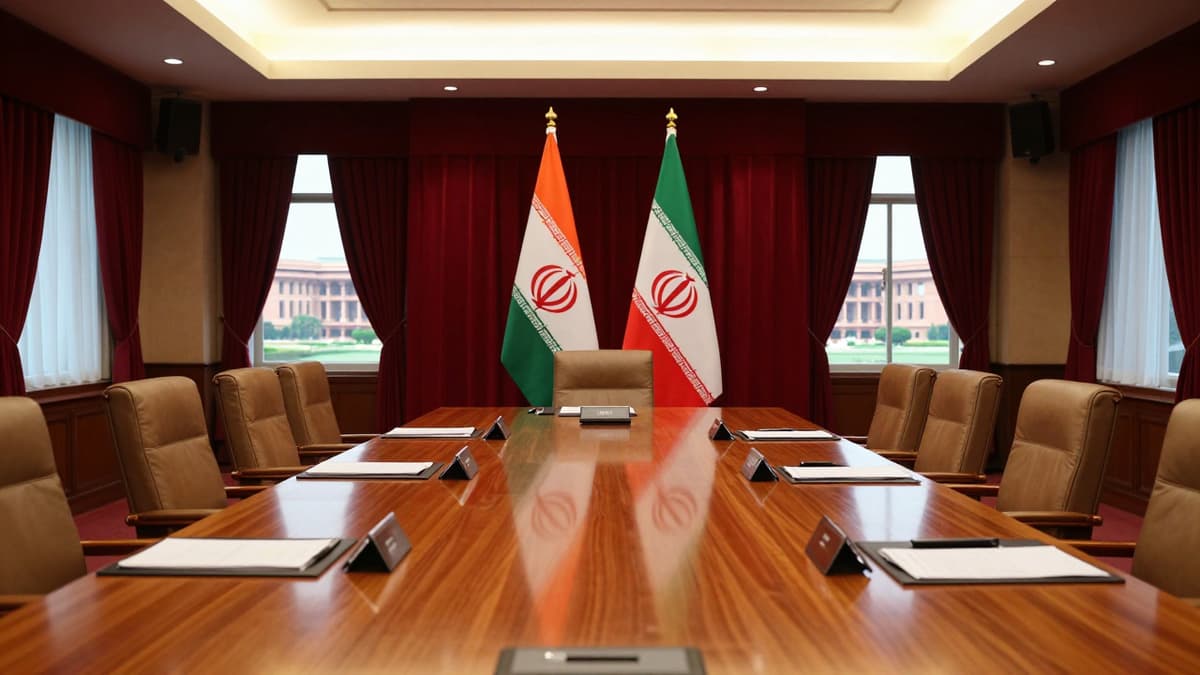
At a pivotal all-party meet, External Affairs Minister S Jaishankar firmly declared India's stance on regional conflicts. He rejected the notion of India acting as a mediator like Pakistan.
The government on Wednesday firmly dismissed suggestions that Pakistan has gained diplomatic ground by offering to mediate between the US and Iran, with External Affairs Minister S Jaishankar addressing an all-party meeting in New Delhi. He emphasized that while Pakistan has a history of inserting itself into regional conflicts, India maintains a distinct strategic posture. The minister clarified during the gathering that the nation follows a policy of multi-alignment to serve its national interests. Additionally, Prime Minister Narendra Modi, in a conversation with US President Donald Trump on Tuesday, highlighted that the war was causing harm to all parties involved.
Sources quoted Jaishankar as stating at the meeting that India cannot be a broker nation, directly countering the narrative emerging from Islamabad regarding the US Iran conflict. The minister drew attention to Pakistan's historical interventions to provide context to the current situation. He recalled that Pakistan previously acted as an intermediary between China and the US in 1971, and again between the US and Iran in 1981. Government sources clarified that Jaishankar was not mocking Pakistan's current actions but rather putting the situation into a broader historical perspective.
India is a major country that pursues multi-alignment, a strategy the minister insisted allows it to maintain good equations with Iran while serving its own national interests. During the discussion, Jaishankar noted the lack of clarity regarding the format and ultimate fate of the US-Iran talks. He pointed out significant uncertainty surrounding the negotiations, including who would officially represent Iran. Specifically, he highlighted the sudden emergence of parliamentary speaker Mohammad Bagher Ghalibaf as Tehran's chief negotiator, indicating the fluid and uncertain nature of the diplomatic engagement.
At the meeting, presided over by Defence Minister Rajnath Singh, opposition MPs raised a host of critical issues. Leaders from the Congress, CPM, AIMIM, NCP, and AAP, including Mukul Wasnik, John Brittas, Asaduddin Owaisi, Supriya Sule, and Sanjay Singh, questioned the government's stance. Their concerns included Prime Minister Modi's recent visit to Israel just before the war broke out, India's alleged silence regarding the assassination of Iran's supreme leader Ayatollah Ali Khamenei, and serious apprehensions over the availability of oil and gas.
S Jaishankar and the government team, which included Home Minister Amit Shah, Finance Minister Nirmala Sitharaman, Petroleum Minister Hardeep Puri, and Parliamentary Affairs Minister Kiren Rijiju, responded to these queries. While acknowledging the gravity of the opposition's points, the government sought to reassure the assembly. Rijiju stated that the government had clearly explained its position to address the concerns of the opposition parties. He noted that in such challenging situations, unity is essential, quoting the Prime Minister's appeal for the Parliament to rise together. Rijiju praised the opposition for displaying maturity during the discussion.
On the specific issue of energy security, Petroleum Minister Hardeep Puri assured the participants that India possesses sufficient stock of petrol and diesel. He further detailed that the government has moved to tie up new sources of supply to ensure stability. Despite these assurances, the Trinamool Congress (TMC) remained the lone major opposition party to skip the meeting, choosing instead to call for a direct discussion on the issue in Parliament. The absence of the TMC highlighted the varying degrees of engagement across the political spectrum regarding the regional crisis.
The meeting served as a platform to clarify India's diplomatic boundaries. Jaishankar's references to historical instances of Pakistan mediation were intended to illustrate that while Pakistan positions itself as a bridge between conflicting parties, India chooses a different path. The minister was careful to note that his comments were not a direct criticism of Pakistan's current diplomatic efforts but rather a factual recollection of their role in past geopolitical shifts. This distinction was crucial in maintaining the tone of the meeting, which aimed to align political voices rather than deepen divides.
The uncertainty surrounding the US Iran conflict remains a focal point for policymakers in New Delhi. With no clear format for the talks and ambiguity over the Iranian negotiator, the situation remains volatile. The government's emphasis on "good equations" with Iran underscores the delicate balancing act required to maintain trade and strategic relations without compromising India's multi-aligned foreign policy stance. The assurance of fuel supplies provides a measure of domestic stability, but the diplomatic landscape continues to shift rapidly.
The government's firm stance on not acting as a broker, combined with its assurances on energy security, signals a strategic move to prioritize national interests over external mediation attempts. As the US Iran conflict persists with unresolved negotiations, India's commitment to multi-alignment suggests it will continue to navigate the situation without taking sides explicitly. The historical context provided by Jaishankar indicates that India views Pakistan's role as unique to that nation's geopolitical needs, distinguishing India's approach as more restrained. Looking ahead, the stability of India's energy supply chains will likely remain a primary concern for the government, even as diplomatic efforts in the region continue to evolve without a clear resolution in sight. The unity displayed by the ruling and opposition parties, despite lingering questions, suggests a collective political will to support the government's diplomatic handling of the crisis in the near future.
May 9, 2026 21:40 UTC
Russia Cuts Heavy Armor From Victory Day Parade Amid War
Join 50,000+ readers getting the global briefing every morning.
No spam. Unsubscribe anytime.
May 10, 2026 07:57 UTC
Celebrate 2026 Mom with Heartfelt Tributes and Humor
May 10, 2026 05:52 UTC
Celebrate Mother's Day 2026 With These Essential Wishes
May 10, 2026 05:02 UTC
MV Hondius Arrives in Tenerife Amid Hantavirus Outbreak
May 10, 2026 03:02 UTC
Vijay Takes Oath, Ending Dravidian Party Era in Tamil Nadu


