
Section
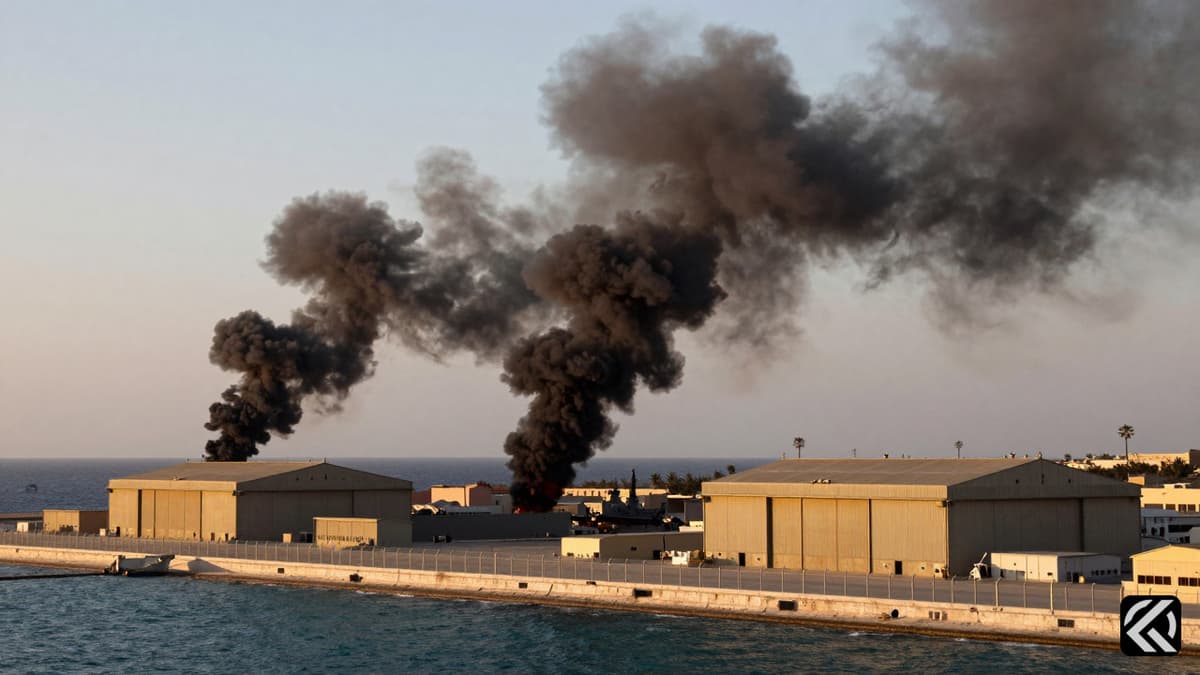
Iran’s IRGC claims a major drone strike on the US Fifth Fleet in Bahrain, intensifying regional tensions following recent US airstrikes in southern Iran.
Iran on Wednesday officially claimed that its naval forces launched a significant drone attack targeting the headquarters of the United States Navy's Fifth Fleet located in Bahrain. This bold military assertion marks a direct escalation in regional hostilities, occurring just hours after Bahrain sounded missile alert sirens and urgently urged its residents to seek immediate shelter. The claim was broadcast by Iranian state media, which reported that the aggressive operation aimed specifically at the Fifth Fleet base in Manama, widely recognized as one of the most critical and heavily fortified military installations maintained by the United States in the Middle East. According to statements released by the Islamic Revolutionary Guard Corps (IRGC), the strike was executed using Shahed-136 one-way attack drones, which were launched against the strategic base at approximately 2:30 am local time.
The IRGC explicitly framed this IRGC drone attack as a necessary countermeasure and retaliation for recent American airstrikes that targeted infrastructure within southern Iran. In a detailed statement, the Guards alleged that their forces responded directly to US military actions that damaged civilian infrastructure along Iran's southern coastline. Explaining the strategic rationale behind the decision to target the American naval hub, the IRGC stated that the United States had struck several specific locations in southern Iran earlier in the same day. "The warmongering US regime attacked several points in Jask, Sirik and Qeshm early this morning under false pretexts, damaging a telecommunications mast in Sirik and destroying two water tanks in the city," the statement read, according to local media reports. The Guards emphasized that their naval fighters launched the strike on the Bahraini 5th Navy at 2:30 am, which corresponds to 2300 GMT on Tuesday, as a direct consequence of what they described as a "vicious move" by their adversaries.
The group further issued a stern warning to Washington, cautioning against any further military action. The IRGC declared that stronger retaliatory measures would follow if the United States continued its attacks. They alleged that clashes were still actively underway and reiterated that any additional US military action would trigger a "stronger response." Over 16 distinct explosion sounds were heard in Bahrain, indicating the intensity of the alleged assault. Meanwhile, according to Iraqi media, several Iranian missiles were observed heading towards the island nation. Simultaneously, in Jordan, the IRGC claimed that its Aerospace Force launched long-range solid-fuel missiles at an airbase in Jordan that hosts US military personnel. The IRGC claimed this strike successfully hit four key targets, including hangars for F-35 fighter jets and a command-and-control centre, describing the action as part of a wider retaliatory operation targeting US military assets across the broader region.
The Fifth Fleet, headquartered in Bahrain, plays a pivotal role in overseeing US naval operations across the Arabian Gulf, the Red Sea, the Arabian Sea, and parts of the Indian Ocean. It serves as a key instrument for protecting international shipping lanes and maintaining security stability in the region. This dramatic development follows fresh US airstrikes on Iran after an American Army AH-64 Apache attack helicopter crashed near the Strait of Hormuz. According to US Central Command, American fighter jets targeted Iranian air defence systems, ground control stations, and surveillance radar sites. The US described the operation as a proportional response to recent threats against American forces and commercial shipping interests. Iran, however, accused Washington of attacking civilian infrastructure and vowed retaliation for the damage inflicted.
Iranian Foreign Minister Abbas Araghchi warned that Iranian forces would not leave any attack unanswered, raising the stakes for diplomatic resolution. "Iranian forces will leave no attack or threat unanswered," Araghchi wrote on X, adding a stark directive: "Leave our region if you want to be safe." The latest exchange has further strained efforts to secure a lasting ceasefire in the conflict, which has seen periodic flare-ups despite previous agreements. It comes just days after Iran and Israel exchanged fire for the first time since a fragile truce took effect earlier this year.
The confirmation of an attack on the US Fifth Fleet headquarters signals a dangerous shift from proxy conflicts to direct state-on-state confrontation. Given the IRGC's warning of "stronger responses," the likelihood of a prolonged military cycle increases significantly. If Washington interprets this as a red line, immediate counter-strikes could devastate regional infrastructure. Conversely, diplomatic de-escalation seems increasingly remote as both sides invoke sovereignty and retaliation. The immediate future will likely see heightened naval mobilization in the Strait of Hormuz, threatening global energy supplies, and increased risk of miscalculation leading to a broader regional war.
Jun 11, 2026 12:59 UTC
US Strike on Settebello Kills Indian Sailors Amid Strait of Hormuz Tensions
Jun 11, 2026 12:49 UTC
Air India Flight 171 Crash Sparks Debate Over Boeing 787 Dreamliner Faults
Jun 11, 2026 08:51 UTC
US-Iran Conflict: Indian Seafarers Killed in Gulf Strike
Jun 11, 2026 18:04 UTC
Healey Quits Government Over Defence Spending Dispute


